


Texas · Chapter PR-209
Property Code Ch. 209 (Texas Residential Property Owners Protection Act) — Plain-English Summary
Official title: Texas Residential Property Owners Protection Act. Translated into plain English for board members and homeowners.
General
-
Sec.209.001
Names this chapter the 'Texas Residential Property Owners Protection Act.'
-
Sec.209.002
Defines key terms used throughout Chapter 209: assessment, board, declaration, owner, lot, property owners' association (POA), and restrictive covenant.
-
Sec.209.003
Chapter 209 applies to residential subdivisions in which an owner is automatically a member of a property owners' association. Does not apply to condominiums…
-
Sec.209.0041
Sets requirements to adopt or amend a declaration after the development period. Requires written consent of at least 67 percent of total votes allocated unde…
-
Sec.209.0042
Default is one vote per lot for member votes unless the declaration provides otherwise.
-
Sec.209.005
An owner may request production of association books and records. The association must produce them within 10 business days or 15 business days for older rec…
-
Sec.209.0051
Board meetings are open to all members. Notice must be posted in a conspicuous place at least 72 hours before a meeting (144 hours during peak summer or wint…
-
Sec.209.0052
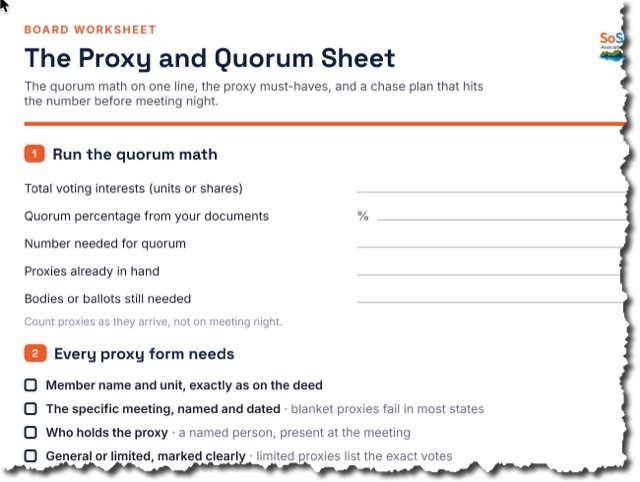
Sets quorum and voting requirements for the board. Allows board action without a meeting only by unanimous written consent.
-
Sec.209.0055
Sets procedures for member voting and recounts. An owner who is denied a recount within 15 days of a written demand may sue to compel one.
-
Sec.209.0056
Notice of any election or vote of members must be sent not less than 10 nor more than 60 days before the meeting. Absentee and electronic voting are allowed …
-
Sec.209.0057
Owners may request a recount within 15 days. The association must provide certified copies of ballots and election records for inspection.
-
Sec.209.0058
Election records must be maintained and accessible to owners during the recount period.
-
Sec.209.0059
An owner may not be denied the right to vote even if delinquent in assessments, unless the declaration expressly so provides and the assessment is more than …
-
Sec.209.006
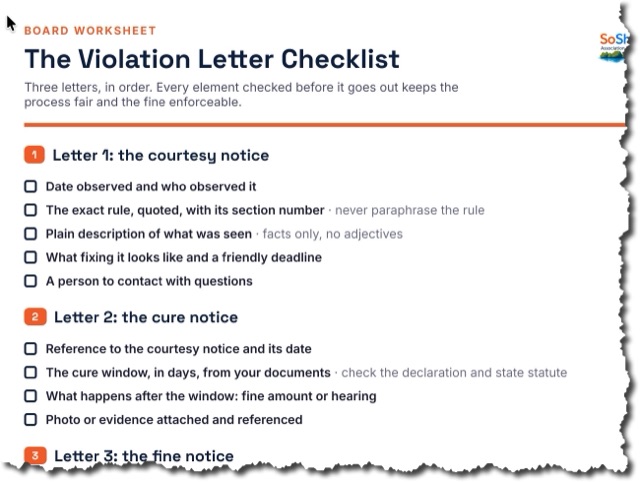
Before an HOA can fine an owner, file a lawsuit, or charge attorney fees for a violation, the association must give written notice that describes the violati…
-
Sec.209.0061
Payments received from an owner must be applied first to assessments, then to late fees, fines, and other charges, regardless of any contrary association pol…
-
Sec.209.0062
Associations must adopt a policy offering owners an alternative payment schedule of at least 3 but no more than 18 months for delinquent assessments before r…
-
Sec.209.0063
Reiterates payment application priority order applied to delinquent accounts.
-
Sec.209.0064
Before referring an owner's account to a third-party collection agent or attorney, the association must give written notice of the referral and an opportunit…
-
Sec.209.007
An owner is entitled to a hearing before the board within 30 days of a written request after receiving a violation notice. The association must also offer al…
-
Sec.209.008
Either party may recover reasonable attorney's fees in an action to enforce the declaration.
Foreclosure
-
Sec.209.009
An HOA may NOT foreclose to collect a debt consisting only of: (1) fines, (2) attorney fees, or (3) other amounts that are not assessments. Foreclosure is pe…
-
Sec.209.0091
Before foreclosing for unpaid assessments, the association must: (1) send written notice by certified mail at least 30 days in advance, (2) state the amount …
-
Sec.209.0092
An HOA assessment lien may be foreclosed ONLY through judicial foreclosure (court order). Texas does not allow non-judicial HOA foreclosure (unlike for mortg…
-
Sec.209.0093
Owners may vote (by simple majority) to either remove or grant the association's foreclosure authority through a declaration amendment.
-
Sec.209.0094
Detailed requirements for the 30-day foreclosure notice including specific statutory warning language about losing the home and instructions on how to cure.
-
Sec.209.010
Within 30 days of a foreclosure sale, the association must mail notice of the sale to the former owner by certified mail.
-
Sec.209.011
After a foreclosure sale, the former owner has a right of redemption: 180 days for residential subdivisions and 90 days for condos. The owner pays the sale p…
Restrictive Covenants on Owner Property
-
Sec.209.012
Restrictive covenants that prohibit or unreasonably restrict installation of solar energy devices are void. The ARC may approve location but cannot ban solar.
-
Sec.209.013
Owners may display political signs on their property starting 90 days before an election and ending 10 days after. Size limit 4x6 feet.
-
Sec.209.014
Sets rules about easements created in association declarations.
-
Sec.209.015
Owners may display religious items on the entry door or door frame regardless of the declaration, up to 25 square inches in total area.
-
Sec.209.0151
Restrictive covenants may not prohibit owners from installing energy-efficient, reflective, or impact-resistant roofing that is similar in appearance to roof…
-
Sec.209.016
Limits on HOA regulation of leases. The HOA may require a copy of the lease but cannot collect rent directly from tenants.
-
Sec.209.017
Justice courts have jurisdiction over many HOA enforcement actions up to $20,000.
-
Sec.209.018
Owners may install rain barrels and rainwater harvesting systems. The HOA may regulate location and appearance but cannot prohibit.
-
Sec.209.0185
Owners may install standby electric generators. HOAs may regulate location, screening, and noise but cannot ban.
-
Sec.209.019
HOAs may not adopt or enforce restrictive covenants that prohibit lawful possession, transportation, or storage of firearms by owners or their guests.
-
Sec.209.020
Owners may display the U.S. flag, Texas flag, and certain military and first responder flags. HOAs may regulate location, size, and number with reasonable li…
-
Sec.209.021
Sets procedures for compelling production of association records via subpoena in civil litigation.
Frequently asked about Chapter PR-209
- What is Texas Chapter PR-209?
- Texas Chapter PR-209 — the Property Code Ch. 209 (Texas Residential Property Owners Protection Act) — is the body of law that governs how every Texas HOA is structured, operated, and held accountable. It covers governance, voting, records, assessments, fining, and most of the day-to-day legal questions a board will face.
- How many sections are in Chapter PR-209?
- Chapter PR-209 contains 39 sections in this reference. Each is summarized in plain English on its own page, with links to the official text at statutes.capitol.texas.gov.
- Is the summary on this site legal advice?
- No. These pages are plain-English summaries prepared by SoShiny for board members and managers. For binding legal advice or interpretation of how a section applies to your specific situation, consult a Texas-licensed attorney.
- How often does Texas Chapter PR-209 change?
- The Texas Legislature can amend any chapter in any session. We update these summaries when we re-import the official text — see the 'Last updated' date on each section page.
- Does SoShiny enforce Chapter PR-209 for me?
- No software 'enforces' a statute — but SoShiny is built around it. Voting, meeting minutes, records access, fining workflow, and audit trails are designed to meet this body of law's requirements out of the box, so the board can demonstrate good-faith compliance if challenged.
Running a HOA in Texas?
SoShiny is built around Chapter PR-209 from day one — every feature on every plan.
Start your community free →