
New York · Law NPC
Not-for-Profit Corporation Law — Plain-English Summary
Every section of this body of law translated into plain English for New York board members and homeowners.
Short Title; Definitions; Application; Certificates; Miscellaneous
-
§102
Defines key terms used across the N-PCL, including corporation, member, director, certificate of incorporation, and bylaws.
Non-judicial Dissolution
-
§1001
A corporation may be dissolved non-judicially by a plan of dissolution approved by the board and the members.
-
§1002
The plan of dissolution must describe how liabilities will be paid and how remaining assets will be distributed consistent with the certificate and any restr…
Corporate Purposes and Powers
-
§201
Authorizes formation of nonprofit corporations for specified purposes. Most HOAs are Type B (formed for civic, social, or recreational purposes) or Type C (f…
-
§202
Lists general powers including the power to sue and be sued, contract, hold and convey property, adopt bylaws, and assess members for the corporation's expen…
-
§204
Limits activities that a nonprofit may undertake, particularly distribution of profits to members.
Formation of Corporations
-
§402
Required contents of the certificate of incorporation: corporate name, type (A/B/C/D), purposes, county of office, and similar items.
-
§404
Identifies which state agencies must approve specific certificate filings before they may be filed with the Department of State.
Members
-
§601
Membership is governed by the certificate of incorporation or bylaws. Multiple classes with different voting and other rights are allowed.
-
§602
The initial bylaws are adopted by the incorporators or directors. Subsequent amendments are by the members unless the bylaws give that power to the directors.
-
§603
Annual meetings of members must be held at the time and place fixed by or under the bylaws.
-
§604
If an annual meeting for election of directors is not held within the time set by the bylaws, members may demand a special meeting or apply to court for an o…
-
§605
Written notice of every member meeting must be given not less than 10 nor more than 50 days before the meeting, stating the place, date, time, and purpose.
-
§606
Notice may be waived in writing or by attendance, except where the member attends solely to object to lack of notice.
-
§608
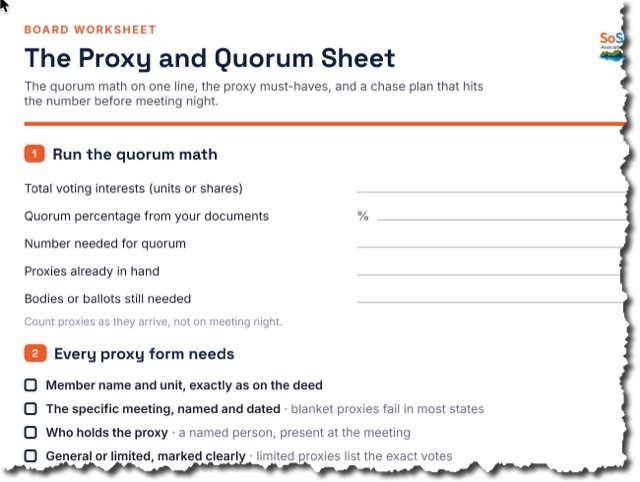
Unless the certificate or bylaws set a different number, members representing a majority of votes is a quorum. Bylaws may set quorum as low as 100 members or…
-
§609
Members may vote by written proxy. A proxy is valid for not more than eleven months unless it provides otherwise.
-
§611
Bylaws may set a record date no more than 50 nor less than 10 days before the meeting to determine who is entitled to vote.
-
§612
Bylaws may limit voting rights of members in arrears on dues or otherwise out of good standing.
-
§613
Default vote required is a majority of members present and entitled to vote. Specific actions may require a higher threshold.
-
§614
Member action may be taken without a meeting only with unanimous written consent of members entitled to vote, unless the certificate allows a lesser consent.
-
§615
The certificate or bylaws may require a higher quorum or vote threshold than the default.
-
§621
Members may examine and copy the minutes, list of members, and financial statements during business hours, on written demand stating a proper purpose.
-
§623
A member may bring a derivative action on behalf of the corporation after written demand on the board. Court may require security for expenses if certain con…
Directors and Officers
-
§701
All corporate powers are exercised by or under the direction of the board, except where the certificate or this chapter provides otherwise.
-
§702
The board must consist of at least three directors. The exact number is set in or fixed in accordance with the certificate or bylaws.
-
§703
Directors are elected by the members at the annual meeting for terms of one year unless the bylaws provide for staggered terms of up to four years.
-
§705
Newly created directorships and vacancies may be filled by the board or the members, as the bylaws provide.
-
§706
Directors may be removed for cause by the members or, in some cases, by the board. The bylaws may also authorize removal without cause by the members.
-
§707
A majority of directors in office is a quorum unless the certificate or bylaws set a different number, which cannot be less than one-third.
-
§708
Board may act by majority vote at a meeting with a quorum, or by unanimous written consent. Bylaws may permit conference call participation.
-
§710
Meetings may be held at any place and time as fixed by the board or bylaws.
-
§711
Regular meetings may be held without notice if the time and place are fixed by the bylaws. Special meetings require notice.
-
§712
The board may create an executive committee and other committees of three or more directors to act on the board's behalf.
-
§713
Required officers include a president, secretary, and treasurer. The same person may hold multiple offices unless restricted by the bylaws.
-
§714
Any officer may be removed at any time, with or without cause, by the board.
-
§715
A related party transaction is permitted only if it is fair, reasonable, and in the best interest of the corporation, and is approved by the board after full…
-
§715-A
Every corporation must adopt a written conflict of interest policy, with annual disclosure by directors, officers, and key persons.
-
§716
Loans to directors, officers, or key persons are generally prohibited.
-
§717
Directors, officers, and key persons must discharge their duties in good faith and with the care an ordinarily prudent person in a like position would exerci…
-
§719
Directors who vote for or concur in an improper distribution of assets or loan are jointly and severally liable for the amount.
-
§720
Actions against directors, officers, and key persons may be brought by the corporation, a member, the attorney general, or a creditor in specified circumstan…
-
§720-A
Uncompensated directors, officers, key persons, and trustees of 501(c)(3) corporations are immune from civil liability to third parties for acts in execution…
-
§721
The statutory indemnification provisions do not exclude additional indemnification rights provided by the certificate, bylaws, or agreement.
-
§722
A corporation may indemnify directors and officers against judgments, fines, settlements, and reasonable expenses incurred in actions to which they were a pa…
Amendments and Changes
-
§801
A corporation may amend its certificate of incorporation to add or change a provision required or permitted by this chapter.
-
§803
Amendments are authorized by board resolution and approved by members at a meeting after notice stating the purpose.
Frequently asked about Law NPC
- What is New York Law NPC?
- New York Law NPC — the Not-for-Profit Corporation Law — is the body of law that governs how every New York co-op or condo is structured, operated, and held accountable. It covers governance, voting, records, assessments, fining, and most of the day-to-day legal questions a board will face.
- How many sections are in Law NPC?
- Law NPC contains 46 sections in this reference. Each is summarized in plain English on its own page, with links to the official text at nysenate.gov.
- Is the summary on this site legal advice?
- No. These pages are plain-English summaries prepared by SoShiny for board members and managers. For binding legal advice or interpretation of how a section applies to your specific situation, consult a New York-licensed attorney.
- How often does New York Law NPC change?
- The New York State Legislature can amend any chapter in any session. We update these summaries when we re-import the official text — see the 'Last updated' date on each section page.
- Does SoShiny enforce Law NPC for me?
- No software 'enforces' a statute — but SoShiny is built around it. Voting, meeting minutes, records access, fining workflow, and audit trails are designed to meet this body of law's requirements out of the box, so the board can demonstrate good-faith compliance if challenged.
Running a co-op or condo in New York?
SoShiny is built around Law NPC from day one — every feature on every plan.
Start your community free →