
The Florida Condo Violation Workflow, Step by Step

Nothing sours a community faster than rule enforcement that feels personal, and nothing exposes a board faster than enforcement that skips steps. Florida condominium boards operate under Chapter 718, which spells out how violations must be handled before a fine can ever stick. Here is the workflow, start to finish.
Step 1: Document before you act
Every enforceable violation starts with a record: what happened, where, when, who observed it, and, ideally, a photo. A verbal "someone complained about the balcony again" is not a record. Write it down the day it happens, attach the evidence, and note which rule or declaration provision it violates, by number. If you cannot cite the rule, you do not have a violation. You have a preference.
Step 2: The friendly first contact
The statute does not require a courtesy notice, but experienced boards almost always start with one: a short, polite letter that names the rule, describes what was observed, and asks for correction by a reasonable date. Most violations end here. A renter didn't know, or an owner forgot. Send it in writing (paper for owners without email), keep a copy, and log the date. That letter becomes Exhibit A of the board acting reasonably.
Step 3: The formal notice
If the violation continues, the formal machinery starts. Under §718.112 and related provisions, before a fine or suspension of use rights can be imposed, the owner must receive reasonable written notice and an opportunity to be heard. The notice should state the specific rule, the facts, the proposed consequence, and the hearing details. Vague notices lose hearings. Specific ones settle them.
Step 4: The independent committee
Here is the part boards most often get wrong: in Florida condominiums, a fine or use-right suspension must be confirmed by a committee of unit owners who are not board members, officers, or their close relatives. This group is often called the fining or compliance committee. The board proposes. The committee disposes. If the committee does not confirm, the fine cannot be imposed. Minutes of that committee meeting belong in the violation file.
Step 5: Fines, limits, and follow-through
Statutory limits cap condo fines (commonly $100 per day up to $1,000 in aggregate for a continuing violation, and governing documents can set different limits). A fine that reaches the aggregate cap does not become a lien on a condo unit. Track cure dates, collect what is confirmed, and close the file with a resolution note. An enforcement history that shows the same rules applied the same way to everyone is your strongest shield against selective-enforcement claims.
Renters, and who actually gets the letter
Condo violations get complicated when the occupant is a tenant. The lease is between the owner and the renter. The association's relationship is with the owner. So the formal notice always goes to the owner, with a copy to the unit when the occupant is the one who needs to change behavior. Boards that only chase the renter build a file against someone they have no direct authority over. Boards that notify the owner create the pressure that actually fixes things. The owner can enforce the lease. Keep both addresses current: the unit address for the occupant, and the owner's mailing address, which for many Florida condos is out of state or out of the country for half the year. This is exactly why every notice in a good workflow records where it was sent and how, not just when.
Step 6: Keep the paper trail forever
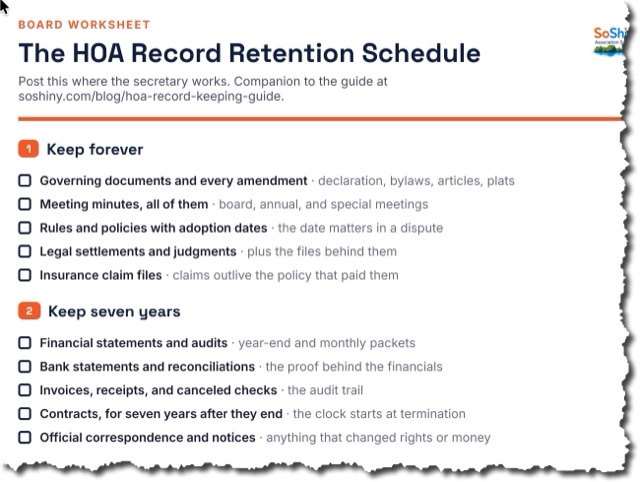
The complete file is an official record: observation record, photos, courtesy letter, formal notice with proof of mailing, committee minutes, hearing outcome, and resolution. Keep it organized and retrievable. This is precisely the workflow we built into SoShiny: a violation module with rich-text notices, digital signatures, evidence attachments, an explicit email-to-owner step, and printed First-Class letters for the owners you can't reach digitally.
The mindset that keeps boards out of trouble
Enforce rules the way you would want to be enforced against: cite the rule, show the evidence, give time to fix it, and treat the tenth violation letter with the same procedure as the first. Boards get sued over process far more often than substance. Process is cheap. our elections guide makes the same point about ballots And software makes process automatic.
SoShiny costs $25/month plus 33 cents a unit, and the Florida statute library behind every citation above is free to browse.
General information, not legal advice. Fining procedures interact with your specific declaration, so have counsel review your enforcement policy once, then follow it every time.
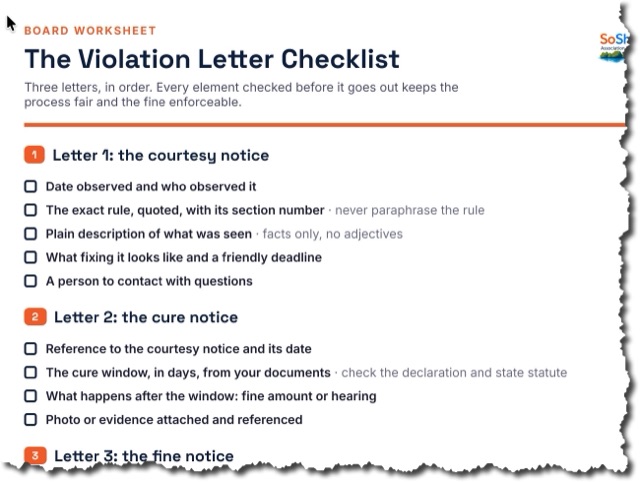
The Violation Letter Checklist (PDF)
Courtesy notice, cure notice, and fine notice: every element each letter needs before it goes out, so the process stays fair and the fine holds up.
Related reading
SoShiny Software Team is the collective byline for posts written by the people building SoShiny: engineers, designers, and the board members we work with every day.
We write about what actually works for community associations: governance that holds up under scrutiny, communication that residents read, and software that doesn't fight the people using it.
SoShiny is association management software for HOAs, condominium associations, and housing co-operatives anywhere in the United States. Headquartered in Daytona Beach, Florida. Built by people who've sat on a board.