
How Florida HOA Board Elections Actually Work — a Plain-English Guide

Every year, thousands of Florida homeowners associations hold board elections, and every year, a surprising number of them get challenged. A notice went out late, a quorum was miscounted, or ballots were handled loosely. None of that comes from bad intent. It comes from a process that lives in Chapter 720 of the Florida Statutes, written in language nobody reads twice voluntarily.
Here is the whole thing in plain English.
Step 1: Know which rules apply to you
Florida HOAs (single-family and townhome communities) run under Chapter 720. Condominiums follow a different, stricter playbook under Chapter 718. In a condo, much of what follows differs, especially around ballots. Your own bylaws sit on top of the statute: where the statute is silent, your documents govern. Where they conflict, the statute usually wins. Before every election season, read the election section of your bylaws once, start to finish. It takes ten minutes and prevents most disputes.
Step 2: The notice clock
Elections in an HOA usually happen at the annual meeting, and the annual meeting has notice requirements: members must receive notice of the meeting and the election within the timelines set by §720.306 and your bylaws, commonly at least 14 days, delivered by mail, hand delivery, or electronically to owners who have consented to email. Two practical traps live here:
- Bad addresses. A notice mailed to an old address is a notice the owner never got. Keep the roster current year-round, not the week before the meeting.
- Email consent. You may only email official notices to owners who have agreed to receive them electronically. Everyone else gets paper, which is exactly why we built printed-letter mailing into SoShiny.
Step 3: Nominations
Chapter 720 is more relaxed than condo law here. Check your bylaws first, and expect that candidates can be nominated in advance or even from the floor at the meeting. Your bylaws may impose candidate-notice deadlines. Honor them exactly. Publish the candidate list to every owner as soon as it is final, along with anything the candidates want to say for themselves. An informed vote is a defensible vote.
Step 4: Quorum, the number that cancels meetings
A quorum is the minimum turnout (in person or by proxy) required before any business can happen. For HOAs it is set by your bylaws, commonly 30 percent of voting interests. Miss quorum and the meeting, election included, cannot lawfully proceed. The fix is boring and effective: chase participation early. Communities using an online portal see this constantly. A reminder announcement, a text alert, and a mailed notice to the offline owners will outperform a single legal-minimum mailing every time.
Step 5: Proxies and ballots
HOA members vote in person, by proxy, or, where your documents allow, by secret ballot or electronically. Three habits keep this clean:
- Date-stamp everything that comes in: proxies, ballots, envelopes.
- Verify eligibility before counting: one vote per voting interest, and check your documents on whether delinquent owners' voting rights are suspended.
- Count in the open. Let candidates or their representatives observe. Nothing kills a challenge faster than a count everyone watched.
Step 6: Record it like it will be audited
It might be. Keep the notice with its mailing date, the sign-in sheet, the proxies, the tally, and the minutes together as the election record. Florida gives owners broad rights to inspect official records. A complete, organized election file is your best defense, and it takes minutes to assemble if you kept things digital from the start.
Where boards actually stumble
After watching many communities run this cycle, the failure points are always the same: notices sent late or to stale addresses, quorum missed for lack of reminders, and ballots counted behind closed doors. All three are communication problems before they are legal problems, which is why our own violation workflow guide and budget guide repeat the same theme: write it down, send it on time, keep the proof.
SoShiny handles the mechanics: online voting with a recorded tally, announcements, text alerts, and printed letters for members without email. Pricing is simple: $25 a month plus 33 cents a unit. And our Florida statute library is free to everyone, member or not.
This guide is general information, not legal advice. For a contested election or unusual bylaws, involve a Florida community-association attorney.
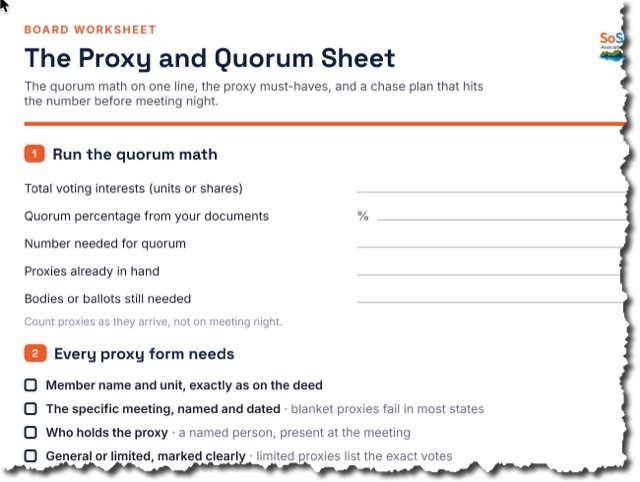
The Proxy and Quorum Sheet (PDF)
The quorum math on one line, the six things every proxy form needs, and a chase plan that hits the number before meeting night.
Related reading
- From the blogThe Florida Board's Compliance Guide: Chapters 718, 719, and 720
- From the blogSpecial Assessments: How Boards Decide, Notice, and Collect Them Fairly
- From the blogThe HOA Annual Meeting Checklist: Notices, Quorum, and the Night Itself
- From the blogHOA Budgets and Reserves in Plain Language
- From the blogThe Florida Condo Violation Workflow, Step by Step
SoShiny Software Team is the collective byline for posts written by the people building SoShiny: engineers, designers, and the board members we work with every day.
We write about what actually works for community associations: governance that holds up under scrutiny, communication that residents read, and software that doesn't fight the people using it.
SoShiny is association management software for HOAs, condominium associations, and housing co-operatives anywhere in the United States. Headquartered in Daytona Beach, Florida. Built by people who've sat on a board.