
The Confident Self-Managed HOA Board, Part 4: Sharing the Load Without Burning Out


Hard work does not kill most self-managed boards. One overloaded volunteer does. That person carries everything, burns out, and quits. The board panics and hires a management company. The fix is not more effort. It is sharing the load on purpose.
Key takeaways
- One overloaded volunteer, not hard work, sinks most self-managed boards.
- Name an owner for each bucket (money, repairs, records, decisions, communication) and make the work visible to the whole board.
- Plan for turnover by keeping knowledge in the portal, not in any one inbox. You hand over a login, not a shoebox.
Name an owner for each job
Use the five buckets from earlier in this series: money, repairs, records, decisions, and communication. Give each one a clear owner. The treasurer holds money. One member holds repairs. Another holds records and documents. The secretary holds meetings and votes. The president or a volunteer holds communication. Now no single person carries the whole community.

Make the work visible
Shared work only works when everyone can see it. This is where a shared system earns its keep. Put dues, work orders, and documents in one portal, and every board member sees the same picture. Nobody has to ask the treasurer for a balance or the secretary for a file. The information is open, so the load is shared, not just reassigned.
Set a light rhythm
Agree on a simple cadence. Hold a short board check-in each month. Glance at open work orders each week. Open a vote online the day a decision comes up instead of saving it for one tense annual meeting. Small, steady habits beat heroic catch-up sessions. A little plus a little plus a little adds up to a community that runs itself.
Plan for turnover
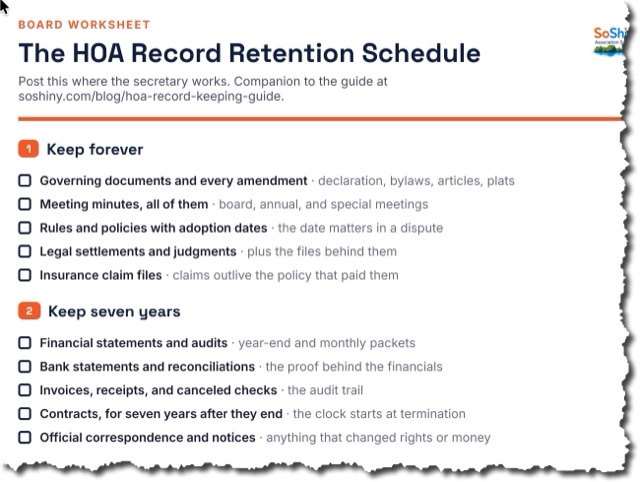
Boards change. Members move, resign, or rotate off. Knowledge walks out the door when it lives in one person's head or inbox. A shared system fixes that. Keep the records, history, and tasks in the portal, and a new member picks up where the last one left off. You hand over a login, not a shoebox.
Protect your volunteers
Sharing the load is not just about speed. It is about keeping good people. A volunteer who owns one clear job, and can see the whole board pulling with them, stays. A volunteer buried under everything leaves. Many boards that outsource were really protecting a burned-out treasurer who never should have carried it all.
Write down who owns what
One habit helps more than any other. Write down who owns what, and post it where the whole board can see it. A simple role list, kept current, ends the quiet confusion about whose job a thing is. Clear, visible responsibilities stop work from slipping between well-meaning volunteers.
Split the five jobs. Make the work visible. Keep a light rhythm. Plan for turnover. Do those four things and a volunteer board can run a community for years without a manager, and without grinding anyone down.
There is one honest exception. Sometimes a board really does need to hire out. The final post in this series covers exactly when, so you can tell the difference between fear and a real need.
Enjoying this? Get the next one by email.
Practical guides for self-managed boards, written by a board treasurer. About one a month.
FAQ about sharing the Homeowners Association board workload
How do you avoid burnout on a self-managed HOA board?
How should HOA board duties be divided?
How do you keep institutional knowledge after a board turnover?
How often should a self-managed board meet?
Can a board share work without a single chairperson?
Related reading
- From the blogThe Confident Self-Managed Board, Part 2: What a Management Company Actually Does
- From the blogThe Confident Self-Managed Board, Part 1: The Fear of Going It Alone
- From the blogHOA Embezzlement: How Small Boards Prevent It Without Accusing Anyone
- From the blogThe Confident Self-Managed Board, Part 5: When You Actually Need a Management Company
- From the blog5 Systems That Replace Your HOA Management Company
SoShiny Software Team is the collective byline for posts written by the people building SoShiny: engineers, designers, and the board members we work with every day.
We write about what actually works for community associations: governance that holds up under scrutiny, communication that residents read, and software that doesn't fight the people using it.
SoShiny is association management software for HOAs, condominium associations, and housing co-operatives anywhere in the United States. Headquartered in Daytona Beach, Florida. Built by people who've sat on a board.