
Glossary › Money and Finances
HOA Money Terms Every Board Should Know
Money runs the association. Board members handle owner fees, plan budgets, and save for big repairs. These terms come up at almost every meeting.
Assessment
#The fee each owner pays to fund the association. Regular assessments cover steady costs like landscaping, insurance, water, and management. Boards collect them monthly, quarterly, or once a year.
See also: Roof Came in Under Budget: What Happens to the [[orange: Leftover]] Money · Your Building's Hurricane Deductible Is $840,000. Here Is Your Share.
Special Assessment
#An extra charge on top of regular assessments. Boards use it for large costs the budget did not plan for, such as a new roof or a legal bill. Many states cap how much a board can levy without an owner vote.
See also: Roof Came in Under Budget: What Happens to the [[orange: Leftover]] Money · Your Building's Hurricane Deductible Is $840,000. Here Is Your Share.
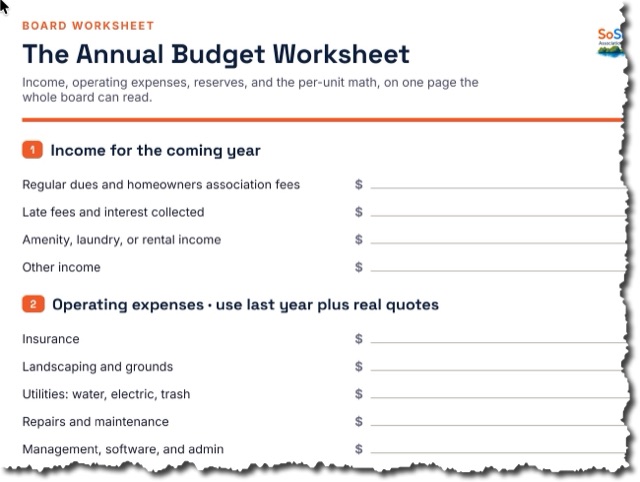
Operating Budget
#The yearly plan for income and spending. It lists expected fees coming in and costs going out. The board approves it and uses it to set assessment amounts.
Reserve Fund
#Savings set aside for major repairs and replacements down the road. It pays for big items like roofs, roads, pools, and elevators. A funded reserve keeps the board from hitting owners with surprise charges.
See also: How to Read an HOA Budget as an Owner (Not a Board Member) · Homeowners Association Reserve Funds in Plain English
Reserve Study
#A report that predicts future repair costs. An expert inspects the property and estimates the remaining life of each major part. The study tells the board how much to save each year.
See also: Homeowners Association Reserve Funds in Plain English · HOA Budgets and Reserves in Plain Language
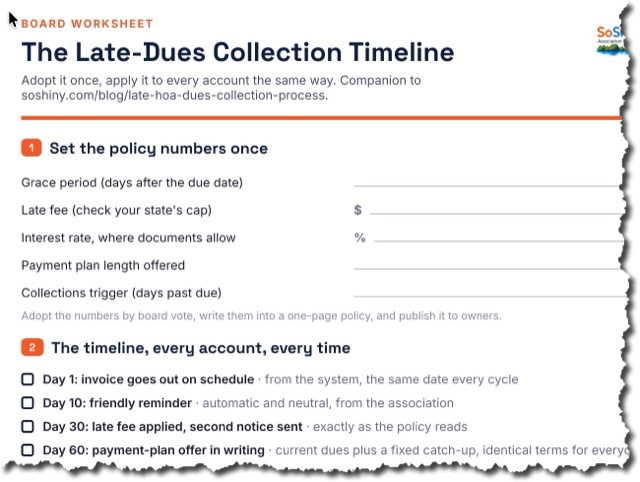
Delinquency
#An unpaid or late assessment. Boards track delinquent accounts and apply late fees or interest. Long delinquencies can lead to a lien or legal action.
See also: Late Dues: A Firm, Fair Process for Collecting From Neighbors
Lien
#A legal claim against a home for unpaid assessments. It attaches to the property and must clear before a sale closes. In many states the association can foreclose on the lien.
Fiscal Year
#The 12-month period the association uses for accounting. It often runs January to December, but some groups pick other dates. Budgets and audits follow this calendar.
Audit
#An outside review of the association books. A certified accountant checks records for accuracy and red flags. Some states require one each year above a set budget size.
See also: Electronic Signatures · Sign Any PDF
Capital Improvement
#A major upgrade that adds value or extends the life of common property. New playground equipment or a repaved lot counts. These cost more than routine repairs and often draw from reserves.
My Safe Florida Condominium Pilot MSFCPP
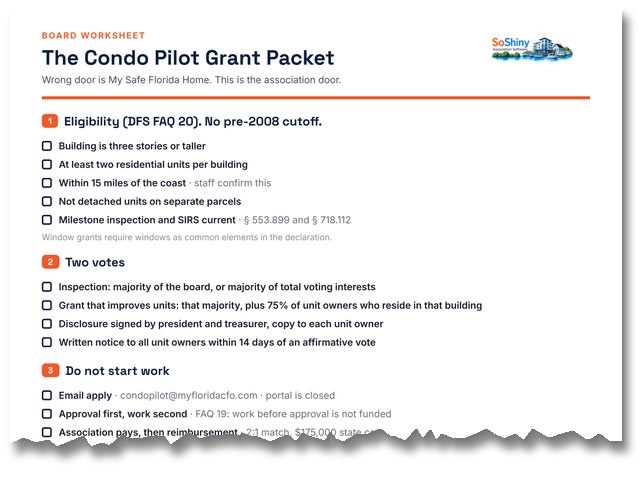
#A Florida Department of Financial Services grant for eligible condominium associations. The association applies. The inspection is free. The state matches $2 for every $1 the association spends, up to $175,000. Individual unit owners cannot apply. The house program, My Safe Florida Home, rejects condos.
Wind Mitigation
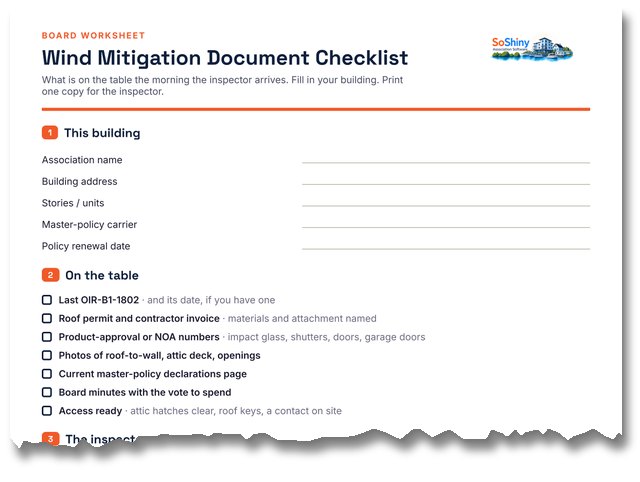
#Work that makes a building resist hurricane wind: a stronger roof connection, sealed roof deck, impact-rated openings. In Florida a licensed inspector records those features on form OIR-B1-1802 so the insurer can apply required premium credits.
See also: My Safe Florida Home Will Reject Your Condo. Here Is the fix · The Wind Mitigation Inspection: How a Florida Board Turns Form 1802 into Insurance Credits
Named-Storm Deductible
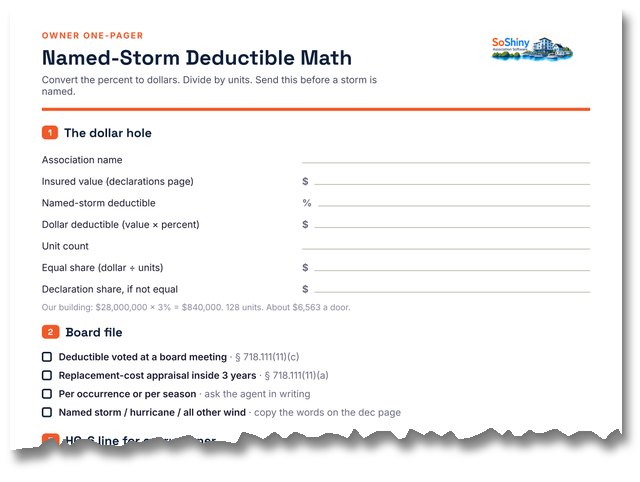
#A percentage of a building's insured value that the association pays before wind coverage responds, once the National Hurricane Center names a storm. A 3 percent deductible on a $28 million building is $840,000. That amount is a common expense, split among unit owners.
See also: Your Building's Hurricane Deductible Is $840,000. Here Is Your Share.
OIR-B1-1802 Form 1802
#Florida's Uniform Mitigation Verification Inspection Form. Every property insurer in the state must accept it. Inspections on or after 1 April 2026 use Rev. 04/26. The form is valid up to five years with no material change to the structure.
See also: The Wind Mitigation Inspection: How a Florida Board Turns Form 1802 into Insurance Credits