
What Does an Association Manager Do?


A Complete Hiring Guide for HOA, Condo, and Co-op Boards
A community association manager (CAM) is the paid professional your HOA, condo, or co-op board hires to handle the day-to-day operations the board doesn't have time to do itself: collecting dues, paying vendors, preparing budgets, running meetings, enforcing rules, maintaining records, and keeping the community in legal compliance. The board still sets policy and makes decisions. The manager executes.
- Key takeawaysAn association manager handles seven core buckets: financial operations, administrative support, vendor coordination, maintenance, compliance, owner communication, and dispute resolution.
- National average pay sits around $64,000 a year. Experienced portfolio managers earn $90,000–$150,000.
- Florida licenses the role (Chapter 468). Most states do not. Industry credentials (CMCA, AMS, PCAM) are the de facto signal of competence everywhere else.
- The board is still on the hook. Hiring a manager doesn't transfer fiduciary duty.
What Is a Community Association Manager?
A community association manager, often called a CAM, HOA manager, condo manager, or simply "the manager," is a paid professional who supports the volunteer board of directors of a homeowners association, condominium association, cooperative, or master-planned community.
Community Associations Institute (CAI), the national industry body, defines the role simply: "A community association manager's role is to implement the policies set by the board of directors, oversee operations, services, and programs as laid out in the contract with the association, and provide information and advice to assist board members in their decision-making."
That last clause matters. The manager advises, but doesn't decide. The board sets policy. The manager carries it out.
A CAM may be:
- Employed directly by the association (common in large condos and high-rises, often called an "on-site manager")
- Contracted through a management company (common in HOAs and portfolio arrangements)
- An independent contractor (smaller communities, often a former on-site manager)
Some communities have one manager assigned to them full-time. Others share a "portfolio manager" with five or ten other associations. The structure depends on size, complexity, and budget.
The Core Duties: What an Association Manager Actually Does
Boards hiring their first manager often expect the role to be narrower than it really is, and existing managers often find themselves doing work that was never written into their contract. To avoid that drift, here's the full operational scope CAI and most professional management companies recognize.
1. Financial Operations
The biggest single bucket. A competent manager handles:
- Billing and collecting assessments, dues, and special assessments
- Tracking delinquencies and following up on overdue accounts
- Paying invoices and bills on behalf of the association
- Preparing payroll for any on-site employees
- Drafting monthly and annual financial reports
- Drafting and managing the annual budget (subject to board approval)
- Maintaining the reserve study and reserve funding plan
- Working with the association's CPA on tax preparation
- Keeping the board regularly informed of the association's fiscal health
The board still approves the budget and signs major checks. The manager prepares everything and runs the books day-to-day. The unit-level data this all rests on (ownership percentage, monthly assessment, payment history) lives in the unit record.
2. Administrative Support
Less glamorous, equally critical:
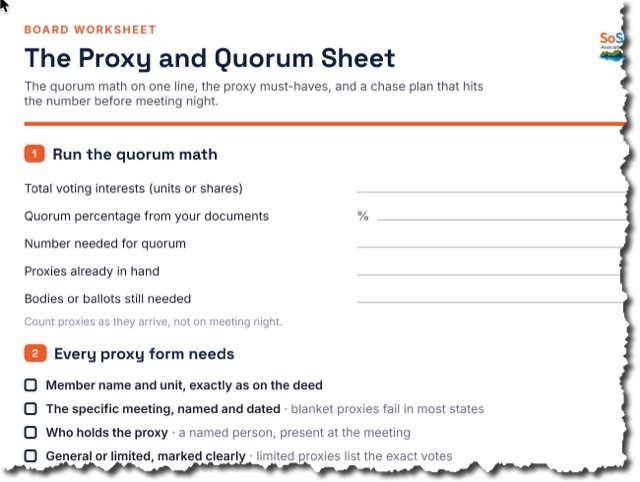
- Organizing and attending annual meetings, board meetings, and committee meetings
- Sending meeting notices in compliance with state law and the governing documents
- Preparing meeting agendas, board packets, and supporting reports in advance
- Taking and distributing meeting minutes
- Maintaining the membership roster, official records, and document archive
- Handling vendor paperwork, contracts, and procurement
- Drafting correspondence: newsletters, violation notices, flyers, and homeowner communications
This is where modern association management software earns its keep. A manager running a portfolio of five communities on spreadsheets, email, and a shared drive will burn 30% of their week on administrative friction. A manager with a real platform, with built-in meeting agendas and minutes, a searchable document archive, and tracked email broadcasts, spends that time on the things only humans can do. (See the hidden cost of running an HOA on email and spreadsheets for the math.)
3. Vendor and Contractor Coordination
The manager is the operational contact between the association and every outside service provider:
- Soliciting bids for repairs, landscaping, snow removal, pool service, security, and capital projects
- Reviewing vendor contracts before submitting to the board
- Supervising the bidding and selection process
- Monitoring contractor performance (note: monitoring, not supervising, a distinction CAI emphasizes)
- Tracking invoices, work orders, and payments
- Handling vendor disputes and contract violations
Good vendor management saves an association 10–20% of its operating budget annually. Bad vendor management (favoritism, no competitive bids, missed contract renewals) is where most fraud and waste happens.

4. Maintenance Coordination
The manager doesn't fix things personally. They coordinate the people who do:
- Identifying maintenance, repair, and upgrade needs in shared areas
- Overseeing the building maintenance plan (cleaning, plumbing, painting, HVAC)
- Coordinating grounds upkeep: landscaping, pool, snow removal, trash, recreational facilities
- Providing periodic inspection reports to the board
- Monitoring on-site employees and outside service providers
- Enforcing architectural guidelines and design covenants
- Triaging emergency repairs and routing them to the right vendor
Every one of those tasks is a work order: logged, assigned, status-tracked, and visible to the whole board. In condos and high-rises, the manager often supervises a small in-house staff (superintendents, doormen, porters). In HOAs, almost everything is contracted out.
5. Compliance and Rule Enforcement
This is where boards get into trouble fastest, and a credentialed manager is worth their fee:
- Enforcing the association's bylaws, CC&Rs, and rules consistently
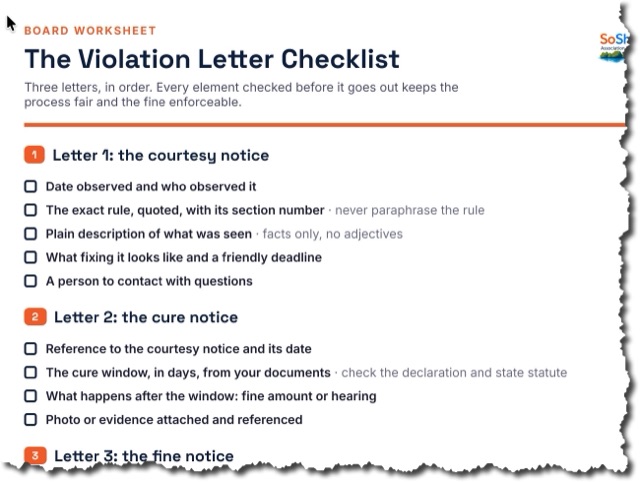
- Sending violation notices and tracking the response
- Following due process per state law (notice requirements, hearing rights, fining limits)
- Staying current on changes to state and federal law affecting HOAs and condos
- Coordinating with the association attorney on legal matters
- Filing required state reports and disclosures
- Meeting fair-housing, ADA, and anti-discrimination requirements
In states with strong consumer-protection statutes, like Florida (Chapters 718, 719, 720), California (Davis-Stirling Act), New York (Martin Act and the Real Property laws), Texas (Property Code Chapters 81, 82, 202, 204, 209), Arizona (Title 33 Chapter 9 and Chapter 16), a manager who misses a procedural step can expose the association to lawsuits and personal liability for board members.
6. Homeowner Communication
The manager is usually the first call when something goes wrong in a unit or a common area:
- Email, phone, text, and in-person communication with owners
- Newsletters and community announcements
- Welcome packets for new owners
- Estoppel letters and resale disclosures
- Coordinating community events
- Handling complaints and routing them to the right party
Note the limit: per CAI, "The community manager is available to residents and can answer questions, but he or she is not the board's information officer." A manager who finds themselves fielding 40 phone calls a week about board decisions they didn't make is being used wrong.
7. Dispute Resolution and Mediation
The manager is trained to defuse conflict, not adjudicate it:
- Mediating neighbor-to-neighbor disputes when association rules are involved
- De-escalating conflicts between owners and the board
- Documenting incidents for the legal record
- Bringing unresolvable issues to the board for decision
Per CAI: "The manager is trained to deal with conflict but typically will not get involved in homeowner disputes unless association rules are being violated."
What an Association Manager Does NOT Do
Equally important. Boards routinely ask managers to take on work that's outside their authority, expertise, or the management contract. That creates resentment, liability, and turnover.
A manager does not:
- Set policy. That's the board's job. The manager implements policy.
- Vote on board decisions. They advise, they don't decide.
- Sign checks over the contract threshold. Most associations require board signatures above a set amount.
- Waive rules unilaterally. Owners requesting variances must go to the board.
- Provide legal advice. That's the association attorney's job.
- Provide tax advice or audit financials. That's the CPA's job.
- Perform maintenance and repairs personally. They coordinate vendors.
- Manage individual unit interiors. They oversee common areas only.
- Act as the board's communications shield. Owners are still entitled to direct board contact for matters within the board's authority.
A manager who is being asked to do all of the above is being set up to fail, and most likely to quit within 18 months. Boards new to hiring managers benefit enormously from writing a tight job description that draws the line clearly.
Licensed vs. Unlicensed: What State Law Requires
Most states do not license community association managers. A handful do. The strictest is Florida.
Florida (the most regulated)
Under Chapter 468, Part VIII of the Florida Statutes and Rule 61E14 of the Florida Administrative Code, a CAM license is required when:
- The association has more than 10 units, OR
- The annual budget exceeds $100,000, AND
- The manager receives compensation for management services
To obtain a Florida CAM license, an applicant must:
- Be at least 18 years old
- Complete a 16-hour pre-licensure education course from an approved provider
- Submit fingerprints for a background check
- Pass the state CAM examination: 100 multiple-choice questions, 75% or higher to pass
- Pay the $228 application fee
- Be of good moral character
Licenses renew every two years for $105, and renewal requires 15 hours of continuing education across legal updates, insurance/finance, physical property, HR, and HOA-specific topics. Florida requires the firm itself to be licensed too, if it manages more than 10 units or $100,000+ budgets.
Volunteer board members are exempt. They can run their own community without a license, provided they receive no compensation.
Other licensed states
States with formal CAM licensing or registration programs include:
- Nevada: formal CAM license required
- Virginia: Common Interest Community Manager certification
- Georgia: registration required for managers of communities with mandatory assessments
- Illinois: Community Association Manager license
- Connecticut: Community Association Manager license
- California: state license not required, but the Common Interest Development Manager certification under Davis-Stirling is the de facto credential
Most states, including New York, Texas, Arizona, North Carolina, the Carolinas, and most of New England and the Midwest, do not require a state license. In those states, CAI's voluntary credentials become the de facto signal of competence.
CAI Credentials: CMCA, AMS, and PCAM Explained
The Community Associations Institute administers three professional designations that have become the national gold standard for managers, regardless of state licensing.
CMCA: Certified Manager of Community Associations
- Level: Entry / foundational
- Issuer: Community Association Managers International Certification Board (CAMICB)
- Requirements: Complete CAI's M-100 course, pass the CMCA exam
- Covers: Governance, legal and financial basics, operations, maintenance, risk management
- Signal: This person knows the fundamentals.
AMS: Association Management Specialist
- Level: Intermediate
- Issuer: CAI
- Requirements: CMCA + at least two years of experience + two additional CAI courses
- Covers: Advanced governance, legal, financial analysis, budgeting, strategic planning
- Signal: This person can run a portfolio independently.
PCAM: Professional Community Association Manager
- Level: Advanced / mastery
- Issuer: CAI
- Requirements: AMS + five years of experience + six advanced PMDP courses + a Case Study course
- Covers: Leadership, conflict resolution, advanced financial planning, regulatory compliance, complex governance
- Signal: This person can lead a management company or a master-planned community.
PCAM holders represent roughly the top 10% of the industry and command salaries 30–50% above the median. For most associations under 200 units, a CMCA-credentialed manager is the right baseline. Larger communities, condo high-rises, or master-planned developments should expect AMS or PCAM.
What Does an Association Manager Earn?
National compensation data for 2025–2026, drawn from the Bureau of Labor Statistics, CAI's compensation study, ZipRecruiter, and PayScale:
| Role Range Median | ||
| National average (all CAMs) | $37,000 – $92,000 | $64,104 |
| Entry-level CAM (0–4 years) | $37,000 – $55,000 | $48,000 |
| Mid-career CAM (5–9 years) | $55,000 – $80,000 | $67,758 |
| Senior CAM (10–19 years) | $65,000 – $95,000 | $74,557 |
| HOA Portfolio Manager | $65,500 – $130,000 | $100,458 |
| High-rise / on-site manager | $80,000 – $135,000 | $110,000 |
| Large-scale community manager | $110,000 – $200,000 | $143,500 |
| Management company CEO | $100,000 – $250,000 | $125,000 |
| PCAM-credentialed manager | $62,000 – $226,000 | $77,000 base |
Florida-specific (BLS 2025): average $71,257, Tampa $63,040, Miami $69,370, Naples / Marco Island $73,400, Ocala $54,900, entry-level around $36,500, top decile $132,165.
Hourly contractors (smaller communities, independent CAMs): $18–$30/hour entry, $35–$75/hour experienced.
Budgeting on the management-company side
If you're hiring through a management company rather than direct, the association typically pays a per-unit-per-month fee plus add-ons. Industry ranges:
- Small HOAs (under 50 units): $20–$35 per unit per month
- Mid-size HOAs and condos (50–200 units): $15–$25 per unit per month
- Large condos and high-rises (200+ units): $10–$18 per unit per month, often with a dedicated on-site manager
- Master-planned communities (1,000+ units): negotiated portfolio contracts, often $8–$15 per unit per month plus reimbursed staff
Watch out for incidental fees in management contracts: postage, mileage, after-hours calls, meeting attendance beyond a monthly cap, document copying, and special-project surcharges can quietly add 15–25% to the headline rate. Boards should require all charges to be itemized upfront. For a wider price comparison of self-management vs management company vs software, see our three-path breakdown.

How to Hire the Right Manager: A Board's Checklist
Whether you're hiring an in-house CAM or contracting a management company, the same fundamentals apply.
Before you advertise the role:
- Read your governing documents. Confirm the board has authority to hire a manager and check for any specific restrictions.
- List the duties you need covered. Use the seven categories above as a starting template.
- Decide on-site vs. portfolio vs. company. Each has tradeoffs.
- Set a budget range. Use the table above as a sanity check.
- Write the job description. Have your association attorney review it.
During hiring:
- Verify state license (Florida, Nevada, Illinois, etc. if applicable)
- Verify CAI credentials (CMCA at minimum)
- Request references from at least three current or recent associations
- Check that the candidate's E&O insurance is current
- Confirm they're insured and bonded if they'll handle association funds
- Ask about technology: what software they use, how they handle records, how owners get information
Contract terms:
- Term of 1 year initially (industry standard suggests 1 to 3 years, and shorter protects the board)
- 30-day termination notice for cause, 60-day notice from the manager
- All fees itemized: flat, hourly, incidentals, special-project rates
- Scope of services explicitly defined (what's included, what's a charge-back)
- Insurance and bonding requirements
- Records ownership clause: when the manager leaves, the association's records must transfer cleanly (see how to switch software without losing data for the same principle applied to vendors)
- Annual performance review built into the contract
The board's fiduciary duty doesn't end when you hire a manager. The board remains liable to meet all its obligations under the governing documents.
Where Software Fits
A modern association manager spends 60–70% of their time on workflows that didn't exist 30 years ago and shouldn't be done by hand today: tracking unit-level dues, routing work orders, storing governing documents, distributing meeting notices, running online votes, and giving owners a self-service portal so they're not calling the manager's cell phone at 9 p.m. about a leaking pipe.
That's the gap SoShiny exists to close. We give the manager and the board one system for:
- Owner billing and dues with automated reminders, tied to the unit record
- Work orders and maintenance tracking with vendor assignment, see work orders
- Document storage for bylaws, CC&Rs, minutes, and financial reports, see documents
- Online voting and ballots that comply with state notice requirements, see voting & ballots
- Board meeting agendas, minutes, and packets, see board meetings & minutes
- Compliance hubs for Florida, New York, Texas, and Arizona statutes, so the manager always has the current law one click away
- A free public website for the association so the manager isn't fielding calls about basic information
Everything is included. No per-feature upcharges. $25 a month base plus $0.33 per unit. See pricing for details and security for how the data is protected.
Frequently Asked Questions
Is an association manager the same as a property manager?
No. A property manager works for individual rental property owners and manages tenants, leases, and rent collection on private units. An association manager works for a homeowners or condo board and manages common property and community-wide operations on behalf of all owners. The two roles overlap in vocabulary but not in scope or fiduciary structure.
Does our association need a manager at all?
Maybe not. State law in most jurisdictions allows the board to operate without an outside manager, provided the board members handle the work and receive no compensation. Small associations (under 30 units) often self-manage with a board treasurer running the books and an outside bookkeeper for taxes. Once you hit 50 units, the administrative load typically exceeds what volunteers can sustainably handle. Our breakdown of the three paths walks through the decision.
Can our board fire the manager?
Yes, per the terms of the management contract. Standard contracts allow termination with 30 days' notice. Always have your association attorney review the termination clause before signing.
What if the manager makes a mistake that costs the association money?
This is what the manager's E&O insurance and surety bond are for. The board should verify both are in place before signing. Beyond insurance, the contract should specify the manager's standard of care, typically "ordinary professional negligence" rather than "fiduciary duty."
Do board members report to the manager, or does the manager report to the board?
The manager reports to the board. Always. The manager may have day-to-day authority on operational matters within the contract scope, but the board is the manager's client and supervisor.
What to Do Next
If your board is hiring its first manager: list the duties from the seven categories above, set a budget range using the salary table, and draft a job description your attorney reviews before posting.
If your board is evaluating whether to keep or replace a current manager: use the seven duty categories above as a performance-review checklist. A good manager will welcome the exercise.
If you're a manager looking to systematize your portfolio: SoShiny gives you a single platform across every community you manage. Bring your associations onto one system, save 8–12 hours a week on administrative friction, and give boards the modern owner portal they're starting to expect. Start a free trial.
Sources: Community Associations Institute (CAI), Florida Department of Business and Professional Regulation (CAM Licensing), CAI Florida Advocacy, U.S. Bureau of Labor Statistics, ZipRecruiter, FirstService Residential, Nolo, Prolicense Florida.
Enjoying this? Get the next one by email.
Practical guides for self-managed boards, written by a board treasurer. About one a month.
Related reading
- From the blogThe Confident Self-Managed Board, Part 5: When You Actually Need a Management Company
- From the blog5 Systems That Replace Your HOA Management Company
- From the blogThe Confident Self-Managed Board, Part 2: What a Management Company Actually Does
- From the blogSelf-Managed vs. Management Company vs. Software: What's Right for Your Community
- From the blogGoing Paperless: E-Signatures and Documents for HOA Community Boards
SoShiny Software Team is the collective byline for posts written by the people building SoShiny: engineers, designers, and the board members we work with every day.
We write about what actually works for community associations: governance that holds up under scrutiny, communication that residents read, and software that doesn't fight the people using it.
SoShiny is association management software for HOAs, condominium associations, and housing co-operatives anywhere in the United States. Headquartered in Daytona Beach, Florida. Built by people who've sat on a board.