
Self-Managed vs. Management Company vs. Software: What's Right for Your Community


I have lived this choice from the inside. I'm a board member and the treasurer of a 128-unit oceanfront condo association in Florida. Over the years our building tried versions of all three paths: volunteers with spreadsheets, quotes from management companies, and software. Every board faces the same fork. Run the community yourselves, hire a management company, or self-manage on real software. Each path has a real cost. Here is how they compare, with the numbers I showed my own board.
- Key takeawaysA self-managed board on email and a spreadsheet still spends 10 to 15 hours a week and burns out volunteers.
- A management company often costs $10 to $25 per unit per month. That is $1,500 a month for 100 units, and you trade control for stability.
- Software is the middle path: about $58 a month for 100 units, full control, and the tool carries the busywork.
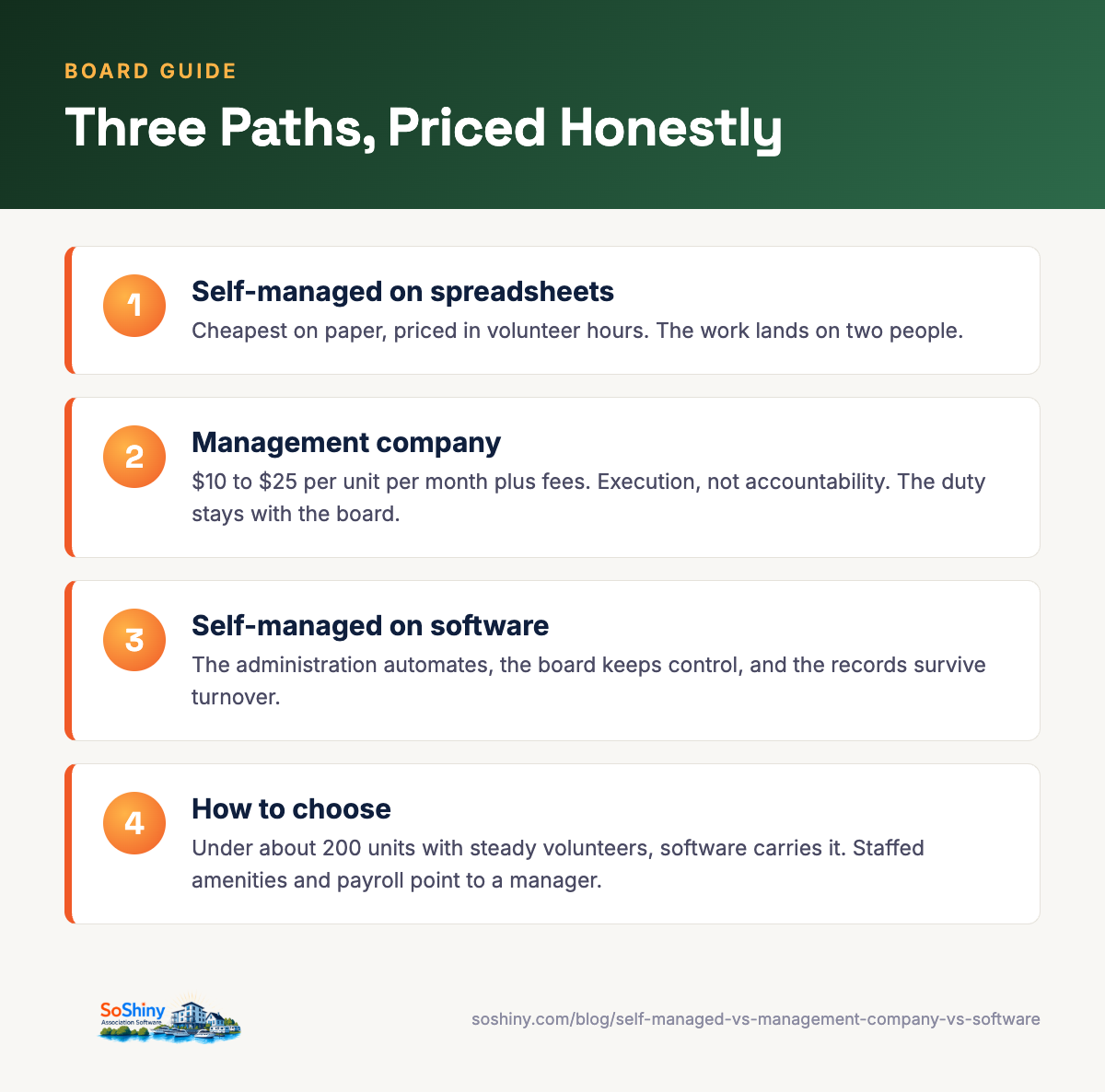
Self-managed on spreadsheets
Volunteers do the work. The cost looks like zero, but it is not. It is hours, and it is burnout. I can tell you what those hours look like. As treasurer I spent Sunday nights reconciling dues in a spreadsheet. Owner questions went to a shared inbox and died there. Three people held three versions of the owner list. One filing cabinet held the records, and one volunteer understood it. A board on email and spreadsheets spends 10 to 15 hours a week on dues, repairs, and records. The knowledge walks out the door when a board member resigns.
Our worst version of this was record keeping. An owner asks a simple question. "Was my February payment received?" The honest answer was "let me get back to you," followed by twenty minutes of scrolling. Multiply that by 128 units and a snowbird season, and you see why board seats got hard to fill.
Bare self-management works for small, simple communities with steady volunteers. It strains fast as the unit count grows. It strains hardest on whoever holds the money. That is why treasurers quit first. Self-management fails when it runs on heroics from two people.
Management company
You hand the work to a pro. The cost is real money, often $10 to $25 per unit per month, sometimes more. Our board priced full-service management. The quotes ran $18,000 to $30,000 a year for a building our size, before project fees. For that you get expertise, continuity, and a buffer between the board and upset owners. Those are real things. I wrote about the cases where a manager truly earns it: big communities, no volunteers, a lawsuit, messy finances.
The brochures skip one part. You still do work. You chase the manager for updates. You review their reports. You explain your community's quirks to each new account rep. And the records, your owner list, your violation history, your financials, often live in the manager's system, not yours. Ask what happens to that data if you switch firms someday. Watch the answer carefully.
A management company fits larger communities with money and complex needs. Many smaller boards pay for more than they use.
Self-managed on software
Software is the middle path, and it is the one our building landed on. The board keeps control, but the tool carries the busywork. Dues track themselves. I can answer "was my payment received?" with the owner still on the phone. Repairs become work orders with a status instead of a promise. Votes run online with quorum counted live. Records live in one place that survives board turnover. Our secretary's term ended, and nothing left with her. Nothing lived in her inbox.
The cost is small and clear, and that matters to me. I defend every line of the budget at the annual meeting. SoShiny is $25 a month plus $0.33 per unit. A 100-unit community pays about $58 a month, against $1,500 for full-service management. Over a year that is the gap between $700 and $18,000. For most communities the $700 version comes with more visibility, not less.
How to choose
Ask three questions, in this order:
- How many units? Under a couple hundred, volunteers plus software can run it. Past that, or with pools, a gym, and paid staff, professional help starts earning its fee.
- How much volunteer time can you count on? Not what people promise in March. What they still show up for in October. Software cuts the hours. It cannot create volunteers who don't exist.
- How complex are your finances? Simple dues and a clear budget fit a treasurer with software. Pooled reserves, an association loan, a state-mandated audit, or messy books call for a professional, at least on the finances.
A small, steady community can self-manage with good software. A large, complex one often wants a management company. Most communities in the middle get the best of both with software: control, plus a tool that does the work.
This is not all or nothing. Software pairs well with a manager. Plenty of communities keep a part-time manager on the same portal the board uses. The manager spends their hours on vendors and judgment calls instead of paperwork. The association's records stay in the association's system. I covered that split in part 2 of the self-managed series.
The fear nobody says out loud
Many boards hire a management company for one reason they rarely admit: fear of doing it wrong. The statutes feel heavy and the stakes feel personal. I know that fear. The first time I signed the association's tax return as treasurer, I read it three times. A board can be exposed when it misses a required notice or botches a vote. Paying someone to carry the worry feels responsible.
Here is what I learned. The worry comes from not being able to see. Make the rules searchable. Send the notices on time by default. Log every action, and show the money to the whole board every month. The fear shrinks to its true size. Organized boards don't miss the things that get boards in trouble. Plenty of boards discover they never needed the management company. They needed to feel organized, and the right tool gave them that for a fraction of the price.
The honest answer
There is no single right path. There is a right path for your size, your volunteer bench, and your budget. For most communities under a few hundred units, self-managing on software is the one that fits. Not sure? You can try the software path for a month, free, with your current arrangement still running. That makes it the cheapest experiment in association governance.
If this guide helped, the tools it describes live in SoShiny, and so does everything else a self-managed board needs. The 30-day trial is free.
Enjoying this? Get the next one by email.
Practical guides for self-managed boards, written by a board treasurer. About one a month.
FAQ about self-managing vs hiring a management company
Is self-managing an HOA legal?
How big does an HOA need to be to need a property manager?
How much does HOA management cost per unit?
Can software actually replace a property manager?
What if our self-managed board burns out?
Can you use software and a management company together?
Related reading
- From the blogThe Confident Self-Managed Board, Part 5: When You Actually Need a Management Company
- From the blogThe Confident Self-Managed Board, Part 2: What a Management Company Actually Does
- From the blog5 Systems That Replace Your HOA Management Company
- From the blogThe Confident Self-Managed Board, Part 1: The Fear of Going It Alone
- From the blogHow to Choose Community Management Software: a 10-Point Checklist
The idea of SoShiny came from a board seat. Kevin joined the board of a large condo HOA and found that one person ran the entire operation from memory. The books lived in Lotus 1-2-3, a program from the 1980s. If that person walked away, the whole community walked away with them. Something had to change. What started as a small fix grew into a full system. SoShiny now runs communities across 23 states and 3 countries.
Kevin has spent his career building teams and turning messy processes into simple products. He ships fast, coaches with candor, and favors action over talk. With SoShiny, he brings that same bias for action to an industry that still runs on spreadsheets, sticky notes, and paper announcements.
An Irish American builder and author, Kevin leads with honesty, grit, and faith. He has three sons and splits his time between Ormond Beach, Florida and Western New York.