
Your Building's Hurricane Deductible Is $840,000. Here Is Your Share.


Last budget night an owner asked what $412,000 in insurance actually buys. I put the declarations page on the projector. Not the premium. The named-storm deductible. Three percent of $28 million. That is $840,000. I divided by 128 units. About $6,563 a door, due the week after a named storm hits.
I am a board member and the treasurer of this 128-unit oceanfront homeowners association (HOA). We are a condominium association in Florida. Our master policy costs $412,000 a year, about 30 cents of every dues dollar. Last renewal the premium jumped 34 percent. Those numbers already live in our insurance guide. This page is the one-pager that guide promised and never printed: your share of the hole, and the HO-6 line that answers it.
Key takeaways
- A named-storm deductible is a percent of insured value, not a flat dollar. $28 million times 3 percent is $840,000.
- That hole is a common expense of the condominium. The board can assess every owner a share.
- On 128 equal units the share is about $6,563. Read the declaration. Some buildings split by percentage interest, not by unit count.
- Florida law requires at least $2,000 of loss assessment coverage on the owner's HO-6, with a deductible of no more than $250. $2,000 does not cover $6,563. Raise the limit. The limit that counts is the one in force the day before the storm. Ask the agent how much of that limit applies to a master-policy deductible assessment.
- Send this one-pager before storm season and before the budget meeting. Not after the water is in the hallway.
The $840,000 hole
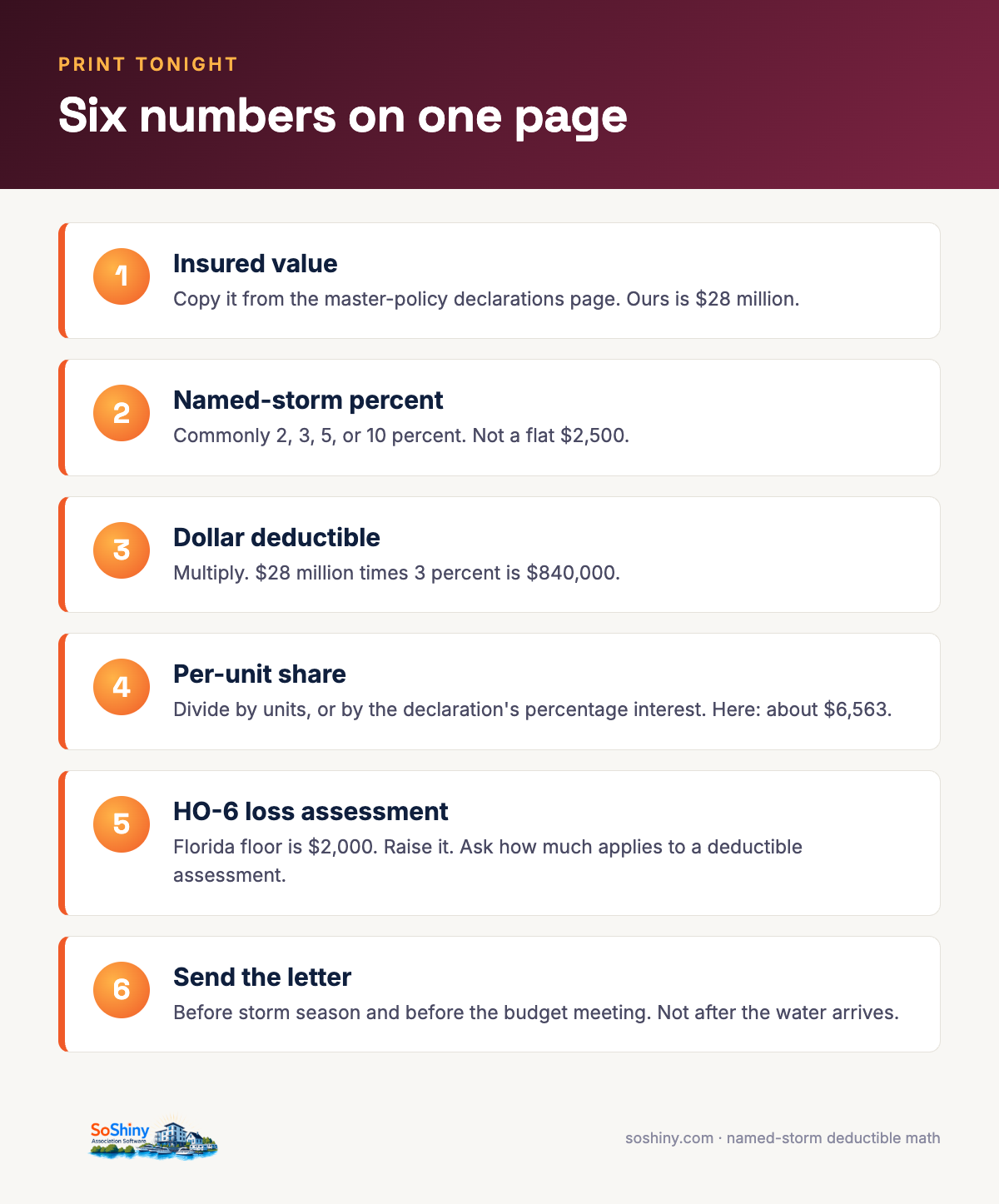
Homeowners think of a deductible as $2,500. A coastal master policy does not work that way. Wind coverage for a named storm uses a percent of the building's insured value. Common figures are 2, 3, 5, or 10 percent.
Run it once on our building:
- Insured value from the declarations page: $28,000,000
- Named-storm deductible: 3 percent
- Dollar deductible: $840,000
- Units: 128
- Equal share: $6,562.50, call it $6,563
The premium and the deductible are different jobs. A homeowners association can pay $412,000 a year and still keep the first $840,000 of a hurricane claim. The board sets the percent. The storm collects it.
A wind mitigation inspection can cut the premium. It does not erase the deductible. Credits change the rate. They do not change 3 percent of $28 million.
 Named storm is not the same as hurricane
A hurricane deductible waits for a hurricane warning. A named-storm deductible does not. The National Hurricane Center names a tropical storm, and the percent can apply. Tropical Storm Emily can trip the same $840,000 hole as a Category 2.
Read the declarations page. Look for "named storm," "hurricane," and "all other wind." They are not synonyms. A named-storm form is the broader trigger. Our policy uses named storm. Yours might not. Copy the words on your page, not the words in this post.
Most coastal forms apply the percent per occurrence. Two named storms in one season can mean two deductibles. Helene and Milton arrived 13 days apart in 2024. Ask the agent, in writing, whether your form is per occurrence or per season. Put the answer in the file.
Who pays: the statute, not the hallway
Florida Statute 718.111(11)(c) lets the board set deductibles at a meeting. The amount has to match industry practice for buildings of this size and age. The board has to base it on available funds and predetermined assessment authority. That vote belongs in the minutes.
After a loss, deductibles and uninsured damage are a common expense of the condominium. That is 718.111(11)(j). An owner who had no water in the unit still pays a share. The exceptions are owner fault: intentional conduct, negligence, or a rules violation. A hurricane on the roof is not owner fault.
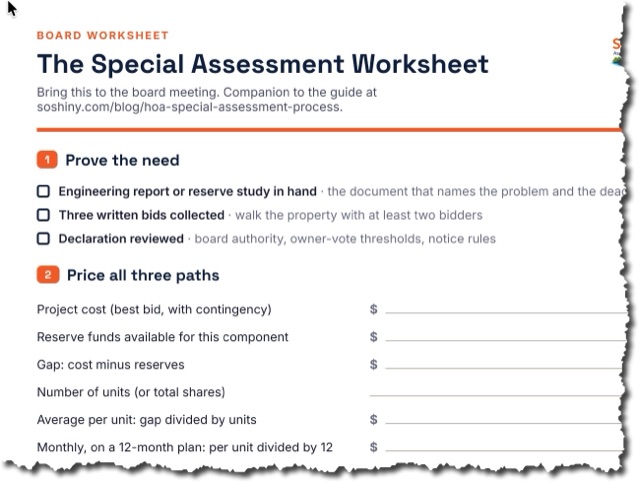
The board funds the hole from reserves, the operating budget, or a special assessment. Our special-assessment guide is the process. This page is the number you drop into that process.
Florida Statute 718.111(11)(a) requires a replacement-cost appraisal at least every 3 years. A stale appraisal is how a $28 million building becomes a $22 million payout plus a surprise. Put the appraisal date on the worksheet next to the deductible.
Your share, and the HO-6 that answers it
Equal units here: $840,000 divided by 128 is $6,562.50. A condominium association that splits by percentage interest will land on a different number per door. Use the declaration, not a napkin.
Every unit owner's residential policy must conform to Florida Statute 627.714. The statute requires at least $2,000 of property loss assessment coverage for assessments from the same direct loss, with a deductible of no more than $250. Lenders look for this. Boards should want it on every unit.
$2,000 against $6,563 leaves $4,563 on the owner. Raise the loss assessment limit. Coverage of $25,000 to $50,000 often costs a few dollars a month. That is the cheap answer on this coast.
Ask the agent one extra question: how much of that limit applies to an assessment that pays the association's master-policy deductible? Some forms treat a deductible assessment differently from other shortfalls. The declarations page of the HO-6 answers it. The sales brochure does not. Do this before a named storm forms. The limit that counts is the one in force the day before the storm, not the one you buy after it is named. That is in 627.714(2). Carriers restrict new coverage once a storm is named.
Loss assessment coverage pays an assessment that traces to a covered property loss. It does not pay a dues increase. It does not pay a reserve catch-up. It does not pay a roof the board deferred for ten years. Name the peril in the assessment notice so owners can file.
The letter to send this week
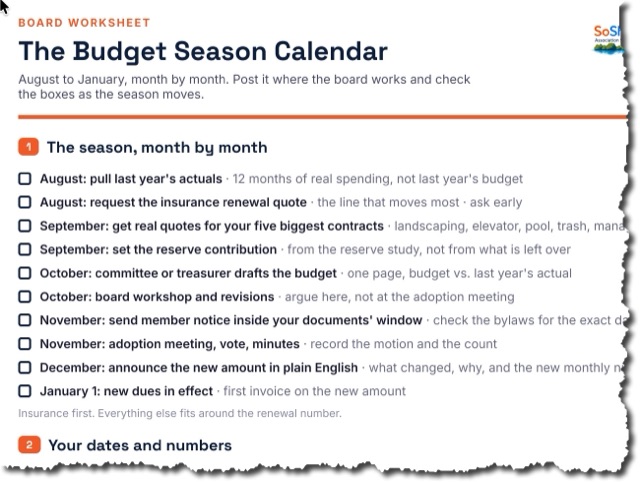
The insurance guide already asked for a one-page summary once a year: the three policies, the deductibles, and one sentence on HO-6 loss assessment coverage. Print it. Mail it. Put it on the owner portal. Budget season on this site runs August through January. Hurricane season is open now. Both clocks want this letter.
The letter is six lines:
- The building is insured for $______.
- The named-storm deductible is ______ percent, which is $______.
- Your share, under the declaration, is about $______.
- Florida requires at least $2,000 of loss assessment coverage on your HO-6. That floor is not enough for this building.
- Call your agent. Raise the limit. Ask how much of it applies to a master-policy deductible assessment.
- Do this before the National Hurricane Center names the next storm.
A homeowners association that sends this in May gets questions. A homeowners association that sends it in October gets collections. I would rather take the questions.
What the board does tonight
- Pull the current master-policy declarations page. Convert the named-storm percent to dollars. Write the number on the worksheet.
- Divide by unit count, then check the declaration for percentage interest. Write both.
- Confirm the replacement-cost appraisal is inside three years. Schedule it if it is not.
- If this board has not voted the deductible this term, put it on the next agenda under 718.111(11)(c).
- Fill the six-line letter. Send it from the owner portal. File it with the minutes.
- Tell owners to call their HO-6 agent this week, not the week a storm is named.
Keep the worksheet in the same file as the 1802 and the grant packet. The next treasurer should not have to reverse-engineer $840,000 from a premium line.
If this guide helped, the tools it describes live in SoShiny, and so does everything else a self-managed board needs. The 30-day trial is free.
This page is a plain-English summary for board members, not legal advice. For binding advice, talk to a Florida-licensed attorney. Official text: §718.111 and §627.714.
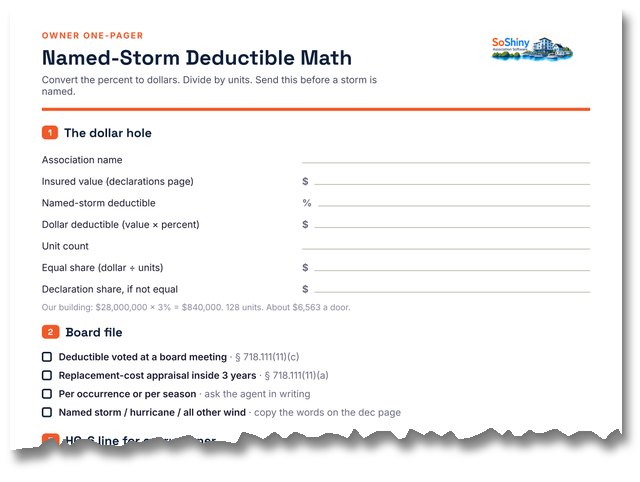
Named-Storm Deductible Math (PDF)
Insured value times the percent, the per-unit share, the HO-6 line, and the six-line owner letter. One page, made to print before a storm is named.
FAQ about HOA hurricane deductibles and your share
What is a named-storm deductible on an HOA master policy?
How do you calculate each owner's share of an $840,000 hurricane deductible?
Can a Florida condominium association assess owners for the master-policy deductible?
How much loss assessment coverage does a Florida condo owner need?
Does a wind mitigation inspection remove the named-storm deductible?
What is the difference between a named-storm deductible and a hurricane deductible?
When should the board send the deductible one-pager to owners?
Does loss assessment coverage pay any special assessment?
How often must a Florida condominium association appraise the building?
Related reading
- From the blogHOA Insurance Basics: Master Policy, HO-6, and D&O, Explained
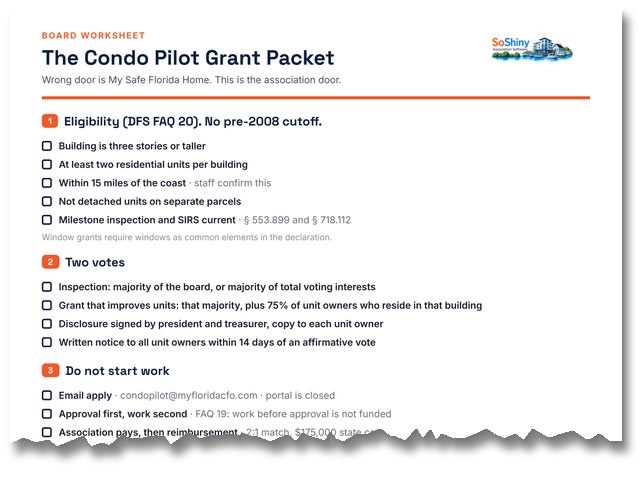
- From the blogMy Safe Florida Home Will Reject Your Condo. Here Is the fix
- From the blogSpecial Assessments: How Boards Decide, Notice, and Collect Them Fairly
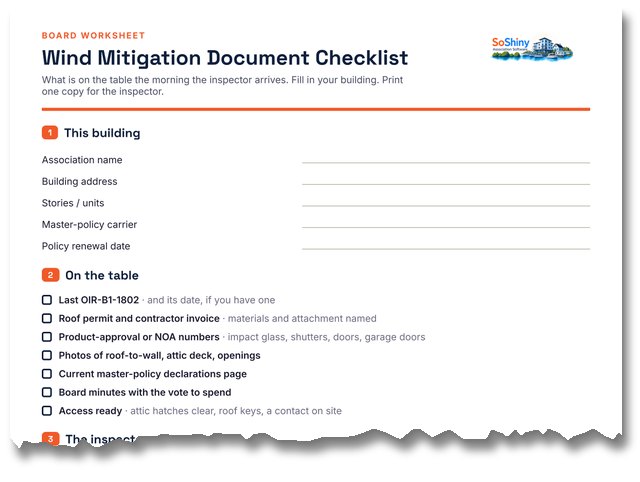
- From the blogThe Wind Mitigation Inspection: How a Florida Board Turns Form 1802 into Insurance Credits
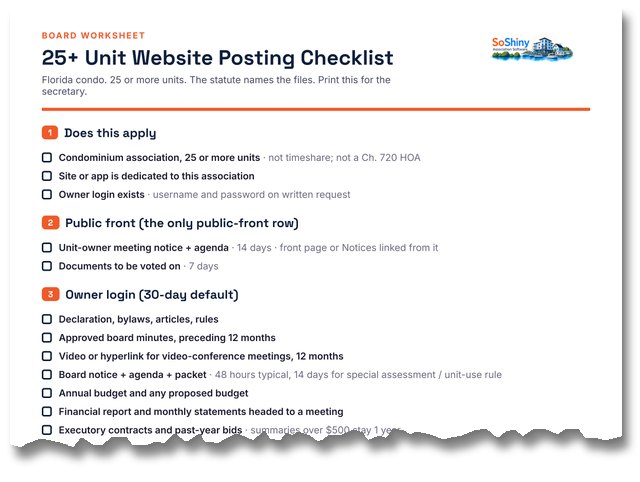
- From the blogYour Florida Condo Must Have a Website, says Statute 718.111(12)(g)
The idea of SoShiny came from a board seat. Kevin joined the board of a large condo HOA and found that one person ran the entire operation from memory. The books lived in Lotus 1-2-3, a program from the 1980s. If that person walked away, the whole community walked away with them. Something had to change. What started as a small fix grew into a full system. SoShiny now runs communities across 23 states and 3 countries.
Kevin has spent his career building teams and turning messy processes into simple products. He ships fast, coaches with candor, and favors action over talk. With SoShiny, he brings that same bias for action to an industry that still runs on spreadsheets, sticky notes, and paper announcements.
An Irish American builder and author, Kevin leads with honesty, grit, and faith. He has three sons and splits his time between Ormond Beach, Florida and Western New York.