
The HOA Budget Season Playbook: Raise Dues Without a Revolt


Two communities raised dues the same year, by the same 8 percent. In one, the meeting lasted 20 minutes and the budget passed without drama. In the other, forty owners packed the room, three board members resigned by spring, and the increase failed, so the shortfall became a special assessment a year later.
Key takeaways
- Start four months out. The revolt comes from surprise, not from the number.
- Show owners the draft before anything is final: three cost drivers, the change in dollars per month, one page.
- Price the honesty gap. A budget that skips the reserve study converts into a special assessment later.
The difference was not the number. It was the process and the timing. A dues increase announced as a done deal in December feels like an ambush. The same increase, built in public over four months, feels like arithmetic. Here is the playbook.
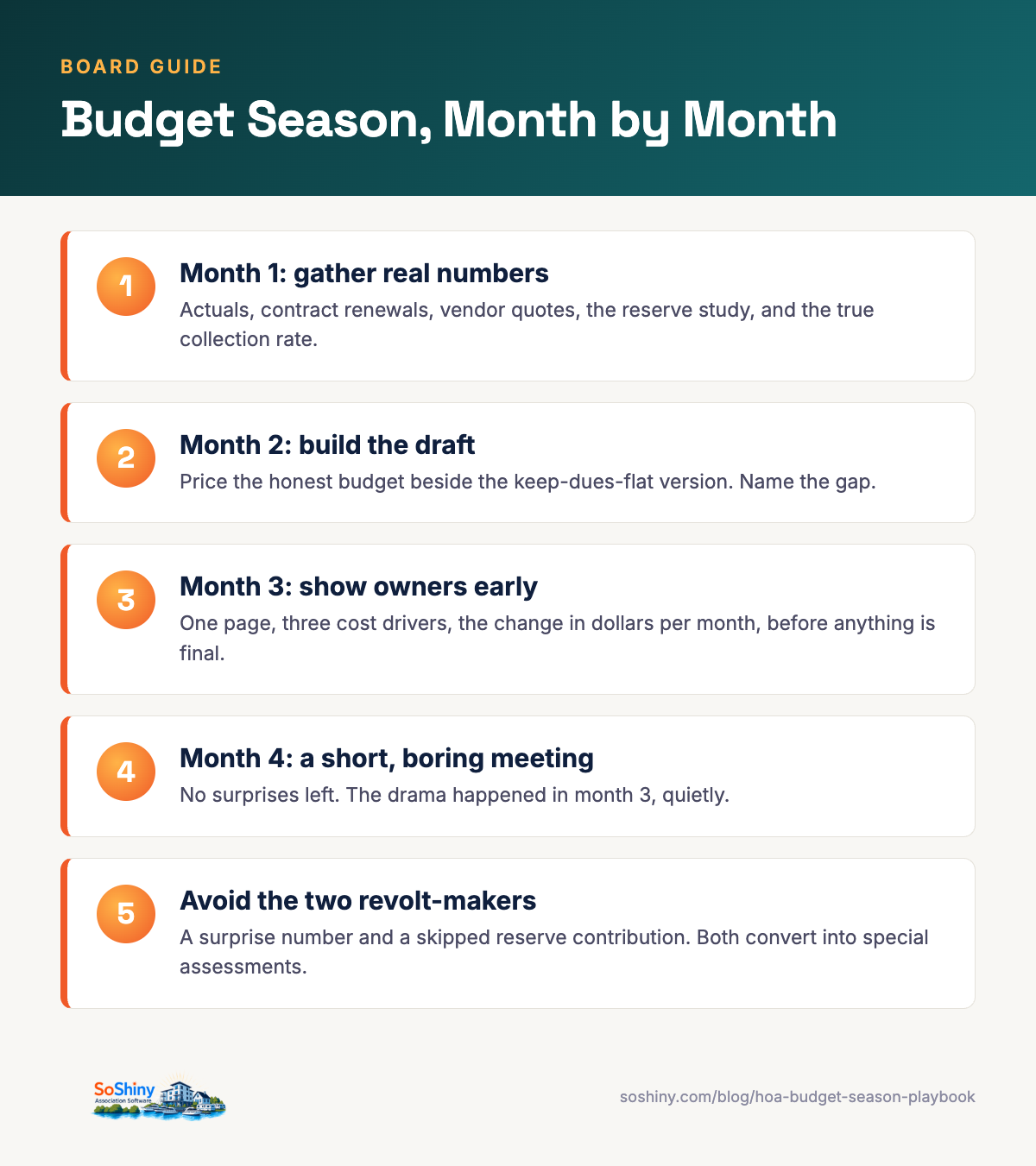
Month 1: Gather the real numbers
Budget season starts about four months before your fiscal year, so a January budget means September work. Pull four inputs:
- Actuals, not last year's budget. What did the community really spend, line by line? Last year's budget was a guess. The ledger is the truth.
- Contract renewals. Call every vendor and ask for next year's price in writing. Landscaping, insurance, trash, and pool contracts have run hot lately, and insurance alone has jumped 20 to 50 percent in some regions over recent renewal cycles.
- The reserve study contribution. The study names the annual savings target. Put the full number in the draft, and treat cutting it as the last resort, not the first.
- Delinquency reality. If 6 percent of dues never arrive, a budget assuming 100 percent collection is fiction. Budget income at your real collection rate.
Boards with a shared portal finish this month in two evenings, since actuals, contracts, and delinquency reports already sit in one place. Boards on spreadsheets spend the month reconstructing the year from bank statements. That gap is the quiet argument for better tools.
Month 2: Build the draft, and price the honesty gap
Add the lines. The total usually lands above current income, and the temptation arrives on schedule: trim the reserve line to keep dues flat. Name that move for what it is, borrowing from future owners without their consent.
Instead, put two versions side by side:
- The honest budget. Real costs, full reserve contribution, real collection rate. Say it plainly: "This requires dues of $268, up from $250."
- The consequences budget. Dues stay at $250, and the draft names exactly what gets cut and what risk grows: reserve funding drops to 60 percent of target, and the paving project moves out two years.
Boards that present a choice get engagement. Boards that present a verdict get a fight.
Month 3: Show owners early, before anything is final
This is the step angry meetings are made from skipping. Six weeks before the vote, send owners a one-page budget preview: the three numbers that moved, why, and the two versions. Invite questions by a stated date, and publish a short Q&A from what comes in.
Three writing rules for the preview:
- Lead with drivers, not totals. "Insurance went up $14,000 at renewal" lands. "Expenses rose 7.2 percent" does not.
- Translate to the monthly number. Owners think in dollars per month, so say "$18 more per month," never just percentages.
- Show the fork. The honest budget beside the consequences budget, with the special-assessment risk priced. A $3,000 future assessment makes an $18 increase look like the bargain it is.
Post the full draft in the owner document library, and note where it lives in every mailing. Transparency before the meeting empties the ambush from the room.
Month 4: Run a short, boring meeting
By meeting night, every engaged owner has seen the numbers, asked questions, and read the Q&A. The presentation takes ten minutes: the three drivers, the fork, the recommendation. Then the vote, by the method your documents require, ideally electronic so every owner can participate instead of just the twelve in the room.
Record the motion, the count, and the adopted budget in the minutes. Publish the final budget and the new dues schedule the same week, with the effective date and the autopay adjustment handled automatically for enrolled owners.
The two mistakes that create revolts
Skipping small increases until a big one is forced. Five flat years followed by a 22 percent correction reads as mismanagement, and owners are not wrong. Costs rise about 3 percent in a normal year. Small annual adjustments are the honest pattern, and they never fill a room with angry neighbors.
Hiding the numbers until the meeting. Every budget fight is really a trust fight. Owners who see actuals, contracts, and reserves all year, in a portal they can open any time, have no reason to suspect the board of anything. The budget becomes arithmetic in public, which is what it should have been all along.
Start the season with your own scoreboard
If this guide helped, the tools it describes live in SoShiny, and so does everything else a self-managed board needs. The 30-day trial is free.
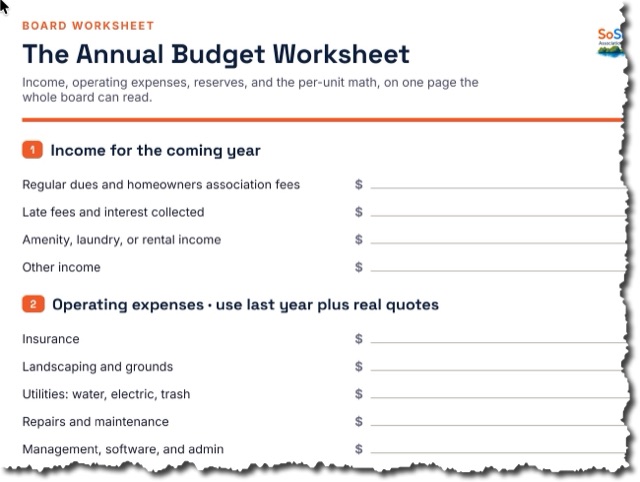
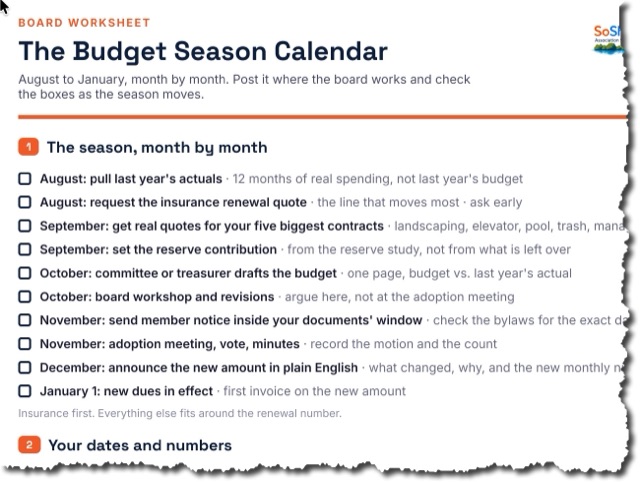
The Budget Season Calendar (PDF)
August to January, month by month: actuals, the insurance quote, real contract bids, notice, adoption, and the plain-English announcement. Post it where the board works.
FAQ about HOA budget season
When should an HOA start budget season?
How much should HOA dues increase each year?
Do owners vote on the HOA budget?
Can the board raise dues without owner approval?
What is driving HOA cost increases lately?
Should we budget for delinquencies?
What belongs in the owner budget preview?
Is it ever right to cut the reserve contribution?
How does software make budget season easier?
Related reading
- From the blogHow to Collect HOA Dues Without Chasing Your Neighbors
- From the blogSpecial Assessments: How Boards Decide, Notice, and Collect Them Fairly
- From the blogHow to Read an HOA Budget as an Owner (Not a Board Member)
- From the blogHomeowners Association Reserve Funds in Plain English
- From the blogElected to an HOA Board, Now What? Your First 30 Days
The idea of SoShiny came from a board seat. Kevin joined the board of a large condo HOA and found that one person ran the entire operation from memory. The books lived in Lotus 1-2-3, a program from the 1980s. If that person walked away, the whole community walked away with them. Something had to change. What started as a small fix grew into a full system. SoShiny now runs communities across 23 states and 3 countries.
Kevin has spent his career building teams and turning messy processes into simple products. He ships fast, coaches with candor, and favors action over talk. With SoShiny, he brings that same bias for action to an industry that still runs on spreadsheets, sticky notes, and paper announcements.
An Irish American builder and author, Kevin leads with honesty, grit, and faith. He has three sons and splits his time between Ormond Beach, Florida and Western New York.