
Self-Managed HOA or Management Company? Run the Real Numbers
Every volunteer board hits the same breaking point. The treasurer is tired, the emails never stop, and someone at the meeting says, "Maybe we should just hire a management company." The room nods. It sounds like relief.
Key takeaways
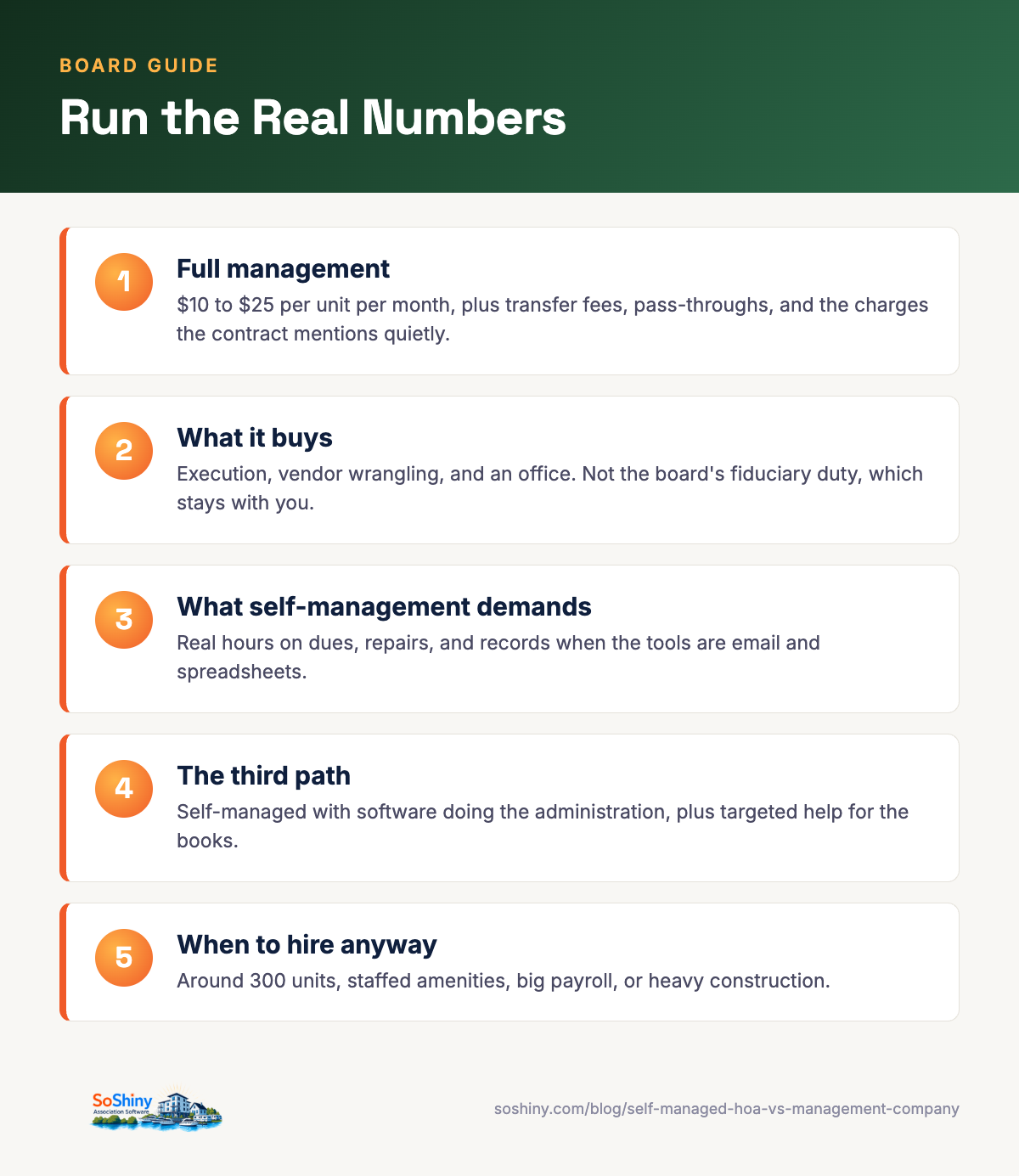
- Full management runs $10 to $25 per unit per month, plus the fees the contract mentions quietly.
- A manager executes decisions. The board keeps the fiduciary duty either way.
- The third path: self-manage with software doing the administration, and hire targeted help for the books.
Then the quotes arrive. For a 100-unit community, full management typically runs $10 to $25 per unit per month. That is $12,000 to $30,000 a year, plus fees the contract mentions quietly. Before your board votes, run the real numbers on both paths. There is a third one too.
What a management company actually costs
The monthly rate is the visible number. The full picture includes:
- Base fee. $10 to $25 per unit per month for a typical mid-size community. Call it $18,000 a year at 100 units.
- Pass-through charges. Copies, mailings, statements, and coupon books, often billed per item. Boards report $1,000 to $3,000 a year here.
- Transfer and resale fees. $150 to $400 per home sale, paid by your owners. At 8 sales a year, owners hand over $1,200 to $3,200.
- Markups. Some contracts add 5 to 10 percent on vendor invoices the manager coordinates.
- Exit terms. 60 to 90 day notice periods, and sometimes a fee to get your own records back in usable form.
A realistic all-in figure for a 100-unit community lands between $20,000 and $35,000 a year. On a $250 monthly assessment, that is roughly a 7 to 12 percent dues increase, spent on administration instead of the roof.
What you actually get for it
Fairness matters here. A good management company brings real things: a licensed manager who knows the statutes, vendor relationships, dues processing, and a buffer between the board and angry owners. For large communities with complex amenities, that value can be worth the price.
But read the contract for what it does not say. The board still makes every decision. The board still approves every budget, every rule, every special assessment. Management companies execute. They do not govern, and the legal duty stays with your directors either way.
And the common complaints are consistent: slow responses from a portfolio manager juggling 12 communities, surprise fees, and owners who feel like account numbers.
What self-management actually demands
The honest case against self-management is time. Run on email and spreadsheets, a 200-unit board loses about 13 hours a week: chasing dues, digging repair requests out of inboxes, and hunting files. Spread across five volunteers, that pace burns people out, and burned-out volunteers quit without handoffs.
The hidden risk is knowledge concentration. The ledger on one laptop. The vendor list in one inbox. Self-management fails when it runs on heroics from two people.
So the real question is not "self-manage or hire?" It is "what makes self-management sustainable?"
The third path: self-managed, with software doing the administration
Most of what a management company sells is administration: collect dues, track requests, store documents, send notices, keep records. Software now does that work for a fraction of the price.
Compare the numbers for the same 100-unit community:
- Full management: $20,000 to $35,000 a year, all-in.
- Self-managed on email and spreadsheets: $0 in fees, and roughly $17,000 a year in volunteer hours at $25 an hour, plus the risk that lives in inboxes.
- Self-managed with a portal: SoShiny runs $25 a month plus 33 cents per unit under the America 250 promo. At 100 units, that is $58 a month, about $700 a year, with every feature on every plan and a free community website included.
The portal path keeps governance where it already lives, with the board, and removes the 13 hours of administrative drag. Dues collect themselves through autopay. Repair requests arrive in a queue instead of five inboxes. Records belong to the association, so a resignation costs an afternoon instead of a quarter.
When hiring a manager is still the right call
Software does not walk the property or negotiate with a roofer. Consider full management when:
- Your community exceeds roughly 300 units with staffed amenities.
- Nobody will serve on the board at all, even with light duties.
- You face major construction litigation or a large capital project needing daily oversight.
Some boards split the difference and hire an accountant for the books or a part-time maintenance coordinator, at $3,000 to $8,000 a year, and keep the rest in the portal. That still beats full management cost by a wide margin.
How to decide at your next meeting
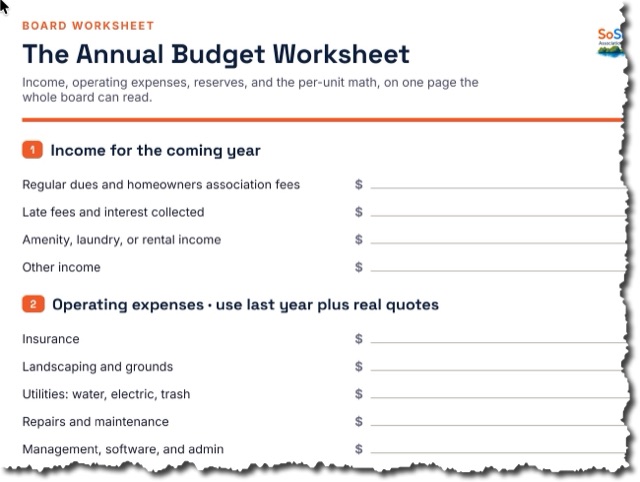
Put three numbers on one page and vote with open eyes:
- The all-in yearly quote from a management company, with every fee named.
- Your board's honest weekly volunteer hours, priced at $25 each.
- The yearly cost of a portal that removes most of those hours.
Boards that run this exercise usually find the middle path wins until they cross 300 units. The money stays in the reserve fund, the board stays in control, and the volunteers get their evenings back.
If this guide helped, the tools it describes live in SoShiny, and so does everything else a self-managed board needs. The 30-day trial is free.
Enjoying this? Get the next one by email.
Practical guides for self-managed boards, written by a board treasurer. About one a month.
FAQ about self-managed homeowners associations
How much does an HOA management company cost?
What percentage of HOAs are self-managed?
Does hiring a manager remove the board's legal responsibility?
What tasks take the most time in a self-managed HOA?
Can a small HOA afford management software?
What are transfer fees, and who pays them?
How hard is it to leave a management company?
Can we self-manage and still hire help for the books?
At what size does a community need full management?
What should we ask a management company before signing?
Related reading
- From the blogThe Confident Self-Managed Board, Part 1: The Fear of Going It Alone
- From the blogSelf-Managed vs. Management Company vs. Software: What's Right for Your Community
- From the blogHomeowners Association Reserve Funds in Plain English
- From the blogHow to Collect HOA Dues Without Chasing Your Neighbors
- From the blogThe Confident Self-Managed Board, Part 5: When You Actually Need a Management Company
Reboooot is the engineering persona behind SoShiny: a seasoned dev + UX designer who pushes back on shortcuts, proposes alternatives, and flags gaps before executing. Most product updates on the changelog ship under this byline.