
HOA Records: What to Keep, How Long, and Where


A title company requested six years of meeting minutes for a unit sale. The board could produce three. The other three lived on a past secretary's laptop, and she had moved to Oregon and stopped answering email. The sale closed late, the buyer's attorney sent a sharp letter, and the board spent a season reconstructing records it once had.
Key takeaways
- Most states expect seven years on official records. Governing documents and minutes never expire.
- Records die on personal laptops. The standard that survives turnover is an association-owned library with access levels and version history.
- A written retention policy is the only defensible way to destroy old records, and never during a dispute.
Every association runs on records, and most volunteer boards keep them the way a garage keeps boxes: everywhere, and nowhere. Here is the plain-English retention guide, and the storage habits that make it stick.
The legal baseline
Most states set retention rules for associations, commonly requiring official records be kept seven years, with some categories kept permanently. Most states give owners inspection rights too: an owner may request records, and the association must produce them within a set window, often 10 business days, with penalties for stonewalling.
Those two rules together define the job. Keep the right things long enough, and keep them findable fast.
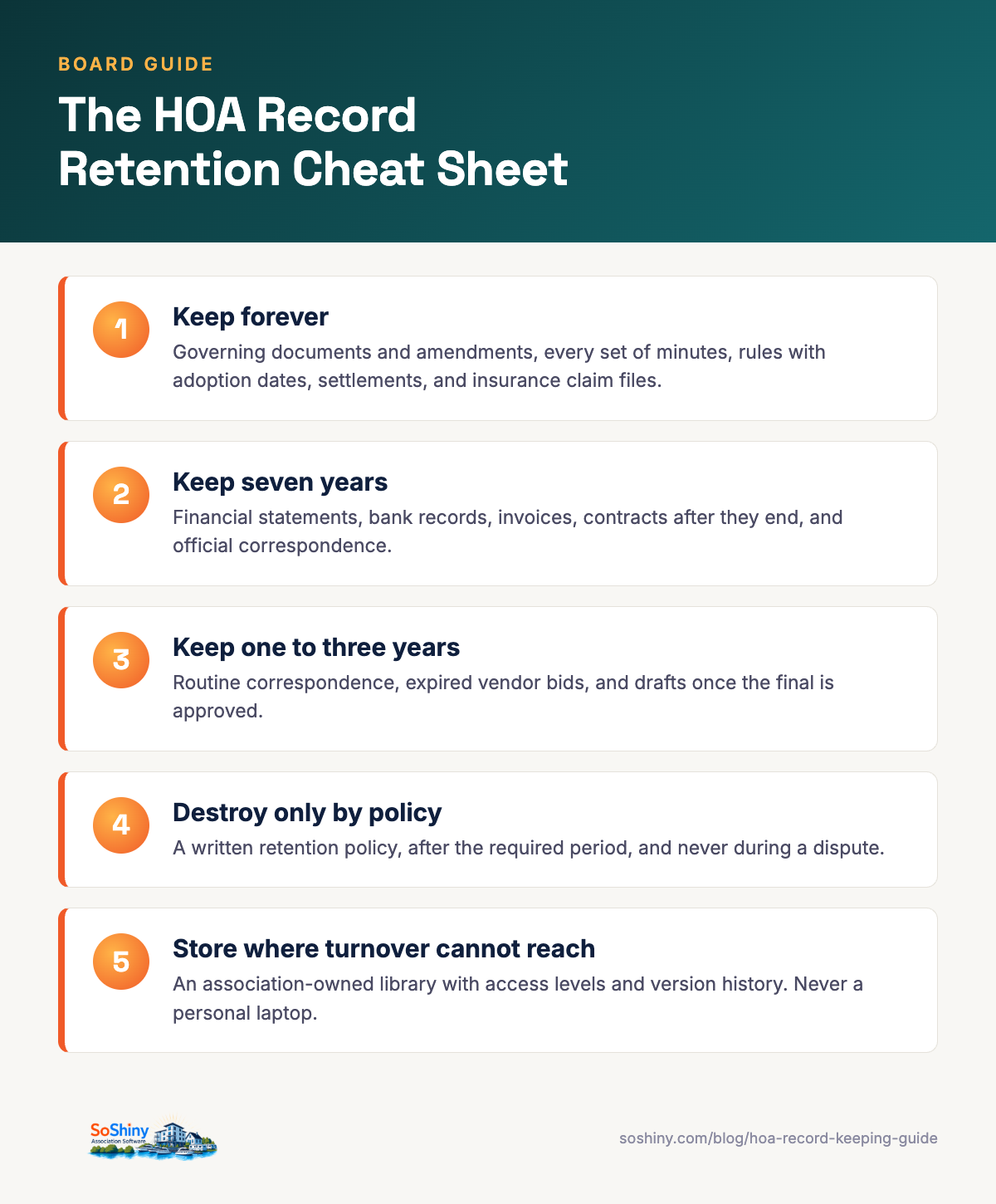
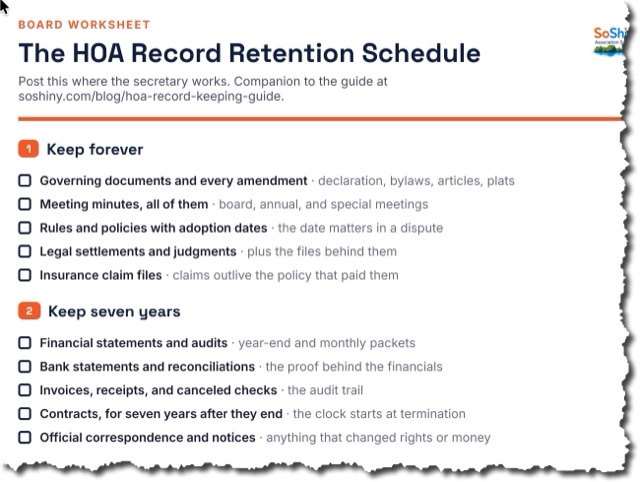
Keep forever
- Governing documents. Declaration, bylaws, articles of incorporation, plats, and every recorded amendment.
- Meeting minutes. All of them, board and membership. Minutes are the association's decision history, and old minutes settle new disputes with strange regularity.
- Rules and policies, with adoption dates. Enforcement depends on proving when a rule took effect.
- Legal outcomes. Settlements, judgments, easements, and anything recorded against the property.
- Major construction records. Warranties, as-built drawings, and contracts for roofs, paving, and structural work. A 20-year roof warranty is worthless in year 12 if nobody can produce it.
Keep seven years
- Financial records. Ledgers, bank statements, invoices, receipts, budgets, audits, and tax returns. Seven years covers most state requirements and IRS lookback.
- Owner account histories. Assessments, payments, fees, and collection correspondence.
- Contracts. Keep the life of the contract plus seven years after it ends.
- Insurance policies and claims. Policies plus seven years, and keep claim files longer when injuries were involved.
- Election records. Notices, ballots or tallies, proxies, and consents, per your state's specific rule, often shorter, but seven is a safe habit.
Keep one to three years
- General correspondence. Routine owner emails and letters that led to no decision.
- Violation files for resolved matters. Keep through resolution plus your state's period, then per policy.
- Vendor quotes not accepted. One budget cycle is plenty.
Write these categories into a one-page retention policy, adopt it by motion, and destruction becomes routine instead of suspicious. A policy-driven cleanup looks like housekeeping. An ad-hoc deletion the week a dispute starts looks like something else entirely.
Where records go to die
The retention schedule fails at the storage layer, and the failure modes repeat across communities:
- The personal laptop. The Oregon problem above. People leave, and their hard drives leave with them.
- The free email account. Ten years of association business in a Gmail owned by a past president, unreachable and unsearchable.
- The shared drive with one owner. Better, until the person who created it stops paying for it, or nobody remembers which of four folders is current.
- The banker's box. Real paper in a real attic, one water heater failure from oblivion.
The common thread: storage owned by people instead of by the association. Board turnover is guaranteed, so any system that depends on a person has a scheduled failure built in.
The storage standard that survives turnover
Five requirements, and any system the association owns can meet them:
- Association ownership. The account belongs to the HOA, and board access changes when the board changes. No personal accounts, ever.
- Access levels. Public documents for anyone, owner documents behind a login, board-only folders for executive session and legal files.
- Version history. The approved budget stays provable even after someone uploads a revision.
- Search. "Find the 2021 roof warranty" should take ten seconds, not a weekend.
- Consistent naming. One pattern, used every time: 2026-07-14-board-minutes. Future volunteers will silently thank you.
With that standard in place, the owner-records-request problem mostly disappears. Owners with access to approved minutes, budgets, and rules stop making formal requests, since the answer sits one click away. The requests that remain get fulfilled in minutes from search, inside every statutory deadline.
The one-evening migration
Getting a decade of scattered records into one library sounds like a winter project. In practice it is one evening for the core set: governing documents, three years of minutes, current budget, insurance, contracts, and the reserve study. Load those first and you cover 90 percent of real-world lookups. Backfill older years a folder at a time, whenever a rainy Saturday appears.
If this guide helped, the tools it describes live in SoShiny, and so does everything else a self-managed board needs. The 30-day trial is free.
The HOA Record Retention Schedule (PDF)
Keep forever, keep seven years, keep one to three, and the storage standard that survives board turnover. One page, made to post where the secretary works.
FAQ about HOA record keeping
How long must an HOA keep its records?
Which records should an HOA keep forever?
Can owners demand to see HOA records?
Can we charge owners for copies?
Are emails official HOA records?
Is it legal to destroy old HOA records?
Should HOA records be paper or digital?
What happens to records when the whole board turns over?
Does SoShiny handle record storage?
Related reading
- From the blogFrom Group Text to Work Order: Fix How Your HOA Handles Repairs
- From the blogHOA Meeting Minutes: What to Record, What to Leave Out
- From the blogElected to an HOA Board, Now What? Your First 30 Days
- From the blogThe Confident Self-Managed HOA Board, Part 4: Sharing the Load Without Burning Out
- From the blog5 Systems That Replace Your HOA Management Company
The idea of SoShiny came from a board seat. Kevin joined the board of a large condo HOA and found that one person ran the entire operation from memory. The books lived in Lotus 1-2-3, a program from the 1980s. If that person walked away, the whole community walked away with them. Something had to change. What started as a small fix grew into a full system. SoShiny now runs communities across 23 states and 3 countries.
Kevin has spent his career building teams and turning messy processes into simple products. He ships fast, coaches with candor, and favors action over talk. With SoShiny, he brings that same bias for action to an industry that still runs on spreadsheets, sticky notes, and paper announcements.
An Irish American builder and author, Kevin leads with honesty, grit, and faith. He has three sons and splits his time between Ormond Beach, Florida and Western New York.