
How to Read an HOA Budget as an Owner (Not a Board Member)

The budget packet shows up in the fall, and most owners read exactly one line: the new monthly dues. I understand the impulse. I'm a board member and the treasurer of a 128-unit oceanfront condo in Florida, and I build that packet every year. This guide is the view from the other side of the table. Twenty minutes with the right three numbers will tell you more about your community's health than an hour of meeting gossip.
Key takeaways
- Your dues are arithmetic, not opinion: the total budget divided among the units. To argue for lower dues, name the line you would cut.
- The reserve contribution is the most honest line in the packet. Somewhere between 15 and 40 percent of the budget is typical. Near zero means a special assessment is coming, someday, to you.
- Three numbers do most of the work: the reserve line, the delinquency picture, and the insurance change from last year.
Start with the arithmetic nobody shows you
Our budget for 2026 is about $1.34 million. Divide by 128 units and you get roughly $10,500 a year, about $875 a month per unit. That is the entire secret of how dues get set. The board does not pick a dues number and hope. It adds up the bills, adds the reserve contribution, and divides by the units. Condo documents weight the split by unit share, so a penthouse pays more than a studio, but the principle holds.
Two things follow. Dues only move when a line item moves. And any owner who wants lower dues is really asking to cut a line: fewer flowers, a cheaper elevator contract, a smaller reserve deposit. Naming the line makes the conversation honest.
Two buckets: operating and reserves
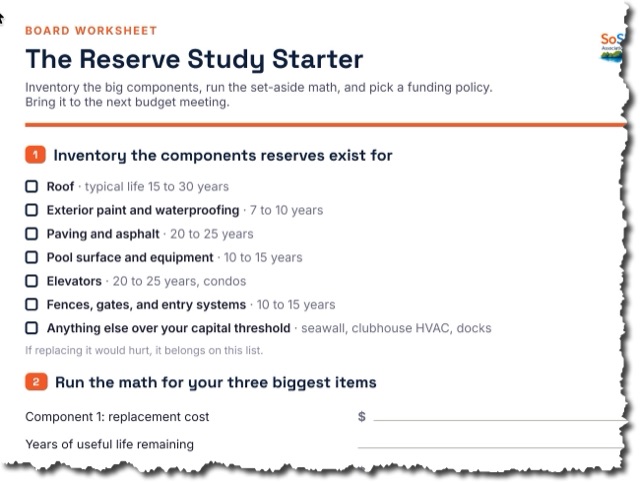
Every association budget splits into two buckets. Operating money pays this year's bills: insurance, landscaping, the water bill, the elevator contract. Reserve money is savings for things that wear out on a schedule: the roof, the paint, the seawall, the elevators themselves. Our building faces the Atlantic, so concrete restoration sits at the top of that list.
The operating side keeps the lights on. The reserve side decides your financial future. A board can fund reserves honestly, or it can keep dues low and let the gap grow, and both look identical on the dues line for years. I wrote a longer explainer on budgets and reserves in plain language if you want the deeper version.
The line items, translated
- Insurance. Our single biggest line at about $412,000, roughly 30 cents of every dues dollar. Florida coastal property drives it. A one-year jump here explains most dues increases in this state.
- Contracts. Elevator, landscaping, pool, pest control, management if you have one. Steady numbers, and worth re-bidding every two or three years.
- Utilities. Common-area power, water, trash, and internet for the office and the cameras.
- Administrative. Legal, accounting, the annual review or audit, software, postage. Small lines that add up to real money.
- Bad debt. Money the board expects to bill and never collect. We budget about two units' worth of dues here. A missing bad-debt line in a community with known delinquency is optimism pretending to be a budget.
- Reserve contribution. The transfer to savings. The one line where lower is not better.
The three numbers I check first
Read any budget, ours included, in this order.
1. The reserve contribution as a share of the total. Between 15 and 40 percent of the budget is the common range. Our packet runs about 21 percent, $280,000 a year, and the reserve study tells us that is still catch-up, not luxury. A contribution near zero does not mean the roof got cheaper. It means the board moved the cost onto a future special assessment.
2. The delinquency picture. Look for a bad-debt line, an aged receivables page, or a delinquency note. Industry surveys put underfunded reserves in about 70 percent of associations, and delinquency is the same story in miniature. When more than 10 percent of owners are behind, everyone else's dues quietly cover the gap.
3. Insurance against last year. Put the two budgets side by side and read one line. Our insurance rose 34 percent in a single renewal a few years back, and that one line moved dues more than every other line combined. An increase with a named cause is not mismanagement. It is Florida.
Red flags, and normal noise
- A fat miscellaneous line. Anything above 2 or 3 percent of the budget with no explanation deserves a written question.
- Actual spending beating the budget by 10 percent or more across several lines, year after year. One bad line is life. A pattern is weak forecasting.
- Reserve money paying operating bills. Borrowing from the roof fund for the water bill is the loudest warning a budget can give.
- No reserve study, or one older than five years. Without one, the reserve number is a guess.
- A special assessment every couple of years. That is a structural dues shortfall wearing a costume.
Now the normal noise. A single line spiking with a named cause. A small variance in either direction. An insurance jump the whole state felt. Boards are volunteers forecasting a year ahead, and small misses are the job working as designed, not a scandal.
How to ask about it without starting a war
Send a written question before the meeting, and name the line. "Insurance went from $362,000 to $412,000. What changed at renewal?" beats "why are dues so high" every time. Specific questions get specific answers, and they tell the board the packet is being read, which sharpens next year's numbers.
Florida gives owners real teeth here. The budget, the reserve study, the monthly financials, and the bank statements behind them are official records, and owners have a statutory right to inspect them. Our guide to Chapters 718, 719, and 720 covers those rights. The annual meeting is the natural moment to ask in person, and our annual meeting checklist shows how that night should run.
And a word from the other side of the table: treasurers love the owner who asks about the reserve line. It means one more vote for funding the future honestly.
The twenty-minute annual read
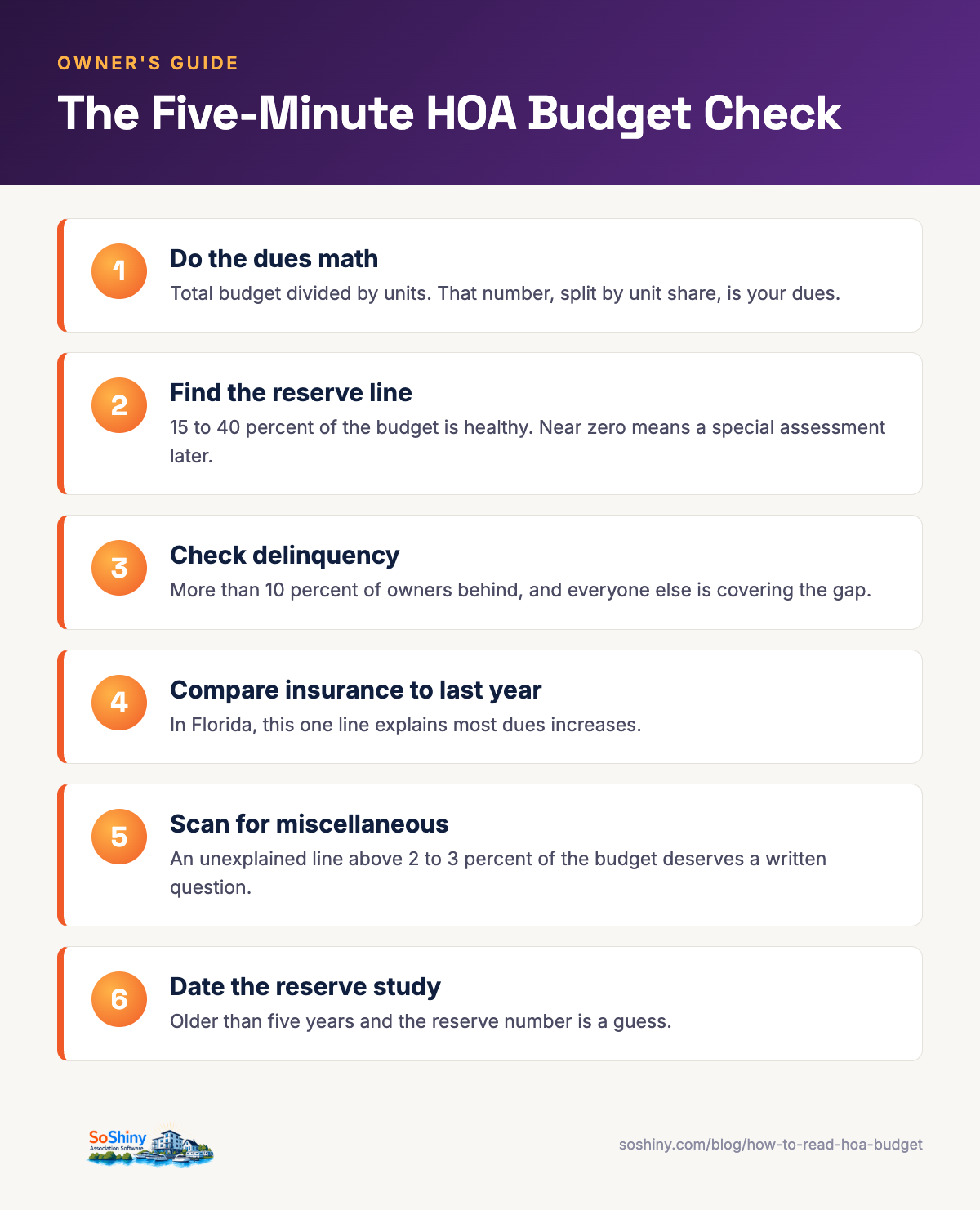
When the packet arrives, find the total and do the division. Check the reserve percentage. Find the bad-debt line. Compare insurance to last year. Scan for a miscellaneous line. Then write down one question and send it in writing. Done. You now know more about your community's finances than 90 percent of your neighbors, and your board knows someone is reading.
Boards that expect to be read publish more. The communities that put the budget, the monthlies, and the reserve study in a shared owner portal have shorter meetings and calmer elections. Ours does.
If this guide helped, the tools it describes live in SoShiny, and so does everything else a self-managed board needs. The 30-day trial is free.
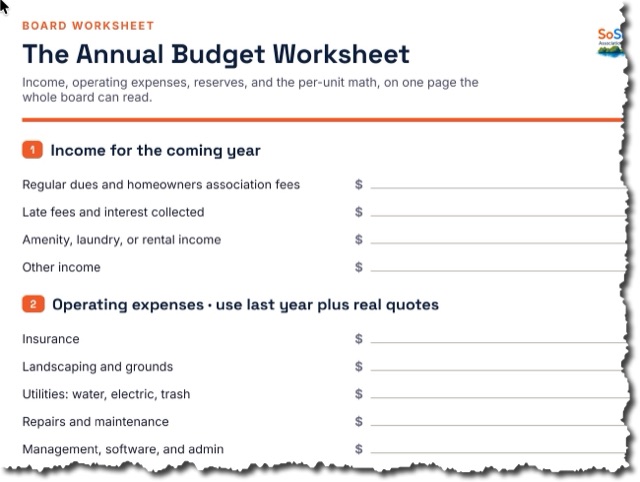
The Annual Budget Worksheet (PDF)
Income, operating expenses, the reserve contribution, and the per-unit math, on one page the whole board can read before the adoption meeting.
FAQ about reading an Homeowners Association budget
How are HOA dues calculated?
What is the difference between the operating budget and reserves?
What percentage of an Homeowners Association budget should go to reserves?
Can owners see the HOA budget and financial records?
What are the biggest red flags in an Homeowners Association budget?
Why did my dues go up when nothing in the community changed?
What is bad debt in an HOA budget?
What is a special assessment?
Related reading
- From the blogHOA Budgets and Reserves in Plain Language
- From the blogHomeowners Association Reserve Funds in Plain English
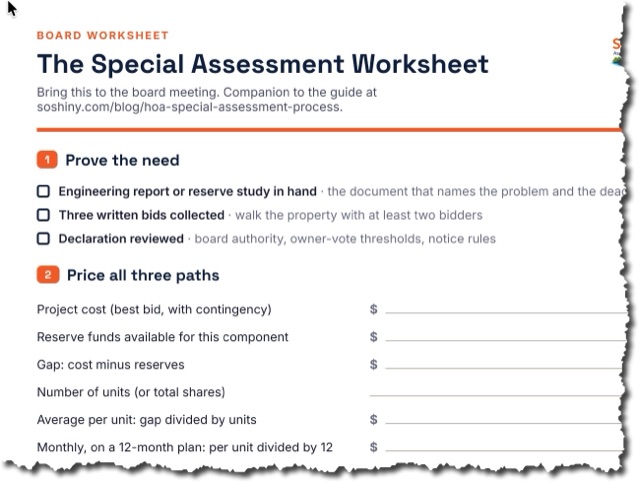
- From the blogSpecial Assessments: How Boards Decide, Notice, and Collect Them Fairly
- From the blogHOA Insurance Basics: Master Policy, HO-6, and D&O, Explained
- GlossaryReserve Fund
The idea of SoShiny came from a board seat. Kevin joined the board of a large condo HOA and found that one person ran the entire operation from memory. The books lived in Lotus 1-2-3, a program from the 1980s. If that person walked away, the whole community walked away with them. Something had to change. What started as a small fix grew into a full system. SoShiny now runs communities across 23 states and 3 countries.
Kevin has spent his career building teams and turning messy processes into simple products. He ships fast, coaches with candor, and favors action over talk. With SoShiny, he brings that same bias for action to an industry that still runs on spreadsheets, sticky notes, and paper announcements.
An Irish American builder and author, Kevin leads with honesty, grit, and faith. He has three sons and splits his time between Ormond Beach, Florida and Western New York.