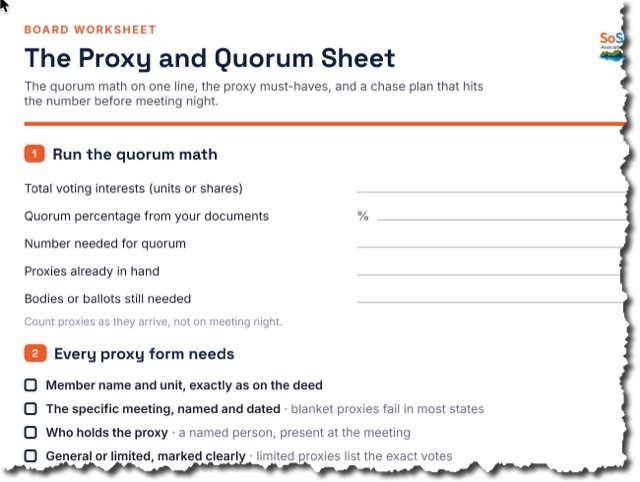

My Safe Florida Home Will Reject Your Condo. Here Is the fix

A unit owner in our building emailed Florida last spring for a My Safe Florida Home grant. The reply came back in a week. Condos are not eligible. She forwarded me the rejection and asked why the board had not told anyone.
I am a board member and the treasurer of a 128-unit oceanfront homeowners association (HOA). We are a condominium association in Florida. Our master policy costs $412,000 a year, about 30 cents of every dues dollar. Owners hear "Florida grant" and they go to the house program. That program is for a single-family, site-built, owner-occupied house with a homestead exemption. A condo unit fails those tests.
The other door is the My Safe Florida Condominium Pilot. The association applies. The inspection is free. The grant is a 2-to-1 match, up to $175,000 per association. This is the packet I wish we had printed the night that rejection arrived.
Key takeaways
- My Safe Florida Home rejects condo units. Do not send owners to mysafeflhome.com for the building.
- The association door is the My Safe Florida Condominium Pilot. Apply by email to condopilot@myfloridacfo.com. The portal is closed.
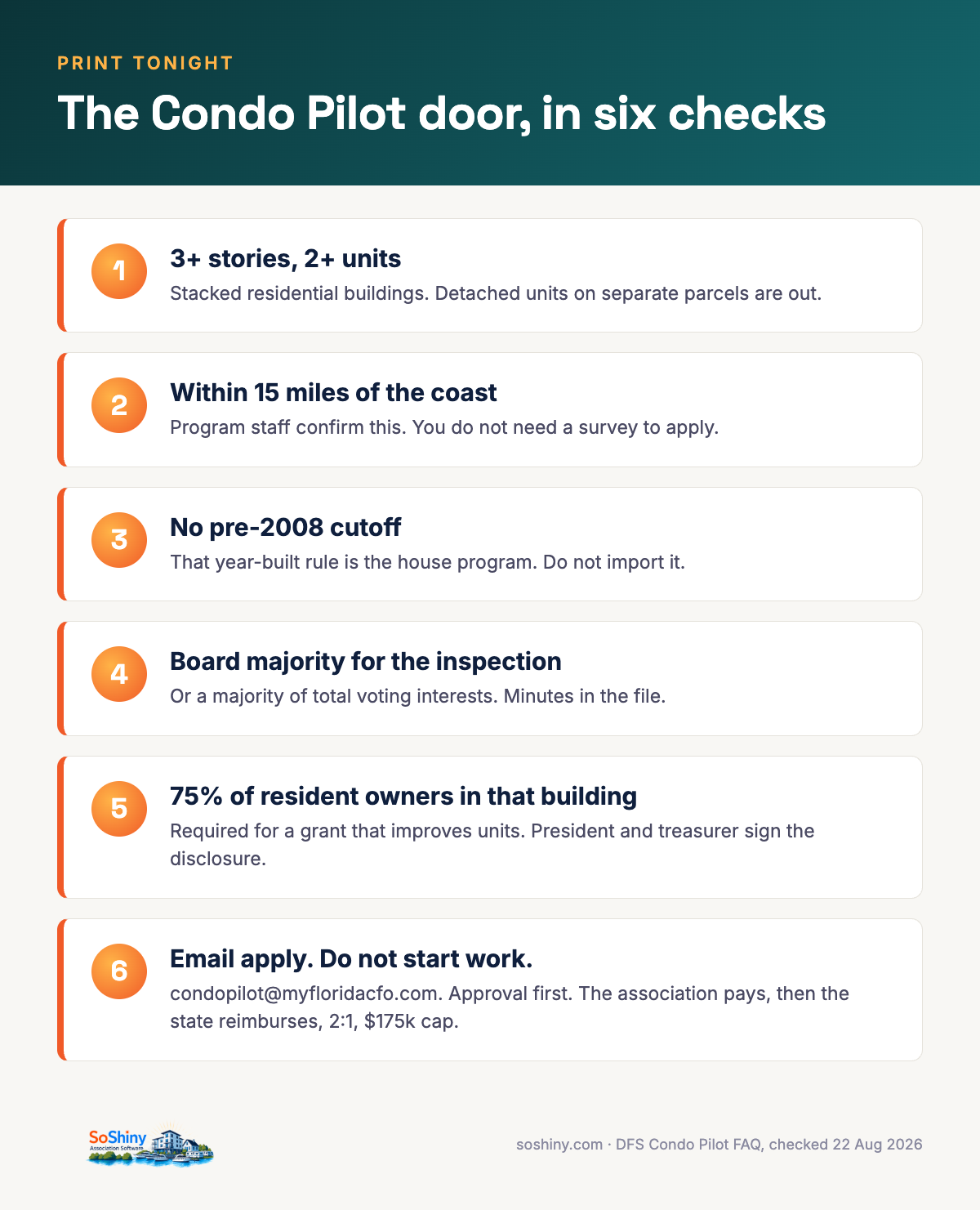
- DFS eligibility: three stories or taller, at least two residential units, within 15 miles of the coast, not detached units on separate parcels. There is no pre-2008 cutoff on this program.
- Two votes. A board majority, or a majority of total voting interests, for the free inspection. A grant that improves units needs 75 percent of unit owners who reside in that building.
- Do not start work before grant approval. The association pays first. The state reimburses.
Two programs, two doors
Florida runs two wind-mitigation grant programs with similar names. Boards and unit owners mix the two programs up. Vendor blogs mix them up and then paste a year-built rule that belongs to the house program.
My Safe Florida Home is the house door. Florida Statute 215.5586 limits the free inspection to a single-family detached home or a townhouse, site-built and owner-occupied, with a homestead exemption. Condominiums sit on the ineligible list with co-ops, mobile homes, rentals, and second homes.
My Safe Florida Condominium Pilot is the association door. Florida Statute 215.55871. A unit owner takes part through a grant awarded to the association. A unit owner does not apply alone. That is FAQ 4 on the Department of Financial Services Condo Pilot page.
A homeowners association of detached houses is not this program either. The statute excludes detached units on individual parcels. This packet is for a condominium association with stacked buildings.
Who the Condo Pilot actually serves
Copy these four tests from DFS FAQ 20. Do not copy them from a contractor's blog.
- The building is three stories or taller.
- It has at least two residential units per building.
- It sits within 15 miles of the coast. Program staff confirm this. You do not need a survey to apply.
- The building is not detached units on separate parcels.
There is no year-built cutoff. There is no pre-2008 permit rule. That rule is a My Safe Florida Home grant rule under § 215.5586(2)(a)4. Vendor posts keep pasting it onto condos. It does not belong here.
The statute adds two tests FAQ 20 leaves out. The association must already be current on its milestone inspection under § 553.899 and its structural integrity reserve study under § 718.112(2)(g) and (h). Window grants require the windows to be common elements in the declaration. Read the declaration before you promise owners new glass.
Our building is 128 units, oceanfront, Daytona Beach. We clear the four FAQ tests. The milestone and SIRS files sit next to this packet. You need both files current before you apply. They do not replace the grant packet.
Two inspections, two different people
Do not book one inspector for both jobs.
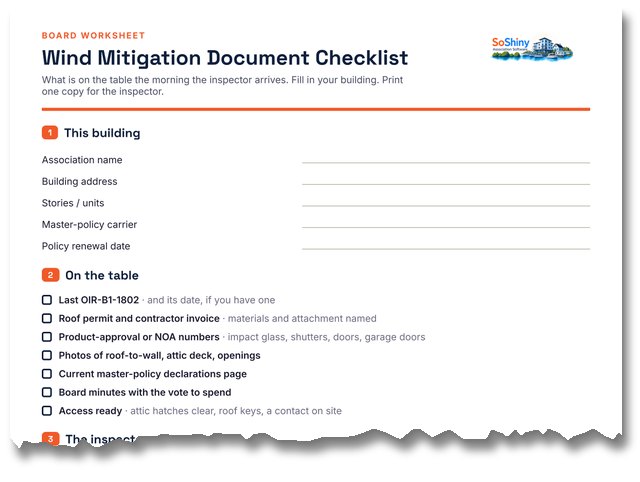
The master-policy wind mitigation inspection is Form OIR-B1-1802. The association hires someone on the § 627.711 list. That form puts credits on the policy the board already buys. Our insurance guide is where that $412,000 line lives.
The Condo Pilot inspection is assigned by DFS. FAQ 6 is blunt: you cannot use your own inspector. A contracted Wind Certification Entity walks the building. The report includes an 1802, and the Type II/III form on a mid-rise, plus cost ranges and estimated premium discounts. The inspection is free for an eligible association.
The association can take the free inspection and stop there. No grant is required. A report that already shows the building is credit-compliant goes to the agent. There is nothing to improve, so there is no grant.
The two votes, in order
Vote one is the inspection. A majority of the board of administration, or a majority of the total voting interests of the association, must approve applying. Put it on a regular agenda. Record the count in the minutes.
Vote two is the grant, and only for work that improves units. You need that board or voting-interest majority again. You then need at least 75 percent of all unit owners who reside within the building that is the subject of the grant. Not 75 percent of every owner in the association. Not a unanimous building. Resident owners in that building.
Before the unit-owner vote, DFS requires a disclosure form signed by the president and the treasurer. A copy goes to each unit owner. The signed form and the minutes are official records of the homeowners association. Within 14 days of an affirmative vote, written notice goes to all unit owners the same way you notice a board election. Our online voting guide is the mechanics. Our records guide is where the packet lives after the meeting.
The 75 percent number is the reason this takes a month, not a weekend. Start the owner conversation the same week the inspection report arrives.
The money, and the line you cannot cross
The match is $2 from the state for every $1 the association spends. The state's cap is $175,000 per association. Roof work and opening protection can both sit under that cap.
It is reimbursement. FAQ 16: the program does not send money up front. The association pays the contractor. Then you apply for reimbursement after a final inspection.
FAQ 19 is the line boards trip over. "Any work done prior to Grant Application approval will not qualify for grant funding." Do not let the roofer start. Do not let the window company cut openings to save time. Approval first. Work second.
The association's share of the match has to come from somewhere. Reserves, the operating budget, or a special assessment. Run that math before you promise owners a free roof. A $262,500 job that draws the full $175,000 state share still leaves $87,500 on the association. On 128 units that is about $684 a unit, plus whatever the grant will not cover.
Grant funds cannot pay an insurance deductible. They cannot reinstall the same type of improvement already on the building. Opening protection means every opening the report recommends. Already-protected windows are not reimbursed. The association must actually receive a mitigation credit. The final report, including OIR Form 1802, goes to the carrier.
Your own licensed, permitted contractor is allowed. The program will not pick the vendor and will not mediate a dispute. A homeowners association that skips the bid file is on its own.
Apply by email. Bring this packet.
The live DFS page is current. The older association guide still talks about a portal. The portal is closed. Email condopilot@myfloridacfo.com. Phone (850) 413-2971. They return calls within 48 hours.
For the inspection application, FAQ 5 asks for the association name and address, an authorized representative, property details, the insurance declaration page, and the board voting results. The president attests under penalty of perjury that the association submitted only one application per property.
Build the file the week before you email:
- Board minutes with the inspection vote
- Current master-policy declarations page
- Declaration pages that name windows as common elements (for a glass request)
- Proof the milestone inspection and SIRS are current
- Building specs: stories, unit count, address
- After the report: the 75 percent resident-owner vote, the signed disclosure, the 14-day notice
The six program steps are inspection application, initial inspection, grant application, final inspection, reimbursement application, then grant funds. Future funding depends on the pilot. Send the file you have. Do not wait for a portal that is not coming back.
If this guide helped, the tools it describes live in SoShiny, and so does everything else a self-managed board needs. The 30-day trial is free.
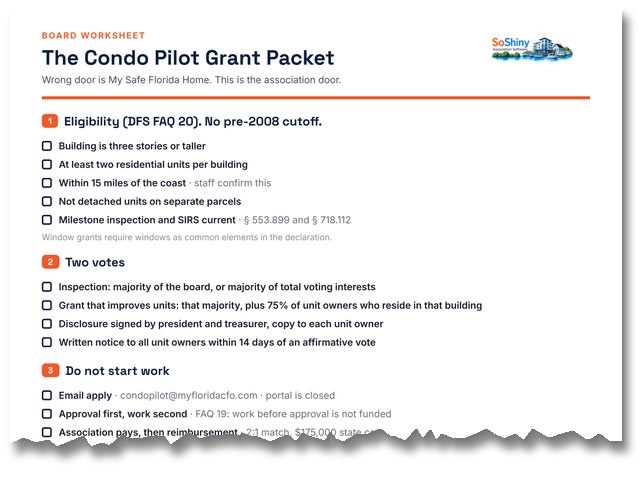
The Condo Pilot Grant Packet (PDF)
Eligibility, the two votes, the do-not-start-work rule, and the documents to email. One page for the board packet the night you apply.
FAQ about My Safe Florida Home vs the Condo Pilot
Can a condo unit owner apply to My Safe Florida Home?
What is the My Safe Florida Condominium Pilot?
Which Florida condos are eligible for the Condo Pilot?
Does the Condo Pilot have a pre-2008 cutoff?
How does a condominium association apply right now?
Do we need a unit-owner vote for the free inspection?
Can we use our own inspector for the Condo Pilot?
Can we start roof or window work before the grant is approved?
How much money can a homeowners association get?
Related reading
- From the blogThe Wind Mitigation Inspection: How a Florida Board Turns Form 1802 into Insurance Credits
- From the blogYour Building's Hurricane Deductible Is $840,000. Here Is Your Share.
- GlossaryMy Safe Florida Condominium Pilot
- From the blogYour Florida Condo Must Have a Website, says Statute 718.111(12)(g)
- From the blogHOA Insurance Basics: Master Policy, HO-6, and D&O, Explained
The idea of SoShiny came from a board seat. Kevin joined the board of a large condo HOA and found that one person ran the entire operation from memory. The books lived in Lotus 1-2-3, a program from the 1980s. If that person walked away, the whole community walked away with them. Something had to change. What started as a small fix grew into a full system. SoShiny now runs communities across 23 states and 3 countries.
Kevin has spent his career building teams and turning messy processes into simple products. He ships fast, coaches with candor, and favors action over talk. With SoShiny, he brings that same bias for action to an industry that still runs on spreadsheets, sticky notes, and paper announcements.
An Irish American builder and author, Kevin leads with honesty, grit, and faith. He has three sons and splits his time between Ormond Beach, Florida and Western New York.