
How to Run an HOA Vote Online and Hit Quorum on the First Try


A 150-unit community scheduled its annual election for a Tuesday night in the clubhouse. Nineteen owners showed up. Quorum required 76. The board rescheduled, mailed a second notice at a cost of $340, and got 31. It took three attempts and eleven weeks to elect two directors.
Key takeaways
- The quorum problem is format, not apathy. Owners vote when voting takes two minutes from a phone.
- Confirm the statute and your documents first, clean the voter roll second. The rest is announcements and reminders.
- Keep the packet: notice, consents, roll, participation, certified totals. The record ends arguments.
The problem was never apathy. It was format. Owners were willing to vote. They were unwilling to spend a Tuesday night in a folding chair to do it. Move the ballot to their phones and the math flips. Here is how to run it.
First, confirm you are allowed to vote electronically
Most states now permit electronic voting for associations, but the rules vary. The common requirements look like this:
- The owner consents to vote electronically, usually by opting in once.
- The system verifies who cast each ballot.
- Secret ballots stay secret where the law requires it, as in many director elections.
- Paper remains available for owners who want it.
Read your state statute and your bylaws before the first vote. Some older bylaws require mailed ballots, and boards can usually amend that once owners see the alternative work.
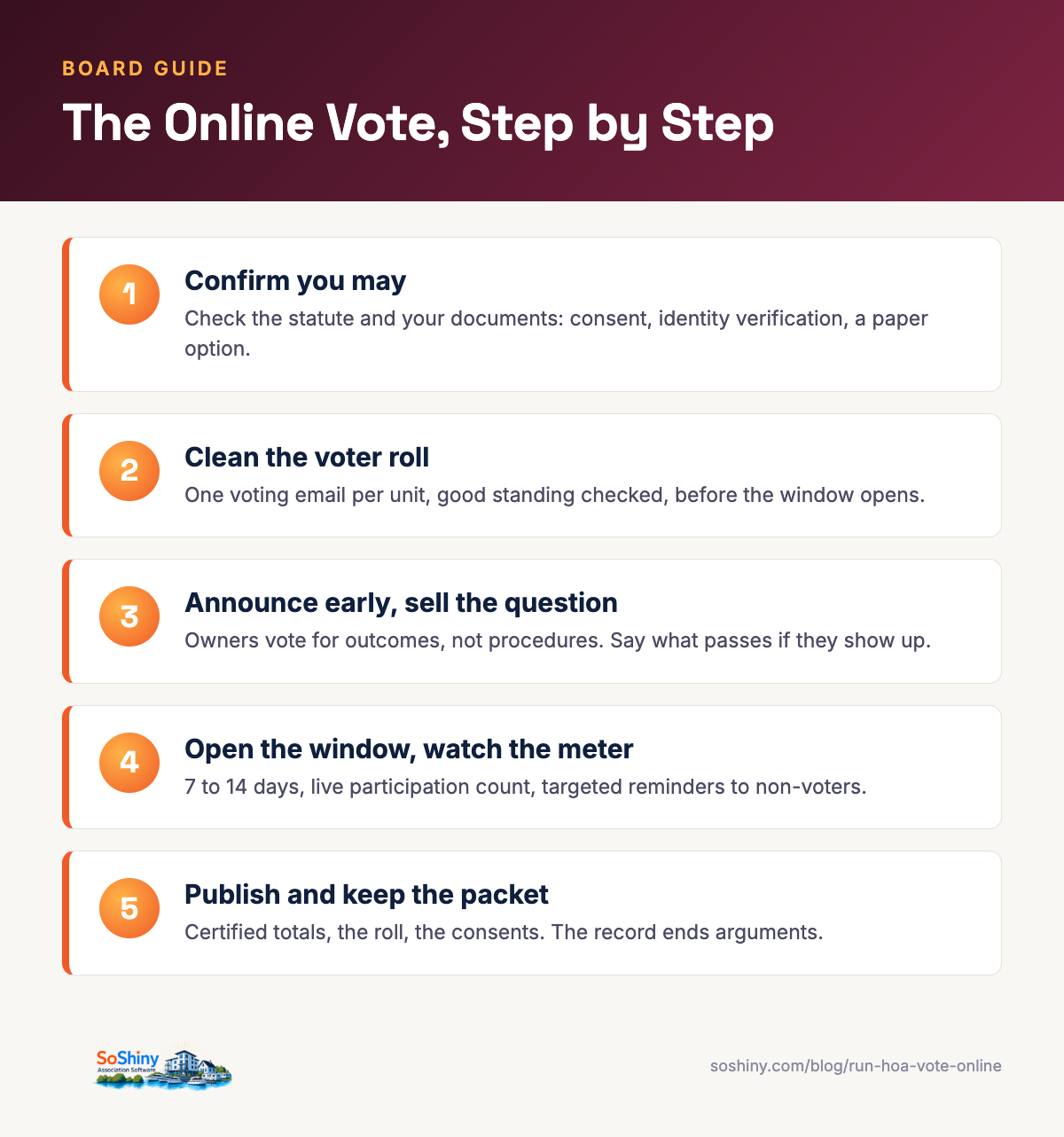
Step 1: Clean the voter roll before anything else
Every voting mess traces back to a dirty roll. Who owns unit 42 after the March sale? Which of the two co-owners casts the vote? Is the investor-owned unit in good standing?
Build one list with unit number, owner of record, one voting email per unit, and standing status. Do this two weeks out. A clean roll makes verification automatic and challenges rare.
Step 2: Announce early, and sell the question
Notice requirements set your floor, often 10 to 30 days. Beat the floor. Owners vote on things they understand, so the announcement should sell the question, not just state it.
Bad notice: "Annual meeting, March 12, elections and budget ratification." Good notice: "Two board seats are open, three neighbors are running, and the budget holds dues flat. Voting takes 90 seconds from your phone."
Send it three times: at the legal deadline, one week out, and the morning voting opens. Each send includes the direct voting link.
Step 3: Open the window, then watch the meter
Online voting turns election night into an election window, commonly 7 to 14 days. The moment it opens, live quorum tracking becomes your best tool. You can see, any hour of any day, exactly how many ballots are in.
That changes board behavior. At 40 percent with five days left, you send a nudge to non-voters only. Voters stop getting reminders the moment they vote, so nobody gets nagged twice. Boards using this pattern routinely hit quorum days before the deadline.
Compare that to the paper world, where the board learns the turnout number at 7:02 pm on meeting night, when it is too late to do anything but reschedule.
Step 4: Count in minutes, publish with confidence
Paper counts take a volunteer committee an evening, and every recount finds a different number. An electronic count is instant and repeats to the same total every time.
When the window closes, the system reports: ballots cast, quorum met or not, and results per question. Publish the outcome to owners the same day. Fast, visible results build the trust that makes the next vote easier.
Step 5: Keep the record that ends arguments
The vote that matters is the one someone challenges. A year from now, an owner claims the special assessment never passed properly. What do you produce?
A well-run electronic vote hands you the whole file in one place: the notice and send dates, the consent records, the voter roll used, who cast a ballot and when, and the certified totals. The dispute ends in one email with one attachment.
Keep the file with your minutes for as long as your state requires association records, commonly seven years.
What about proxies?
Proxies exist to solve a paper problem: the owner cannot attend, so someone carries her vote. Direct electronic ballots solve the same problem better. The owner votes herself, from anywhere, and no proxy forms get lost, forged, or miscounted.
Many associations keep proxies available for the rare owner who wants one, and watch proxy usage fall to near zero within two cycles.
The turnout numbers boards actually see
Across self-managed communities, the pattern repeats. Paper-and-meeting turnout runs 15 to 35 percent. The first electronic vote typically lands at 50 to 70 percent. One 90-unit association went from three failed quorum attempts to 68 percent turnout in nine days, with the treasurer spending under an hour on the whole process.
Higher turnout is not just convenient. Decisions made by 65 percent of owners carry weight. Nobody claims a "small clique" runs the community when two-thirds of it voted.
Run your first one this quarter
Pick a low-stakes question for the first electronic vote, like meeting-date preferences or a landscaping choice. Let owners learn the tool where nothing is at risk. Then run the budget or the election on it with confidence.
If this guide helped, the tools it describes live in SoShiny, and so does everything else a self-managed board needs. The 30-day trial is free.
Enjoying this? Get the next one by email.
Practical guides for self-managed boards, written by a board treasurer. About one a month.
FAQ about online HOA voting
Is online HOA voting legal?
What is quorum, and what happens if we miss it?
Can ballots stay secret in an online election?
How do we handle owners without email or smartphones?
How long should the voting window stay open?
Who is eligible to vote when a unit has two owners?
Can owners who are behind on dues vote?
What records should we keep after the vote?
Do we still need an annual meeting if voting happens online?
Does SoShiny include voting?
Related reading
- From the blogThe HOA Annual Meeting Checklist: Notices, Quorum, and the Night Itself
- From the blog5 Systems That Replace Your HOA Management Company
- From the blogHow to Actually Reach a Quorum: Running Board Votes Online
- From the blogHOA Meeting Minutes: What to Record, What to Leave Out
- FeatureVoting & Ballots
The idea of SoShiny came from a board seat. Kevin joined the board of a large condo HOA and found that one person ran the entire operation from memory. The books lived in Lotus 1-2-3, a program from the 1980s. If that person walked away, the whole community walked away with them. Something had to change. What started as a small fix grew into a full system. SoShiny now runs communities across 23 states and 3 countries.
Kevin has spent his career building teams and turning messy processes into simple products. He ships fast, coaches with candor, and favors action over talk. With SoShiny, he brings that same bias for action to an industry that still runs on spreadsheets, sticky notes, and paper announcements.
An Irish American builder and author, Kevin leads with honesty, grit, and faith. He has three sons and splits his time between Ormond Beach, Florida and Western New York.