
How to Actually Reach a Quorum: Running Board Votes Online


I sit on the board of a 128-unit oceanfront condo in Florida. For years our most reliable annual tradition was failing to reach quorum. Owners cared. They were just a thousand miles north when the meeting happened. Ask any board what stalls them most and you hear a version of this story. People miss the meeting. Proxies pile up on the lobby table. The budget waits another month. As treasurer, I have watched a fiscal year start without a ratified budget for this exact reason. Online voting fixed it for us. It gives you something paper never did: a record nobody can dispute.
- Key takeawaysEmail votes scatter and in-person meetings miss too many owners. Both give you a fuzzy count and a weak record.
- Online voting tracks a live quorum and stores the result forever, anonymous or attributed.
- A one-to-two-week ballot window plus a single reminder lifts turnout by double digits over a 48-hour rush.
Why paper and email votes fail
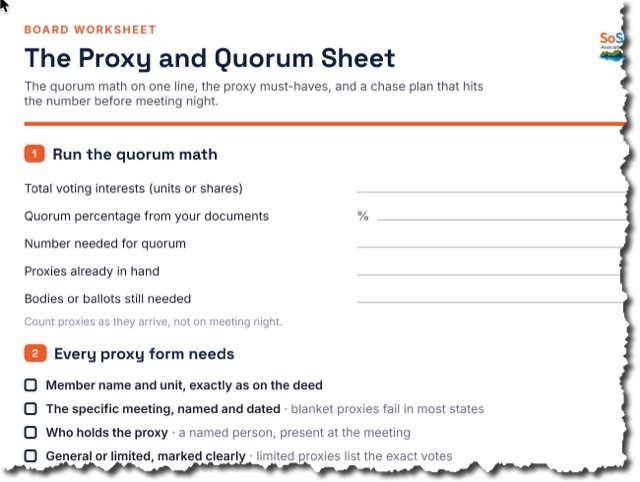
A meeting vote needs people in the room. A seasonal community like ours is missing its snowbirds from November to April. You fall short, and nothing passes. The workaround is proxies, and proxy chasing is its own story: signs in the elevator, calls to owners in three time zones, a board member at the mailboxes with a clipboard. We once collected forty-one proxies by hand for a vote that needed sixty-five owners. It failed anyway.
An email vote is worse. Replies scatter across inboxes. Some owners answer the wrong thread. Somebody votes twice. The count lives with whoever tallied it. Months later an owner challenges the result, and your evidence is a folder of forwarded emails. Both methods lose the one thing a vote needs most: a clean, countable, provable result.
A word about the statute, from someone who has to care
Florida, home of my building, authorizes electronic voting in statute: §718.128 for condos and §720.317 for HOAs. The mechanics matter. The board adopts a resolution authorizing online voting. Owners consent to participate electronically. The system keeps proper records. Most states have an equivalent. This sounds like homework, and it is about an evening of it. Here is the treasurer's view: the statute's record-keeping requirements are exactly what a real voting tool does automatically. A chain of emails never will. The law is not the obstacle to online voting. It is the argument for it.
Do the one-time setup properly. Put the resolution in the minutes and the consents on file. Every vote after that is routine. Check your own state and governing documents before the first one.
How online voting works in SoShiny
You create a ballot. Set the question, the options, the quorum, and the deadline. Owners vote from their dashboard on any device, at any hour. The owner wintering in Michigan votes the same way the owner two floors up does. You watch the quorum count climb in real time. You know where you stand a week out instead of finding out at the podium. Results reveal after the deadline, or the moment quorum is met. You pick anonymous or attributed up front, and the choice locks so nobody can change the rules mid-vote.
The first time our board watched the quorum bar cross the line three days early, someone said what everyone was thinking. "Why did we ever do this with paper?"
Tips for a vote that passes
Give a real window. Open the ballot for one to two weeks so people vote on their own time. A 48-hour window guarantees a low turnout. At that point you are measuring who happened to check email, not opinion.
Send reminders to the right people. Use email broadcasts to nudge only the owners who have not voted yet. A single targeted reminder often lifts turnout by double digits. It spares the people who already did their part.
Keep the question plain. One clear decision per ballot. Stacked or vague questions confuse people and lower the count. "Approve the 2027 budget as presented: yes or no" beats a three-part question every time.
Show the stakes. Tell owners what happens if the vote fails. "If this fails, the roof project waits a year and the price goes up" gets ballots cast. People act when they understand the cost of doing nothing.
Time it around your community's calendar. In a snowbird community, a January ballot beats a July one. Vote when your owners are paying attention, wherever they are.
The record you keep
Every ballot is stored with its result, its timeline, and its participation. An owner will ask months later how a rule passed. You open the record and show them the question, the window, the count, and the timestamps. The argument ends in ninety seconds. Email can never give you that. I sign financial documents for the association, so that part matters most to me. Elections, budget approvals, rule changes: the record keeps the same clean shape for all three.
What changes when voting is easy
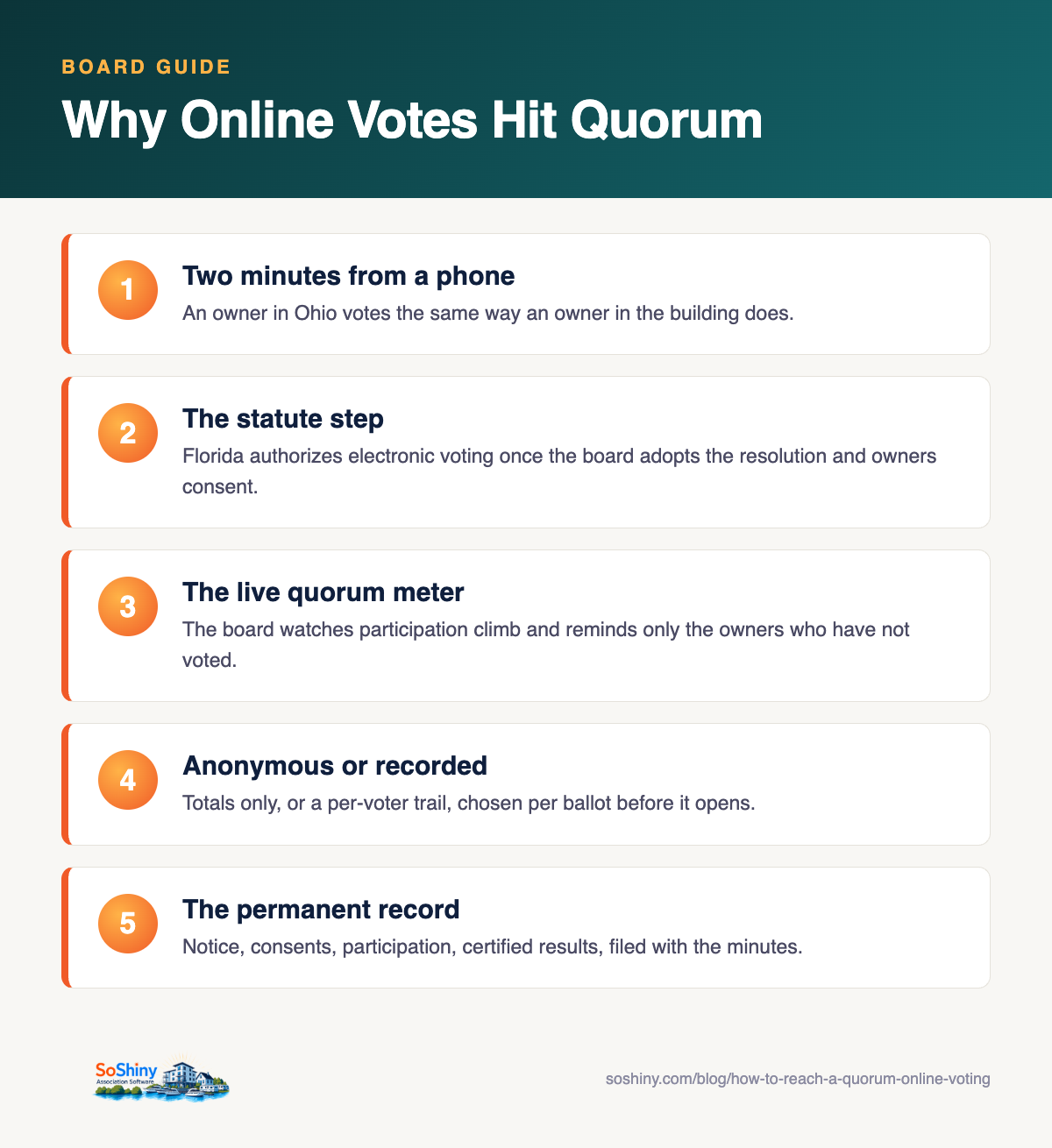
Easy voting changes how a board governs, not just how it counts. A vote takes two minutes on a phone, so you stop saving every decision for the annual meeting. You ratify the budget when the budget is ready. You approve the project with the contractor's quote still valid. You settle the rule change with the argument still fresh in memory.
Owners feel the difference too. A vote that is simple to cast gets cast. Turnout climbs, and decisions carry real weight. More of the community took part. The board stops stalling on choices it can make in a week. Owners stop grumbling that nobody asked them. Over a year, a community that votes easily makes more decisions, makes them faster, and fights about them less. Easy voting is not a small convenience. It is the difference between a board that decides and a board that waits on the calendar all year.
If this guide helped, the tools it describes live in SoShiny, and so does everything else a self-managed board needs. The 30-day trial is free.
Enjoying this? Get the next one by email.
Practical guides for self-managed boards, written by a board treasurer. About one a month.
FAQ about quorum and online voting
Is online voting legal for HOA elections?
How does online voting track a quorum?
Can owners vote anonymously online?
Can a Florida HOA run its annual election online?
What happens if the quorum is not reached?
How do snowbird or absentee owners vote?
Related reading
- From the blogHow to Run an HOA Vote Online and Hit Quorum on the First Try
- From the blog5 Systems That Replace Your HOA Management Company
- FeatureVoting & Ballots
- From the blogHow Florida HOA Board Elections Actually Work — a Plain-English Guide
- From the blogThe Hidden Cost of Running Your HOA on Email and Spreadsheets
The idea of SoShiny came from a board seat. Kevin joined the board of a large condo HOA and found that one person ran the entire operation from memory. The books lived in Lotus 1-2-3, a program from the 1980s. If that person walked away, the whole community walked away with them. Something had to change. What started as a small fix grew into a full system. SoShiny now runs communities across 23 states and 3 countries.
Kevin has spent his career building teams and turning messy processes into simple products. He ships fast, coaches with candor, and favors action over talk. With SoShiny, he brings that same bias for action to an industry that still runs on spreadsheets, sticky notes, and paper announcements.
An Irish American builder and author, Kevin leads with honesty, grit, and faith. He has three sons and splits his time between Ormond Beach, Florida and Western New York.