
The HOA Annual Meeting Checklist: Notices, Quorum, and the Night Itself

Our annual meeting used to sneak up on us. Every year the date arrived, the room was half empty, and the board scrambled through an agenda nobody had rehearsed. I'm a board member and the treasurer of a 128-unit oceanfront condo association in Florida, and I have sat through both versions of this night: the chaotic one and the calm one. The difference is never luck. It is a checklist that starts eight weeks out. Here is ours.
Key takeaways
- The annual meeting is won or lost in the eight weeks before it, not on the night.
- Florida HOAs need at least 14 days of notice under §720.306, and the quorum default is 30 percent of voting interests. Your documents can change both, so read them first.
- The treasurer's budget presentation is the part owners remember. Three columns and no surprises beats a polished speech every time.
Eight weeks out: pick the date and read your documents
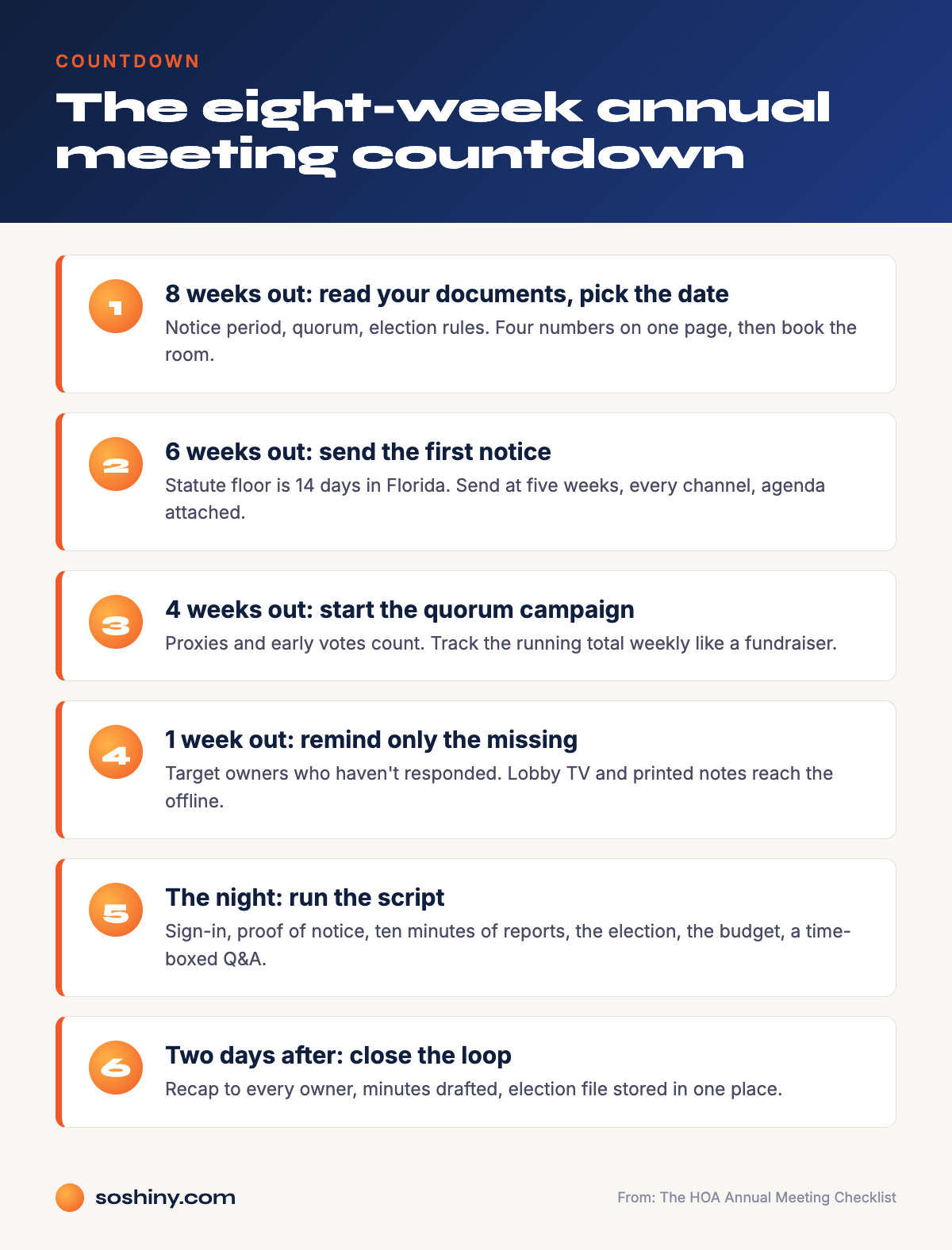
Start with the governing documents, not the calendar. Your bylaws name the meeting month, the notice period, the quorum, and the election rules. Write those four numbers on one page. Every other deadline on this checklist counts backward from them.
Then pick a date your owners can actually make. In a seasonal community this is the whole game. Half our building is a thousand miles north from May to November, so our meeting lives in season, when the parking lot is full. A perfectly noticed meeting on the wrong date still fails quorum.
Book the room, line up a laptop and a screen, and decide who chairs the night. One evening of planning here saves three panicked weeks later.
Six weeks out: run the notice math
Florida HOAs must send notice of the annual meeting at least 14 days out under Chapter 720. Treat that as a floor, not a target. We send our first notice about five weeks ahead: the date, the time, the agenda, and how to give a proxy or vote ahead of the meeting.
Send it every way you can. Email reaches most owners. Mail reaches the rest, and for owners who never consented to electronic notice, mail is what the statute counts. Post it in the lobby and on the community site too. The goal is simple: no owner should be able to say they didn't know. Our elections guide covers the notice rules in more depth, and the same timelines apply here.
Attach the agenda to the notice. Owners who see the budget and the election slate in advance show up with questions instead of suspicions. That trade always favors the board.
Four weeks out: chase the quorum before the meeting
Here is the number that cancels meetings. Florida's default quorum for an HOA is 30 percent of voting interests, and your bylaws can set it lower. For our 128 units that math is unforgiving when the snowbirds are away. So we stopped treating quorum as a night-of surprise and started treating it as a four-week campaign.
Count every path to quorum, not just bodies in chairs. Proxies count. Owners who vote ahead of the meeting online count, where your documents allow it. Track the running total each week the way you track a fundraiser. The year we started doing this, we knew we had quorum three days before the meeting. Nobody paced the lobby counting heads at 6:55 p.m.
Make the proxy easy: one page, pre-filled with the meeting date, returnable by mail, by photo from a phone, or at the office. Every barrier you remove is a percentage point you gain.
The treasurer's part: present the budget without an ambush
Every guide skips this section. I can't, since I'm the one holding the numbers. The budget presentation is the part of the night owners actually remember, and it goes well or badly based on what happened all year, not that night.
My format is three columns: what we budgeted, what we spent, and the difference. One page, big type, up on the screen. I flag the two or three lines with real variances and say why, before anyone asks. Insurance went up. The elevator contract renewed higher. The reserve schedule shows the roof year and what we have saved for it. Owners who watch the money all year through the portal treat this as a review, not a reveal. Our plain-language budget guide walks through the full method.
Two rules keep it calm. Never present a number you can't back with a page in your folder. And when an owner catches something real, thank them in front of the room. A treasurer who welcomes scrutiny gets less of it.
One week out: reminders that actually work
One targeted reminder lifts turnout by double digits. Send an email broadcast to owners who haven't returned a proxy or voted yet, not to everyone. Put the meeting on the lobby TV and a printed note by the mailboxes for the owners who never open email. In our building that combination reaches people no single channel ever has.
Confirm the mechanics the same week: who brings the sign-in sheet, who verifies proxies at the door, who counts ballots, who takes minutes. Names, not roles. "Someone will handle it" is how ballot boxes go missing.
The night itself: a running order
How long should an HOA annual meeting last? Sixty to ninety minutes, and a prepared board hits that every year. The three-hour version is what happens when the eight weeks of prep got skipped.
Our meeting runs on a script. Not word for word, but a printed order the chair follows:
- Sign-in and credentials. A table at the door checks owners in, collects proxies, and keeps the count. The meeting starts when quorum is confirmed, not when the clock says so.
- Call to order and proof of notice. The secretary states when and how notice went out. Thirty seconds now prevents a challenge later.
- Reports. President first, treasurer second, committees briefly. Ten minutes total. Owners came for the election and the budget, not a recap of the mulch decision.
- The election. Follow your documents exactly: nominations, ballots, counting in the open. Results announced in the room, then recorded.
- The budget. Three columns, variances named, reserve schedule shown.
- Owner questions, time-boxed. We give it a firm 20 minutes with a signup sheet. Unanswered items get written down, assigned, and answered within a week. That promise, kept, is worth more than a long night.
- Adjourn and document. The secretary drafts minutes before leaving the room: motions, votes, results, attendance count.
The morning after
Send a short recap to every owner within two days: election results, the adopted budget, and the answers owed from the Q&A. File the election records together in one place: the notice, the sign-in sheet, the proxies, the tally. Florida owners have broad rights to inspect official records, and a complete file assembled in ten minutes is the cheapest legal protection a board can buy.
Then put one more date on the calendar: eight weeks before next year's meeting. The boards that dread this night are the ones that start planning in the final two weeks. The boards that enjoy it started two months ago. If you're new to all of this, our guide on what new board members never get told is the companion piece.
If this guide helped, the tools it describes live in SoShiny, and so does everything else a self-managed board needs. The 30-day trial is free.
The Meeting Minutes Template (PDF)
The header, the order of business, and a motions log. Fill it in during the meeting and the record writes itself. One page, made to print for every meeting.
FAQ about HOA annual meetings
How much notice does an HOA annual meeting require in Florida?
What is the quorum for an HOA annual meeting?
Do proxies count toward quorum?
How long should an HOA annual meeting last?
When should a board start planning the annual meeting?
What happens if the annual meeting fails to reach quorum?
What should the treasurer present at the annual meeting?
Who runs the HOA annual meeting?
Do we have to follow Robert's Rules of Order?
Related reading
- From the blogHow Florida HOA Board Elections Actually Work — a Plain-English Guide
- FeatureBoard Meetings & Minutes
- From the blogHow to Collect HOA Dues Without Chasing Your Neighbors
- From the blogSelf-Managed vs. Management Company vs. Software: What's Right for Your Community
- From the blogSpecial Assessments: How Boards Decide, Notice, and Collect Them Fairly
The idea of SoShiny came from a board seat. Kevin joined the board of a large condo HOA and found that one person ran the entire operation from memory. The books lived in Lotus 1-2-3, a program from the 1980s. If that person walked away, the whole community walked away with them. Something had to change. What started as a small fix grew into a full system. SoShiny now runs communities across 23 states and 3 countries.
Kevin has spent his career building teams and turning messy processes into simple products. He ships fast, coaches with candor, and favors action over talk. With SoShiny, he brings that same bias for action to an industry that still runs on spreadsheets, sticky notes, and paper announcements.
An Irish American builder and author, Kevin leads with honesty, grit, and faith. He has three sons and splits his time between Ormond Beach, Florida and Western New York.