
HOA Meeting Minutes: What to Record, What to Leave Out

An owner disputed a $400 special assessment two years after the vote. The board opened its minutes to settle it. The minutes said, "Long discussion about the roof. Bob was against it." No motion, no vote count, no amount. The board paid a lawyer $1,200 to reconstruct a decision it had made for free.
Key takeaways
- Minutes are the legal memory of the association: motions, votes, counts, and amounts. Debate stays out.
- Fifteen minutes and one to two pages per meeting, approved at the next meeting and locked.
- Store them in an association-owned library. Minutes on a laptop leave with the secretary.
Minutes are the legal memory of your association. Done right, they take fifteen minutes to write. This post covers what goes in, what stays out, and how to keep them findable for a decade.
What minutes are actually for
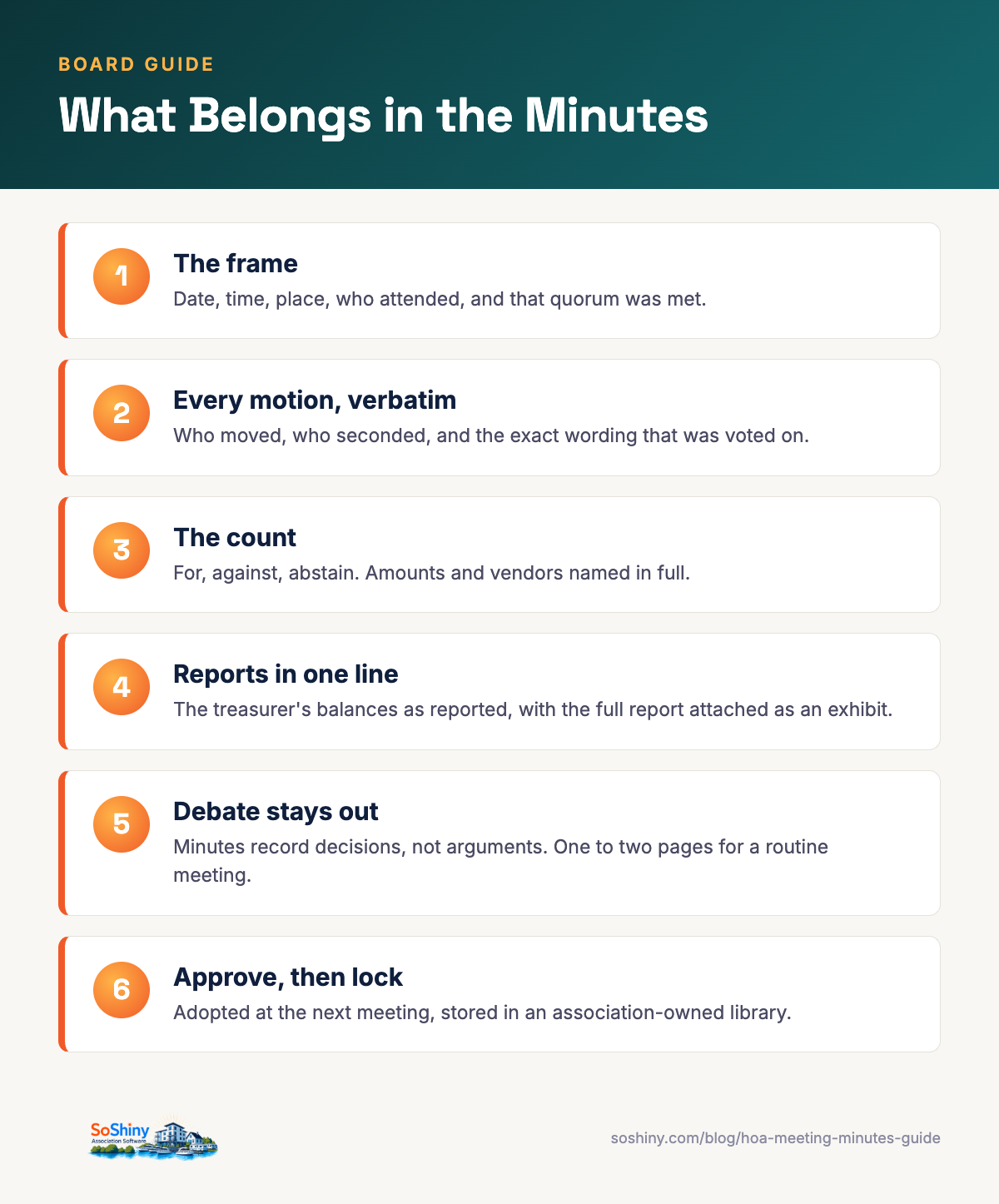
Minutes are not a story of the meeting. They are the official record of decisions. Courts, banks, buyers, and future boards read them for one thing: what did the board decide, and was the decision made properly?
That single purpose answers almost every question about content. A detail goes in when it proves a decision was valid. It stays out when it just describes conversation.
The seven things every set of minutes needs
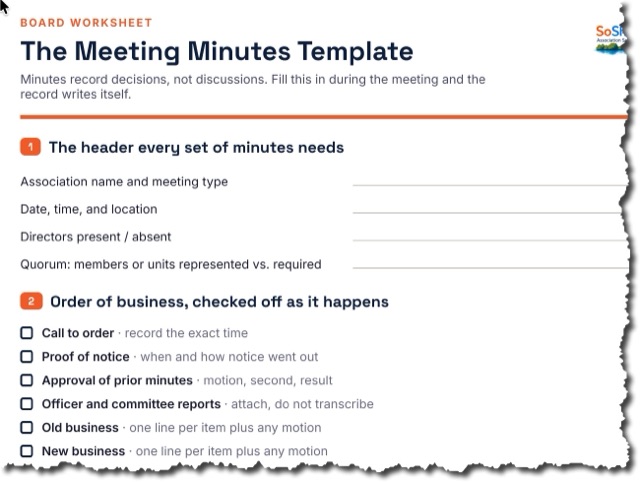
- The basics. Association name, meeting type, date, time, and location or video link.
- Attendance. Which board members attended, which were absent, and whether quorum was met. Name any manager, attorney, or guest presenter.
- Approval of prior minutes. One line: approved as written, or approved with a named correction.
- Every motion, word for word. Who made it, who seconded it, and the exact text voted on.
- Every vote result. Passed or failed, with the count. Record abstentions and recusals by name.
- Key financial facts. Account balances reported, contracts approved with vendor name and dollar amount, and any assessment decision.
- Adjournment time and next meeting date.
That is the whole list. A normal board meeting fits on one to two pages.
What stays out
Volunteer secretaries usually err on the side of writing too much. Extra detail feels thorough, but it creates risk. Every recorded opinion is a sentence a lawyer can read aloud in a dispute.
Leave out:
- Debate and opinions. Write "the board discussed three landscaping bids," not who argued for which and why.
- Owner names in violations or delinquencies. Use unit numbers or account numbers in open-meeting minutes.
- Legal strategy and personnel matters. Those belong in executive session, with separate confidential minutes.
- Verbatim arguments. Minutes record outcomes, not transcripts.
- The secretary's commentary. "This went badly" belongs in nobody's permanent record.
A good test: read each sentence and ask, "Does this prove a decision, or does it just describe talk?" Cut the talk.
A template you can steal
Use the same skeleton every month. Consistency makes minutes fast to write and fast to search later.
- Header: association, meeting type, date, time, place.
- Call to order and quorum statement.
- Roll: present, absent, guests.
- Approval of prior minutes.
- Treasurer's report: balances and one-line summary.
- Old business: motion, mover, second, vote, result. Repeat.
- New business: same format.
- Owner forum: one line noting it happened, topics listed without names.
- Adjournment and next meeting date.
The secretary who fills a skeleton finishes the draft the same night. The secretary who writes from scratch procrastinates for three weeks, and the details fade.
Approve them fast, then lock them
Draft minutes have no legal weight until the board approves them, usually at the next meeting. So the clock matters. Send the draft to the board within a week, collect corrections in writing, and approve at the next session with one motion.
After approval, the minutes become a permanent record. Lock the file. Nobody edits approved minutes. A needed correction happens by motion at a later meeting, recorded in that meeting's minutes.
Storage is where boards quietly fail
Here is the uncomfortable question: where are your 2019 minutes right now? For most volunteer boards the honest answer is "on a past secretary's laptop" or "in a Gmail account we no longer control."
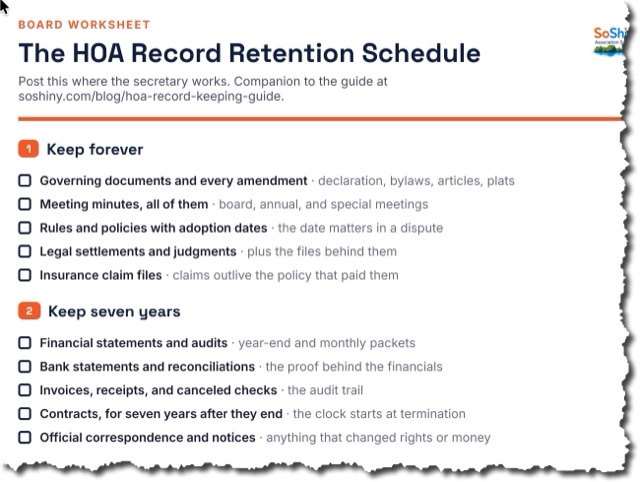
Minutes are among the records most states require associations to keep for seven years or longer. Buyers request them during sales. Lenders request them for loan approvals. Owners have a legal right to inspect them in most states.
The fix is a single document library that belongs to the association, not to a person:
- One folder per year, one file per meeting, named the same way every time: 2026-07-14-board-minutes.
- Owner-visible access for approved open-meeting minutes, so records requests answer themselves.
- Board-only access for executive session minutes.
- Version history, so the approved copy stays provable.
When the secretary role turns over, the new volunteer inherits a decade of records with one login. Nothing walks out the door.
The fifteen-minute habit
Write the skeleton before the meeting. Fill motions and votes live, in the moment they happen. Polish for fifteen minutes the next morning and send the draft. That is the entire discipline, and it beats every alternative.
If this guide helped, the tools it describes live in SoShiny, and so does everything else a self-managed board needs. The 30-day trial is free.
Enjoying this? Get the next one by email.
Practical guides for self-managed boards, written by a board treasurer. About one a month.
FAQ about HOA meeting minutes
Are HOA boards legally required to keep minutes?
Can owners request copies of board minutes?
Should we record the meeting on video instead?
Do we name who voted for and against a motion?
How detailed should the treasurer's report be in minutes?
What are executive session minutes?
Who approves minutes when the secretary leaves mid-year?
How long should minutes be?
Where should an HOA store its minutes long term?
Related reading
- From the blogHow to Run an HOA Vote Online and Hit Quorum on the First Try
- From the blog5 Systems That Replace Your HOA Management Company
- From the blogFrom Group Text to Work Order: Fix How Your HOA Handles Repairs
- From the blogHOA Records: What to Keep, How Long, and Where
- From the blogThe HOA Annual Meeting Checklist: Notices, Quorum, and the Night Itself
The idea of SoShiny came from a board seat. Kevin joined the board of a large condo HOA and found that one person ran the entire operation from memory. The books lived in Lotus 1-2-3, a program from the 1980s. If that person walked away, the whole community walked away with them. Something had to change. What started as a small fix grew into a full system. SoShiny now runs communities across 23 states and 3 countries.
Kevin has spent his career building teams and turning messy processes into simple products. He ships fast, coaches with candor, and favors action over talk. With SoShiny, he brings that same bias for action to an industry that still runs on spreadsheets, sticky notes, and paper announcements.
An Irish American builder and author, Kevin leads with honesty, grit, and faith. He has three sons and splits his time between Ormond Beach, Florida and Western New York.