
When a Sprinkler Pipe Bursts: Your Board's First-Hour Playbook

A sprinkler pipe let go on the fifth floor of our building on a quiet weekday morning. Not a drip under a sink. A pressurized fire-suppression line, dumping water into the unit and hunting for every crack in the slab. Water reached the fourth floor within minutes, then the third. By the time most owners knew anything was wrong, every unit in that stack had water coming through ceiling fixtures.
Our board runs a 128-unit oceanfront condominium in Florida. Nobody on the board had handled a flood before. Two people still got the response right: our president and our community association manager (CAM). The president took the life-safety calls. The CAM took the recovery calls. This article is the playbook I wrote down afterward, so the next person on call does not have to improvise. It works the same in a homeowners association (HOA), a co-op, or a townhome community.
Key takeaways
- Call the fire department for any sprinkler or fire-line break. They shut the system down safely and check the building.
- Learn your shutoff locations today. The domestic main and the sprinkler riser are two different valves in two different rooms.
- Get a water mitigation company on site the same day. Mold starts growing in 24 to 48 hours.
- Photograph everything wet before cleanup starts, unit by unit, and save it all in one place.
- Notify the association's carrier the same day, and tell affected owners to call their HO-6 carriers too.
What happened in our building
The break was a fire-sprinkler line, and that changed the first phone call. A domestic water leak is a plumber problem. A fire-suppression line is a fire department problem. Our president called 911. The fire department shut down the sprinkler riser, drained the line, and confirmed the alarm system could be restored. The flood became a drip in about twenty minutes.
Twenty minutes still hurts. A burst sprinkler line moves 25 gallons a minute or more. That is roughly 500 gallons through the floors below, into drywall, insulation, and carpet pads that hold water like a sponge.
Our CAM worked the second track at the same time. The mitigation company on our vendor list answered its emergency line, and crews arrived with extraction vacuums, air movers, and dehumidifiers that same day. Machines ran for four days. The drywall cuts and repairs took weeks, but nothing grew mold and nobody lost their home.
The first hour, minute by minute
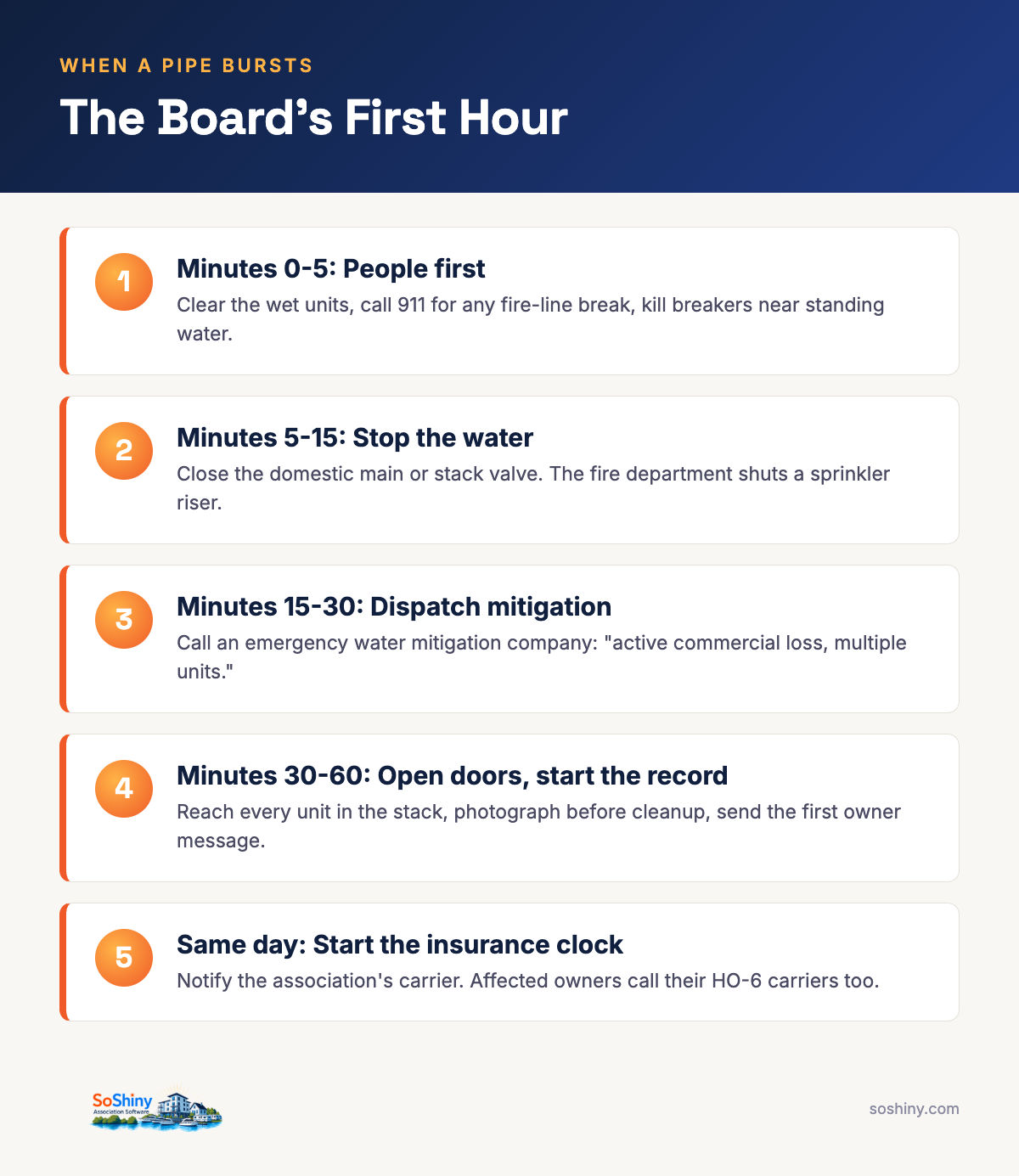
Minutes 0 to 5: people first. Knock on doors in the affected stack. Get anyone with mobility issues clear of standing water. If the source is a fire-suppression line, call 911 now, not the plumber. If water is near outlets or fixtures, kill the breakers in the soaked units.
Minutes 5 to 15: stop the water. For a domestic leak, close the main or the stack isolation valve. For a sprinkler leak, the fire department closes the riser. Either way, one board member stands at the valve and reports when the flow actually stops. Water keeps draining out of walls long after the valve closes, so do not panic when the drip continues.
Minutes 15 to 30: dispatch mitigation. Call an emergency water mitigation company and say the words "active commercial loss, multiple units." That phrase moves you up the queue. Ask for an arrival time, extraction, and drying equipment. No vendor relationship yet? Your insurance agent can name one on the phone.
Minutes 30 to 60: open doors and start the record. Use your occupant list to reach every unit in the stack, including owners away for the season. Photograph each unit before anything gets moved. Then send the first message to the whole building: what happened, what is being done, who to contact. Short and factual beats polished and late.
Two people, two jobs
The reason our response worked was a simple division of labor.
The president owned the life-safety track: 911, the fire department, breakers, and getting people out of wet units. One person talks to first responders, and it stays the same person all night.
The CAM owned the recovery track: the mitigation vendor, unit access, the insurance agent, and owner communication. A self-managed homeowners association has no CAM, so assign this track to a named board member before anything breaks. Write both names on the emergency sheet. "The board will handle it" means nobody handles it.
Document everything before it dries
Your insurance claim is won or lost in the first day. Take photos and video of every affected unit, the source of the break, and the hallways. Get the mitigation crew's first meter readings in writing. Keep a running list: unit numbers, what got wet, whose property it is. Save every invoice, starting with the emergency call-out fee.
Put all of it in the association's document system the same week, not on one director's phone. Our insurance guide covers the master policy versus HO-6 split in detail, and that split is exactly why per-unit photos matter. The association's carrier and four different owner carriers may each need proof of the same morning.
The insurance clock starts the same day
Call the association's agent or carrier the day it happens, even before you know the full damage. Late notice is a classic reason for a hard claim. In Florida, the master policy usually covers the building back to bare drywall, and each owner's HO-6 policy picks up floor coverings, cabinets, paint, and personal property. Owners in the flooded stack should call their own carriers that day.
Mitigation is not optional in the carrier's eyes. Policies expect you to stop further damage, and a fast dry-out is the cheapest claims argument you will ever make. Expect commercial water mitigation to run a few thousand dollars per affected unit. That is still a bargain next to a mold remediation job six months later.
The deductible lands on the association. Funding it, from reserves or from an assessment, is a board decision. Our reserve fund guide covers that conversation.
What we would do differently
Three honest notes from our post-mortem. Our occupant directory had two stale phone numbers, both in the flooded stack, both seasonal owners. Our software has an "Who's Away" list for snowbirds but it too was not up to date. We had their "away key" in the office but could not reach the owner for permission. And our first message to the building went out two hours late because the building manager did not use the announcement board in the lobbies for the emergency announcment, so the rumor version beat the real version by ninety minutes. Every fix landed on the one-page sheet below.
Before the next one: the one-page emergency sheet
Our whole lesson fits on one page. Build yours this month:
- Shutoff locations with photos: domestic main, stack valves, sprinkler riser, gas, and the key that opens each room.
- The two named people: a life-safety lead and a recovery lead, with cell numbers.
- An emergency vendor list: mitigation, plumber, electrician, elevator, locksmith.
- Current occupant and emergency contacts for every unit, including seasonal owners.
- A way to reach the whole building in minutes. We use text alerts for the first message and email for the follow-ups.
- A place where the repairs that follow get logged and tracked. Ours become work orders with photos attached.
Print it, post it in the office and the riser room, and hand the fire department a copy of your building access notes. The next early phone call will still be a bad morning. It does not have to be a disaster.
If this guide helped, the tools it describes live in SoShiny: text alerts, a directory with emergency contacts, document storage for the photos and invoices, and work orders for the repairs that follow. It is $25 a month plus 33 cents a unit, every feature included.
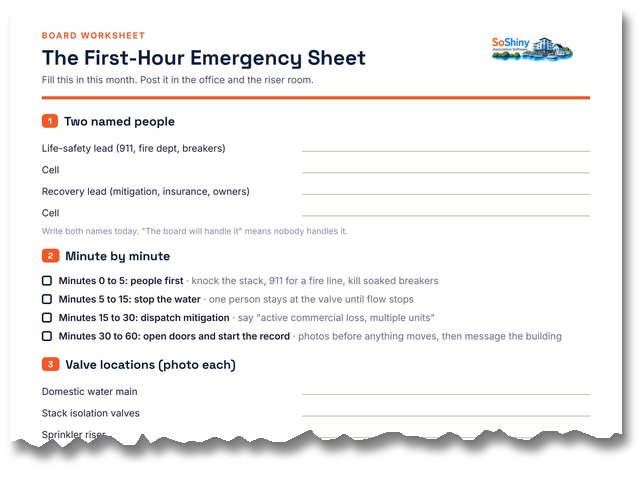
The First-Hour Emergency Sheet (PDF)
Named leads, shutoff locations with photos, 24-hour vendors, and the same-day insurance clock. One page, made to post in the office and the riser room.
FAQ about handling a condo or HOA emergency
What should an HOA board do first when a pipe bursts?
Should you call 911 for a burst sprinkler pipe?
How fast does mold start after a condo flood?
Who pays for water damage in a condo, the association or the owner?
What does emergency water mitigation cost?
When should the association notify its insurance carrier?
Does a homeowners association need an emergency plan?
Can an HOA charge owners for emergency repairs?
Related reading
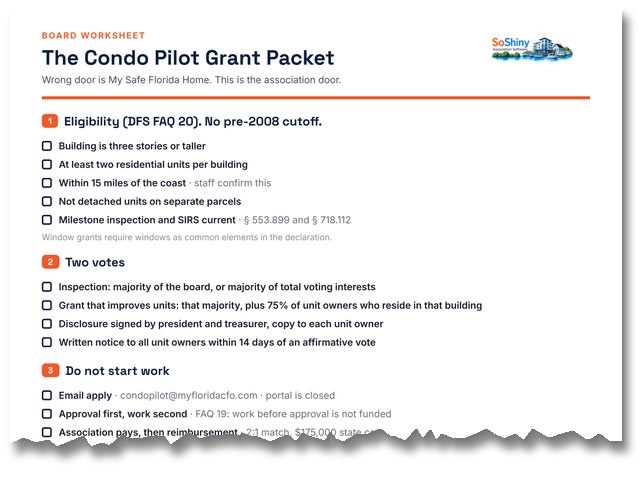
- From the blogMy Safe Florida Home Will Reject Your Condo. Here Is the fix
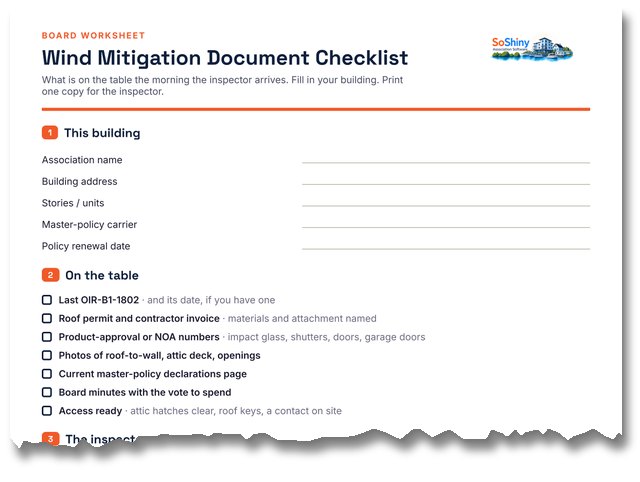
- From the blogThe Wind Mitigation Inspection: How a Florida Board Turns Form 1802 into Insurance Credits
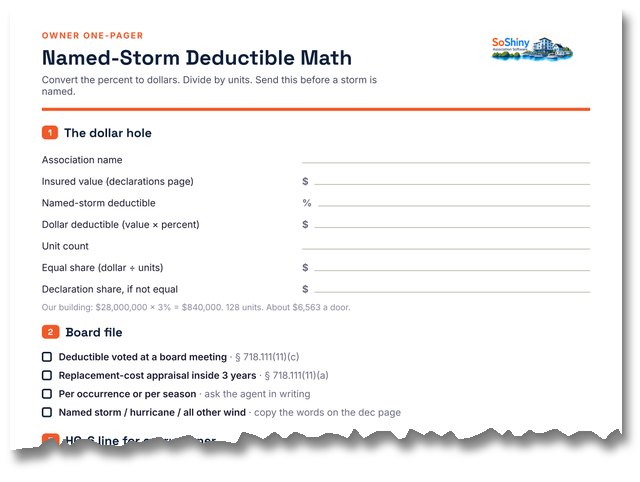
- From the blogYour Building's Hurricane Deductible Is $840,000. Here Is Your Share.
- From the blogThe Crew Showed Up. The Paper Didn't. The HOA Vendor COI Checklist
- From the blogFrom Group Text to Work Order: Fix How Your HOA Handles Repairs
Reboooot is the engineering persona behind SoShiny: a seasoned dev + UX designer who pushes back on shortcuts, proposes alternatives, and flags gaps before executing. Most product updates on the changelog ship under this byline.