
The Crew Showed Up. The Paper Didn't. The HOA Vendor COI Checklist

Picture a normal Tuesday. A roofing crew is already on the clubhouse. Truck in the lot. Ladder on the stucco. Then a shout, a crash, and quiet. One of the roofers is down.
The ambulance is the first problem. The second is in a filing cabinet. Nobody checked the license. The certificate of insurance is last year's PDF in someone's inbox. The association was never named as additional insured. Now that accident can land on every owner who pays dues.
That is Case File #006 of HOA Case Files: The Crew Showed Up. The Paper Didn't. This is the written version, with the questions boards actually search.
I sit on a Florida condo board. I am the treasurer. I sign vendor checks. I would rather spend ten minutes on paper before the ladder goes up than ten months on a claim after it comes down.
This is a board operator's playbook, not legal advice. Insurance and workers' comp rules vary by state and by carrier. Confirm with your association counsel and insurance broker before you change your vendor policy.
Listen to the episode (25 minutes):
Episode page and transcript: soshiny.com/podcast. Prefer Buzzsprout? Listen on Buzzsprout.
Key takeaways
- Being the certificate holder gets you a copy of a piece of paper. It does not put your association on the vendor's policy.
- Three checks before any vendor works: license, a current COI sent by the agent, and additional insured for anything beyond low-risk work.
- A COI is a snapshot. Recheck at every renewal date and before every new job.
What is a certificate of insurance for an HOA vendor?
A certificate of insurance, or COI, is a one-page summary of a vendor's policies, usually on the ACORD 25 form: insurers, policy numbers, dates, and limits for general liability, auto, umbrella, and workers' comp.
Read the small print at the top of that form. It says the certificate is issued as a matter of information only and confers no rights upon the certificate holder. That sentence is the whole reason this episode exists.
A COI tells you a policy existed on the day it was printed. It does not prove the policy is still in force. It does not show exclusions, and some policies carve out work for community associations. If the vendor emails it, it does not prove an insurer ever saw it. A PDF takes thirty seconds to edit.
Certificate holder vs. additional insured: what is the difference?
This is the expensive misunderstanding. Your name in the certificate holder box looks official. It is not coverage.
- Certificate holder means you received a copy of the certificate. That is it. You have no rights under the vendor's policy. Even cancellation notice is soft: the form says notice goes out "in accordance with the policy provisions," not that anyone will call you.
- Additional insured means the vendor's policy has been amended, by an endorsement, to cover your association for liability arising out of the vendor's work. If someone sues both the vendor and the association over that work, the vendor's carrier can owe the association a defense, not just a check at the end. Defense costs are where small associations bleed.
The ACORD form has a small "ADDL INSD" column. A "Y" there is a signal, not proof. Ask for the endorsement page itself. Check that it shows the association's exact legal name, the one on the articles of incorporation, not the nickname on the sign out front.
What endorsements should an HOA require from vendors?
For higher-risk work, these are the three I ask about. Your broker may change the list.
- Additional insured. On the vendor's general liability, naming the association. Many carriers use ISO forms CG 20 10 for ongoing work and CG 20 37 for completed work. The walkway that cracks two years later is a completed-operations claim.
- Waiver of subrogation. Without it, after the vendor's carrier pays a claim, it can try to recover that money from the association. Ask for it on general liability and on workers' comp.
- Primary and non-contributory. This tells the vendor's policy to pay first, before your master policy is touched, and not to ask your policy to share. Keeping claims off the master policy matters at renewal.
Put these in the contract or work order, not a friendly email. Many endorsements only apply when a written contract requires them.
Why does workers' comp matter if the worker is not ours?
When someone gets hurt, the system looks for someone who can pay. If an uninsured vendor's worker is injured on your property, the vendor may not have the money. In many states, the party that hired the work can be treated as the statutory employer of an uninsured contractor's crew. The owners can end up holding the bill.
Two things to watch:
- Exemptions. Some states, Florida included, let certain business owners or officers file an exemption from workers' comp. An exemption covers the person named on it. It does not cover the helpers he brings to your roof.
- Unlicensed often means uninsured. In practice, a contractor the state will not license is very often one no carrier will cover. If the license check fails, stop there.
What are the three checks before a vendor starts work?
- License. Look it up yourself on the state licensing site. In Florida that is the DBPR license search. Active. Not suspended. Matches the trade. A painting license does not cover rewiring the clubhouse. Some trades are licensed locally, so check there too.
- Current COI, sent by the agent. General liability, plus workers' comp where the trade or the state requires it. Have the vendor's insurance agent email it to the board. Not the vendor. If something looks off, call the agency at a number you look up yourself, not the one printed on the PDF.
- Additional insured endorsement. For anything beyond small, low-risk work. Endorsement page in hand, association's legal name on it.
Do we need all of this for a small repair?
No. Boards that demand capital-project paperwork for a pool-gate hinge never get anything fixed. Scale it to the risk:
- Low risk: no height, no water systems, no power tools where residents walk. License, plus a current COI from the agent.
- Higher risk: roofing, plumbing, electrical, tree work, pressure washing at height, pool chemicals. Everything above, plus additional insured and higher limits. Many boards start the conversation at $1 million per occurrence for general liability. Your broker sets the number for your property.
- Capital projects: roof replacement, concrete restoration, paving. All of the above, plus an umbrella policy and a written contract with indemnity language your counsel has read.
How often should a board recheck vendor COIs?
On the show we call it the one-and-done trap: collect the COI once, file it, never look again. A crew with solid coverage on signing day can have none six months later. A missed premium does it. So does a cheaper renewal.
Recheck at four points:
- When the vendor is approved.
- Before each new job or work order.
- On or before every policy expiration date, with a warning on the calendar a month ahead.
- Before the final payment on any large job.
What should a board do if a vendor's COI lapses mid-job?
- Pause the work in writing until a current certificate arrives from the agent. Short and polite. It is the rule, not a judgment of the person.
- Ask counsel what your contract allows on payment for work done after the lapse date.
- Ask the agent whether there was a gap in coverage. If anything happened on site during it, tell your own agent now, not at renewal.
- Note it in the vendor file and the minutes. The next board will want to know.
Where should vendor insurance paperwork live?
Not in one volunteer's personal email. Claims show up years after the work, long after the board that hired the crew has turned over. If nobody can produce the endorsement page, good luck claiming the coverage.
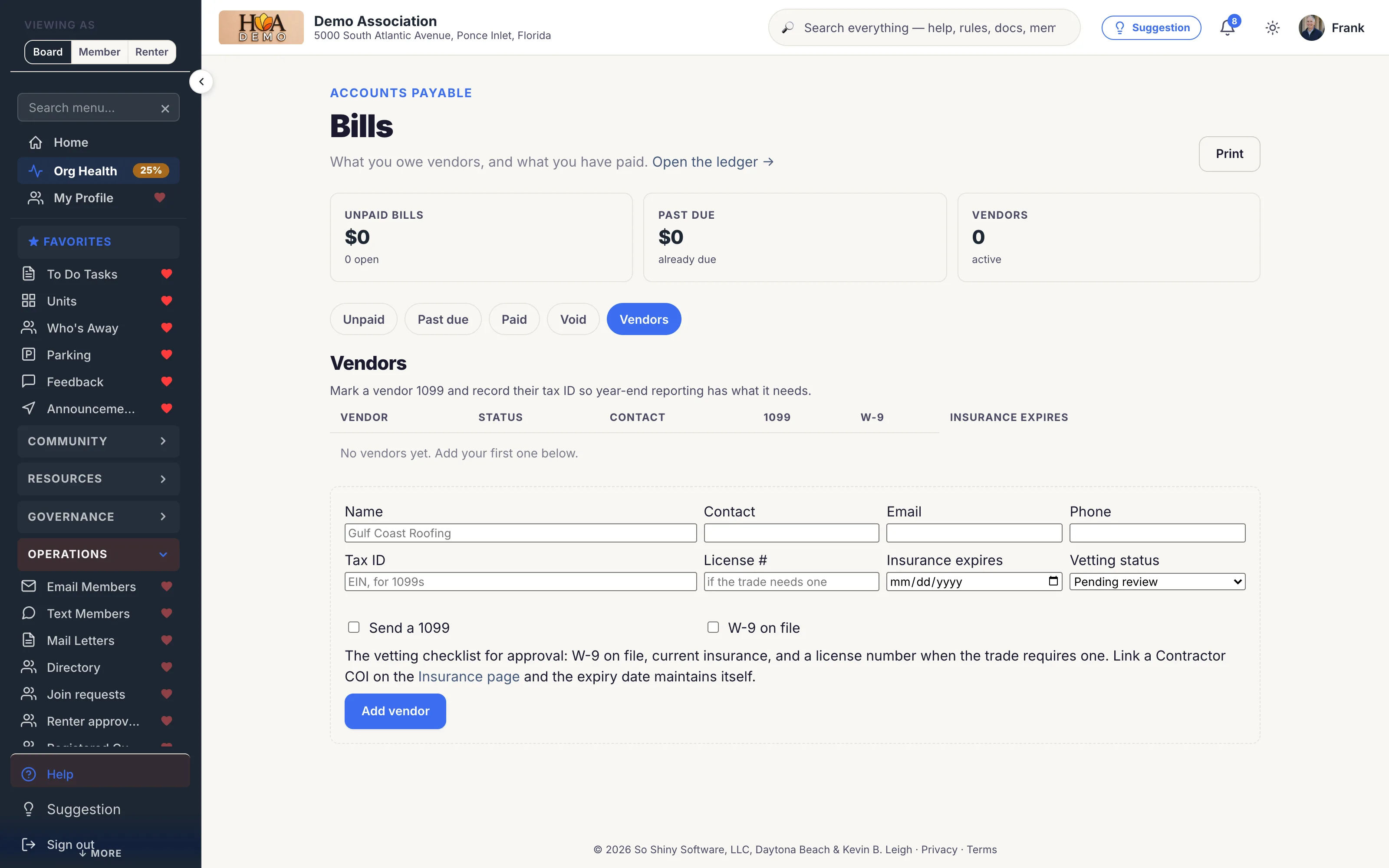
Keep one file per vendor: W-9, license, COI, the endorsement page next to the COI, and every prior version. On SoShiny that is Vendor Desk plus the Insurance & COI Tracker. The board digest warns 30, 14, 7, and 1 day before a certificate lapses, and flags missing paperwork before anyone cuts a check. Software does not make a vendor honest. It keeps the board from approving work in the dark, and takes the awkward "you can't start yet" talk off a volunteer's shoulders.
Track your vendors' COIs free See how COI tracking works →
Quick checklist: vendor paperwork before work starts
- License verified on the state or local site, active, matching the trade.
- COI received directly from the vendor's insurance agent.
- General liability limits meet the board's minimum for this risk tier.
- Workers' comp in force where required. An owner's exemption does not cover the crew.
- Additional insured endorsement page on file, with the association's exact legal name (higher-risk and capital work).
- Waiver of subrogation and primary and non-contributory language, if your contract calls for them.
- Expiration dates on the calendar with a warning a month ahead.
- W-9 on file before the first payment.
- All of it in one place the next board can find.
Homework for this week
Pull three vendors who worked on your property in the last 90 days. License, current COI from the agent, additional insured or only certificate holder. If you cannot find all three in one place, you are already in this case file. You just have not had the accident yet.
Uninsured crews do not disappear when careful boards turn them away. They go to the building that still runs one-and-done.
Hear the full case: The Crew Showed Up. The Paper Didn't. For the master policy side, read HOA Insurance Basics. For keeping the file, see HOA Records: What to Keep.
HOA Case Files is a weekly show for volunteer condo, HOA, and co-op boards. We are not your attorney.
Enjoying this? Get the next one by email.
Practical guides for self-managed boards, written by a board treasurer. About one a month.
FAQ about HOA vendor certificates of insurance
Does being the certificate holder give an HOA any insurance coverage?
What is an additional insured endorsement?
Should an HOA accept a certificate of insurance emailed by the contractor?
What insurance should an HOA require from a contractor?
What is a waiver of subrogation in an HOA vendor contract?
How often should an HOA check a vendor's insurance?
Can an HOA be liable if an uninsured contractor's worker is hurt on the property?
Related reading
- FeatureInsurance & COI Tracker
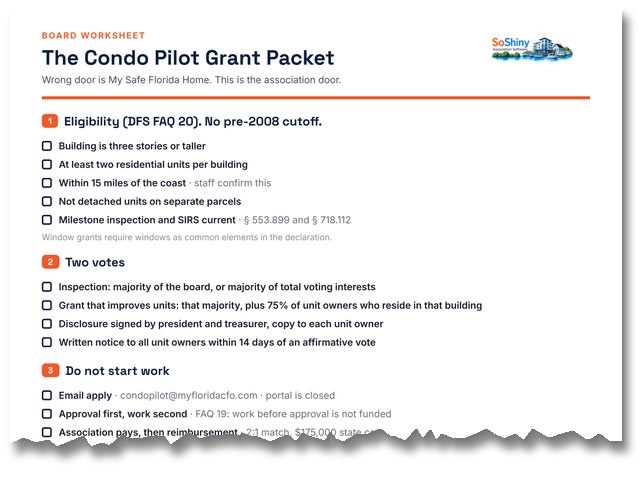
- From the blogMy Safe Florida Home Will Reject Your Condo. Here Is the fix
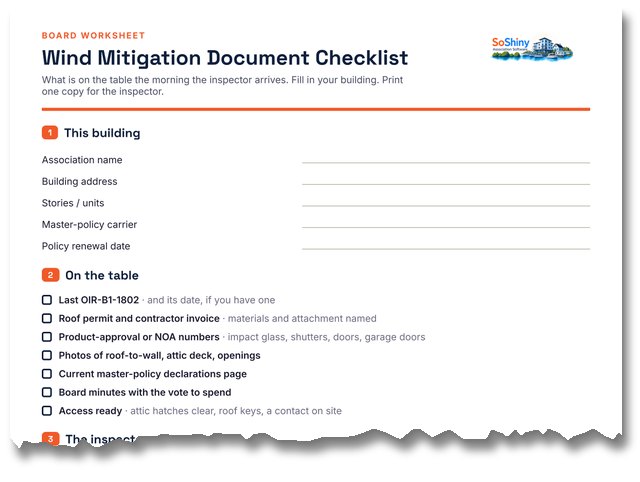
- From the blogThe Wind Mitigation Inspection: How a Florida Board Turns Form 1802 into Insurance Credits
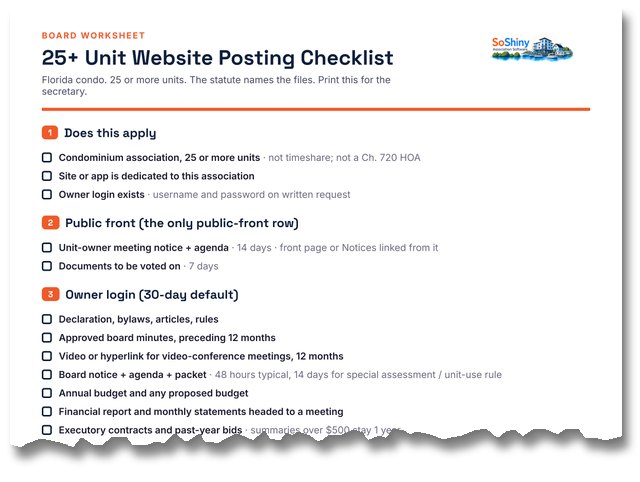
- From the blogYour Florida Condo Must Have a Website, says Statute 718.111(12)(g)
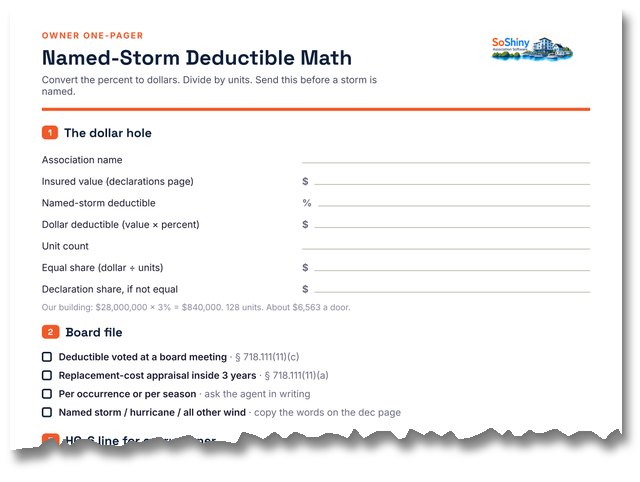
- From the blogYour Building's Hurricane Deductible Is $840,000. Here Is Your Share.
The idea of SoShiny came from a board seat. Kevin joined the board of a large condo HOA and found that one person ran the entire operation from memory. The books lived in Lotus 1-2-3, a program from the 1980s. If that person walked away, the whole community walked away with them. Something had to change. What started as a small fix grew into a full system. SoShiny now runs communities across 23 states and 3 countries.
Kevin has spent his career building teams and turning messy processes into simple products. He ships fast, coaches with candor, and favors action over talk. With SoShiny, he brings that same bias for action to an industry that still runs on spreadsheets, sticky notes, and paper announcements.
An Irish American builder and author, Kevin leads with honesty, grit, and faith. He has three sons and splits his time between Ormond Beach, Florida and Western New York.