
Special Assessments: How Boards Decide, Notice, and Collect Them Fairly

What is a special assessment? A one-time charge on top of regular dues, levied when a cost is too big for the operating budget and the reserves to absorb. I'm a board member and the treasurer of a 128-unit oceanfront condo in Florida, and I have voted for one. This guide is the process we followed: how the board decides, what notice the law requires, how the share math works, and how to collect from your own neighbors without wrecking the community.
Key takeaways
- A special assessment is the third option, after a dues increase and a loan. A board that skips the comparison invites the revolt.
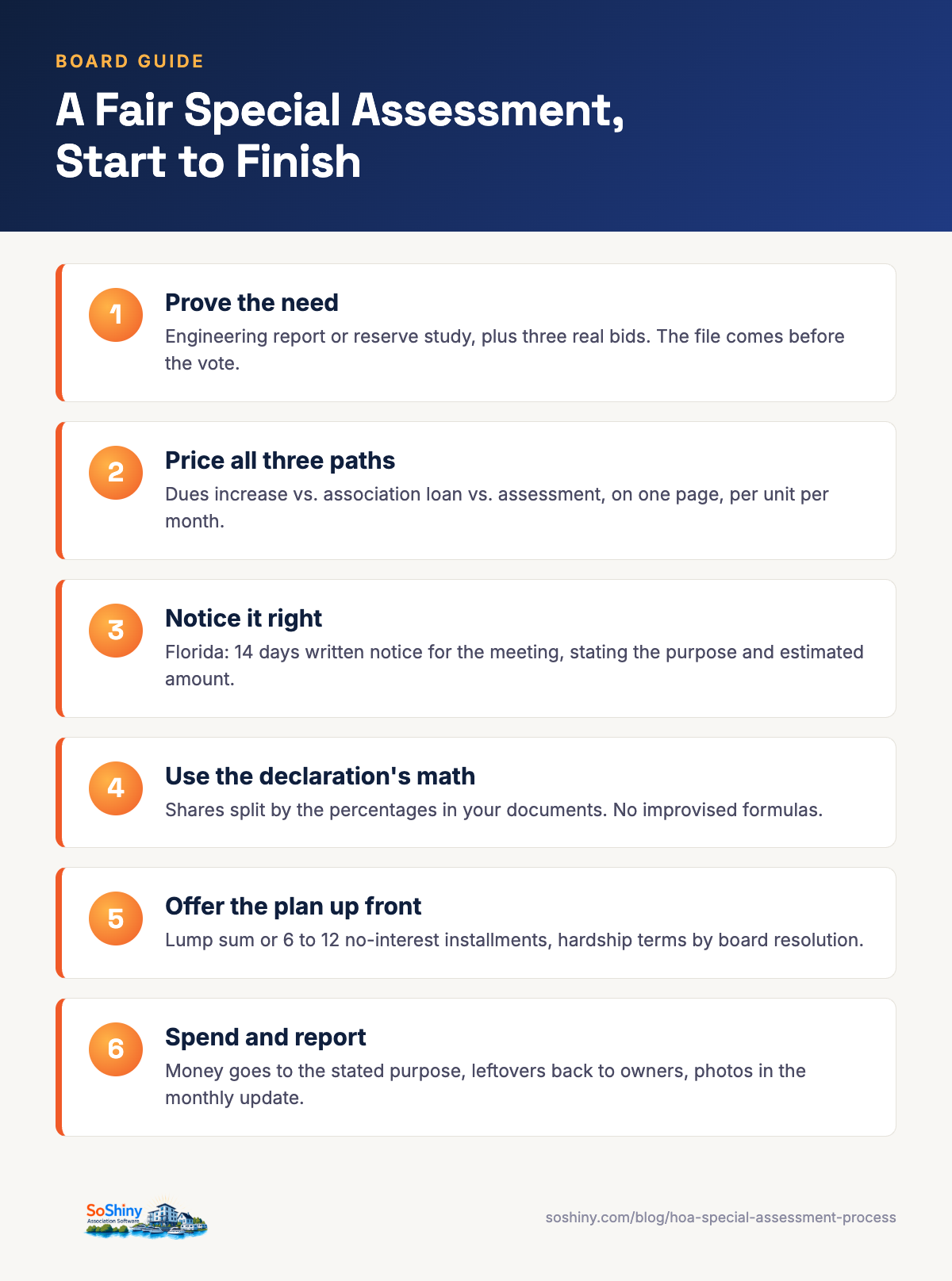
- Florida requires 14 days of written notice for the board meeting where a special assessment will be considered, and the notice must state the purpose and the estimated amount.
- Fair collection is a payment plan offered up front, hardship conversations early, and the lien as the last resort, not the first letter.
Why special assessments happen
Three triggers cover most of them: a major component failed sooner than the reserve study predicted, a storm left a deductible the size of a car, or the reserves were underfunded for years and the bill finally arrived. In coastal Florida there is a fourth: the milestone inspection that turns "someday" concrete repairs into a scheduled project with a legal clock on it.
Notice what is missing from that list: routine operating costs. A special assessment that plugs a hole in the regular budget is a sign the dues are set too low. Our budgets and reserves guide covers that side of the ledger.
Our $350,000 vote
Ours was concrete restoration. The engineering report priced the balcony and spalling work at $850,000. The reserve component for it held $500,000, real money saved over years, and still $350,000 short. We got three bids, walked the property with two of the contractors, and put the gap on the agenda.
The number that mattered most at the meeting was not $350,000. It was $2,734, the average share per unit, and $228 a month on the 12-month plan. Owners can picture $228 a month. Nobody can picture $850,000 of concrete. Do that translation before the meeting, not during it.
How boards decide: the three-way comparison
Every big repair has three funding paths, and a careful board prices all three on one page.
- Raise the dues. Spreads the cost over years. Right for recurring underfunding, wrong for a project with a deadline. A $350,000 gap at our building is a $228 monthly increase for a year, or $19 a month for twelve years.
- Borrow. Association loans exist, and banks write them against the assessment stream. The project starts now and owners pay over five to ten years, with interest. Right when the work cannot wait and the per-unit hit would be brutal.
- Assess. One-time, no interest, done. Right when reserves already carry most of the load and the gap is survivable per unit. That was our case.
We chose the assessment. The deciding fact was the reserve balance: owners had already funded 59 percent of the project through years of honest reserve contributions. Presenting it that way, "your past dues already paid for most of this," changed the room.
What notice does Florida require?
Fourteen days, in writing, for the board meeting where the special assessment will be considered, and the notice must state the specific purpose and the estimated amount. Condos get this from Chapter 718, and Florida HOAs have the same 14-day rule under Chapter 720. Your documents can require more notice, never less.
Do owners get to vote? Usually no. Most declarations put special assessments in the board's hands, and some set a dollar threshold above which owners must approve. Read your declaration before the first bid, not after the meeting. And Florida condo boards: the money must be spent on the stated purpose. Leftovers go back to owners or become a credit, so keep the accounting clean from day one.
The statute is the floor, not the playbook. We sent the formal notice at 14 days, and an informal letter three weeks before that: the engineering photos, the three bids, the funding comparison, and the share math. Nobody should learn about a $2,734 charge from a legal notice.
How each owner's share is calculated
The declaration decides. Condos usually split by ownership share, the same percentages that drive regular dues, so a two-bedroom oceanfront pays more than a studio. Communities with equal shares divide evenly: total divided by units. What a board cannot do is improvise a "fairer" formula on the fly. The split in your declaration is the only legal one.
Put the per-unit number, the monthly-plan number, and the due dates in the notice. Owners forgive a hard number faster than a vague one.
Collecting it fairly
- Offer the payment plan up front. Ours was pay-in-full or 12 monthly installments, no interest, pick one on the enclosed form. Uptake was about half and half.
- Invite hardship conversations early. A retiree on a fixed income needs a longer plan, not a lien. Two owners took 18 months by board resolution. Both paid in full.
- Track it like dues. The assessment ledger sits next to the dues ledger: who paid, who is on plan, who is silent.
- Escalate on the same path as dues. Reminder, late notice, then the attorney letter, then the lien. Florida lets associations collect assessments with the same teeth as dues. Use the teeth last.
- Report as you spend. A monthly one-paragraph update with photos of the concrete work. Owners who can see the scaffolding stop resenting the check.
If you are the owner who got the letter
Check three things. First, the purpose: the notice must say what the money is for, and in a Florida condo it must be spent on that. Second, the math: your share should trace back to the percentages in the declaration. Third, the process: was the board meeting noticed 14 days out with the assessment on the agenda? The budget, the reserve study, and the bids are official records, and you have a statutory right to inspect them. Ask in writing, and ask for the installment plan if the lump sum hurts. Boards say yes to owners who engage early.
The best special assessment is the one you never levy
Every dollar of honest reserve funding is a dollar that never becomes a surprise letter. Our $350,000 assessment would have been $850,000 without the reserve component behind it. Fund the study, show owners the schedule at the annual meeting, and the day a big one lands, you will be dividing a gap instead of a catastrophe.
If this guide helped, the tools it describes live in SoShiny, and so does everything else a self-managed board needs. The 30-day trial is free.
The Special Assessment Worksheet (PDF)
The six-step checklist, the funding math with blanks for your numbers, the Florida notice timeline, and a payment-plan planner. One page, made to print and bring to the board meeting.
FAQ about HOA special assessments
What is an HOA special assessment?
How much notice does a special assessment require in Florida?
Do owners vote on special assessments?
How is each owner's share calculated?
What happens if an owner does not pay a special assessment?
Can the board spend special assessment money on something else?
How long do owners get to pay a special assessment?
Can an owner challenge a special assessment?
Related reading
- From the blogHOA Budgets and Reserves in Plain Language
- From the blogHOA Insurance Basics: Master Policy, HO-6, and D&O, Explained
- From the blogHow Florida HOA Board Elections Actually Work — a Plain-English Guide
- From the blogHow to Collect HOA Dues Without Chasing Your Neighbors
- From the blogThe HOA Annual Meeting Checklist: Notices, Quorum, and the Night Itself
The idea of SoShiny came from a board seat. Kevin joined the board of a large condo HOA and found that one person ran the entire operation from memory. The books lived in Lotus 1-2-3, a program from the 1980s. If that person walked away, the whole community walked away with them. Something had to change. What started as a small fix grew into a full system. SoShiny now runs communities across 23 states and 3 countries.
Kevin has spent his career building teams and turning messy processes into simple products. He ships fast, coaches with candor, and favors action over talk. With SoShiny, he brings that same bias for action to an industry that still runs on spreadsheets, sticky notes, and paper announcements.
An Irish American builder and author, Kevin leads with honesty, grit, and faith. He has three sons and splits his time between Ormond Beach, Florida and Western New York.