
The Wind Mitigation Inspection: How a Florida Board Turns Form 1802 into Insurance Credits

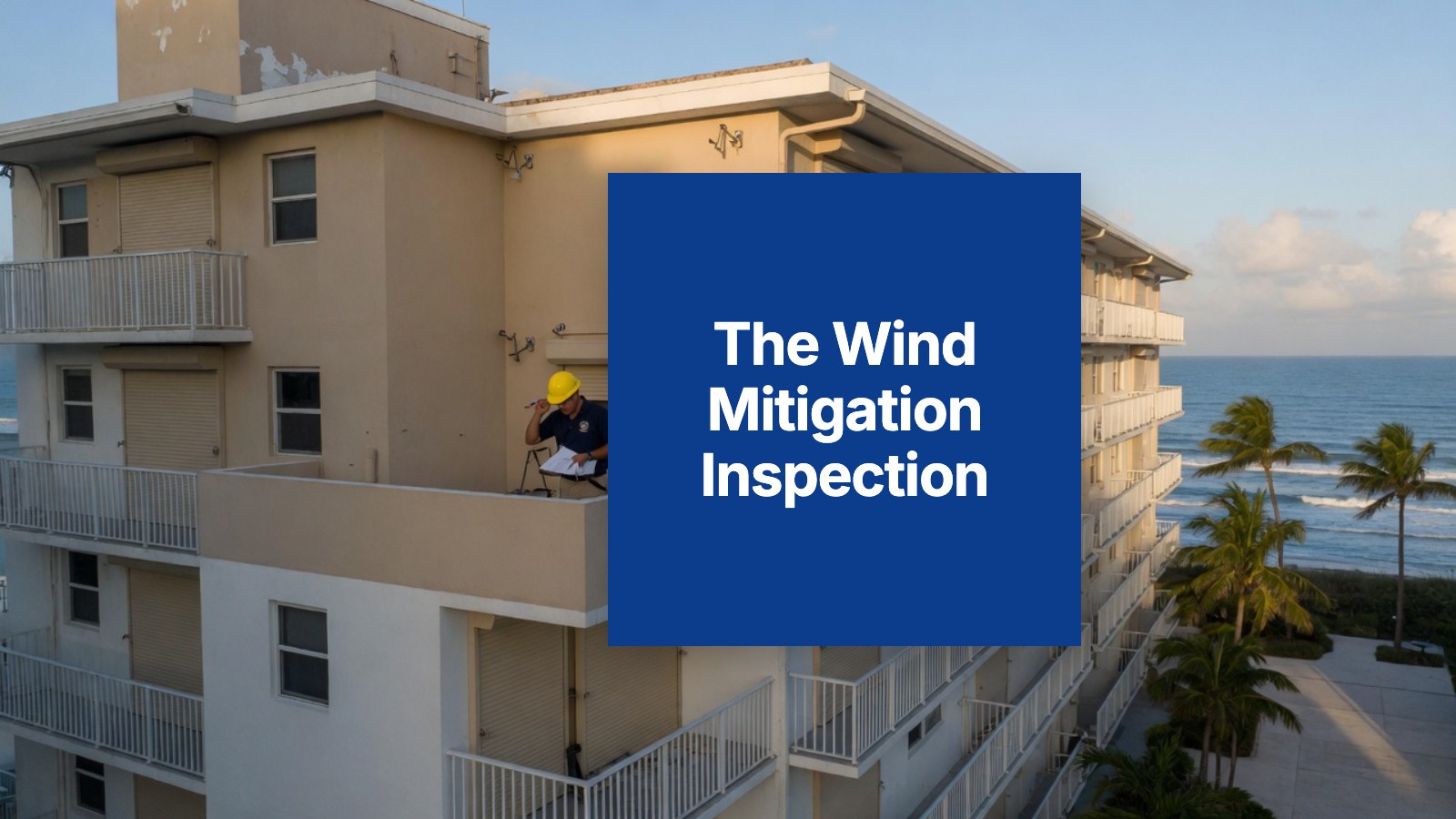
Our master policy costs $412,000 a year. That is about 30 cents of every dues dollar in this 128-unit oceanfront homeowners association (HOA). Last renewal the premium jumped 34 percent. The board cannot vote that line away. The one lever we still own is the wind mitigation inspection.
Wind mitigation is a licensed inspector walking the building and filling out Florida's Uniform Mitigation Verification Inspection Form, OIR-B1-1802. Insurers must offer credits for the wind-resistant features that form records. Florida Statute 627.0629 says so. A homeowners association that never gets the form filled out is paying the undiscounted rate on purpose.
I'm a board member and the treasurer of this condominium association. This is how we get the credit onto the policy before the next renewal.
Key takeaways
- Form OIR-B1-1802 is the document the carrier uses to credit the master policy. Inspections on or after 1 April 2026 must use Rev. 04/26.
- A report is good for five years, with no material change to the structure.
- Only a qualified inspector can sign. A friend with a ladder does not count.
- The credit does not apply itself. Someone on the board has to send the signed form to the agent.
- Level Z: openings that need replacement wipe every wind-mit credit, not just the glass line.
This is a board job, not a house job
Most wind mitigation articles talk to a homeowner with one roof. A condominium association has a different job. The association insures the buildings. The credits attach to the master policy. Unit owners do not schedule this inspection for the common roof. The board does.
The homeowners association owns the permits, the roof contract, the opening-protection invoices, and the last 1802, if one exists. Those papers live in someone's email until they live in the association's file. That is how credits get lost at turnover.
Florida publishes a second table, OIR-B1-1700, for non-single-family residences. The inspection form is 1802 on buildings up to three stories. Four stories and up need the Building Type II and III Mitigation Inspection Form too. Our oceanfront mid-rise is in that bucket. Ask the agent which discount table they filed, and which form they need.
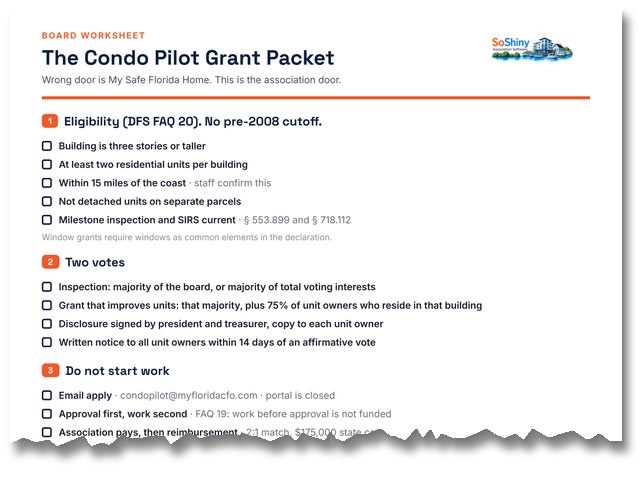
Do not send unit owners to My Safe Florida Home for the building. That program is for individual houses. The association door is the My Safe Florida Condominium Pilot. Get the 1802 first. The grant, if you qualify, is a separate packet. Do not book one inspector for both jobs. The board hires the 1802 inspector. DFS assigns the grant inspector.
What Form 1802 scores
The inspector rates the building on seven construction features:
- Building code and year built. Which Florida Building Code was in force at permit.
- Roof covering. Type, age, and code rating of the roof material.
- Roof deck attachment. Nail size, type, and spacing of the deck to the trusses.
- Roof-to-wall connection. Toe-nails, clips, single wraps, or double wraps. Rev. 04/26 adds performance-based retrofit options here.
- Roof geometry. A hip roof scores higher than a gable.
- Secondary water resistance. A sealed membrane under the covering. Yes or no.
- Opening protection. Impact-rated windows, doors, shutters, and garage doors. This credit is all or nothing. One unprotected opening kills it. Interior blinds and decorative shutters do not qualify.
Those features are the same list a house inspector uses. On a 128-unit building the attic, the roof, and every opening take longer. A single-family inspection often runs $75 to $150. A mid-rise costs more. Get a written bid.
What changed on 1 April 2026
The Florida Office of Insurance Regulation adopted OIR-B1-1802 Rev. 04/26, effective 1 April 2026. The rewrite sits on the 2024 Residential Wind-Loss Mitigation Study by Applied Research Associates.
New inspections on or after that date must use the new form. A valid report completed before 1 April 2026 stays good for its five-year window, with no material change to the structure.
Tighter documentation is the real change. The form wants at least one photograph or document for questions 2 through 9. A FORTIFIED Home Roof, Silver, or Gold certificate can prove the roof and opening questions. Inspectors record product-approval numbers and Notice of Acceptance numbers for opening protection, not a brand name. Roof slope and design wind speed region (ASCE 7-22) sit on the form now.
Level Z is the line that can wipe the credit. A building with openings that need replacement does not qualify for wind-mitigation rate differentials, no matter how good the roof is. One blown window left unrepaired is not a glass problem. It is a whole-form problem.
An upgrade you already paid for does nothing to the premium until it is on the new form. Re-roofed last year? New impact glass on the lobby? Get the inspector back.
Who can sign the form
Florida Statute 627.711(2) names the people who can certify the form:
- A licensed home inspector with hurricane mitigation training
- A licensed building code inspector
- A licensed general, building, or residential contractor
- A licensed professional engineer
- A licensed professional architect
A home inspector on that list needs three hours of CILB hurricane-mitigation training and a proficiency exam, not just the license. A professional engineer or a licensed contractor may send a direct employee. Everyone else inspects in person. An insurer may accept someone it recognizes as qualified.
Confirm the license before anyone climbs the roof. Collect a certificate of insurance from the inspector the same way you collect one from the roofer. An uninsured person on your roof is a claim waiting to happen. A form signed by anyone off that list is invalid. Knowingly filing a false form to get a discount is a first-degree misdemeanor.
The file on the table the morning the inspector arrives
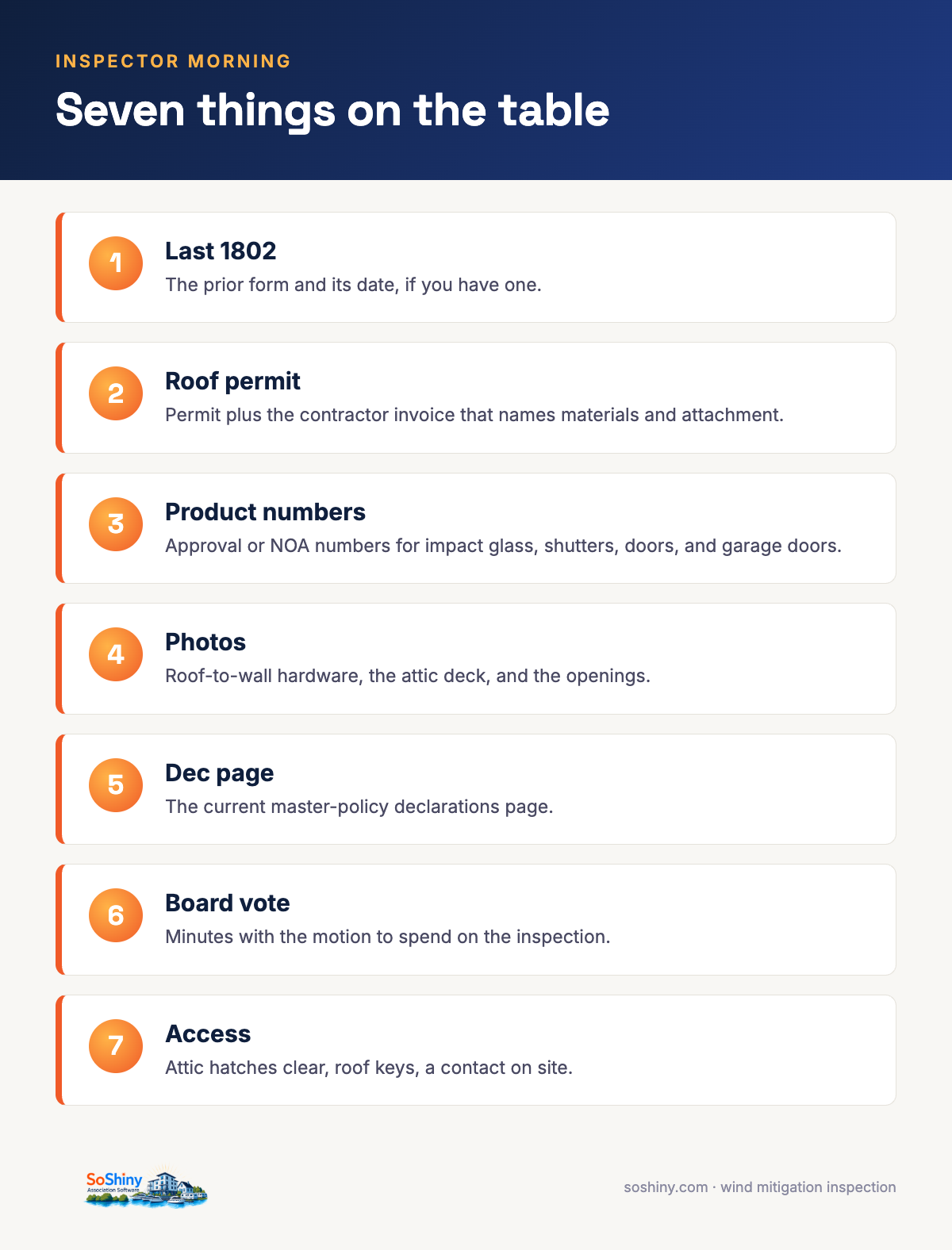
Build this packet the week before:
- The last OIR-B1-1802, if you have one, and its date
- Roof permit and the contractor's invoice that names materials and attachment
- Product-approval or NOA numbers for impact glass, shutters, doors, and garage doors
- Photos of roof-to-wall hardware, the attic deck, and openings
- The current master-policy declarations page
- Board minutes with the vote to spend on the inspection
- Access: attic hatches clear, roof access keys, a contact on site
Hand the inspector copies. Keep the originals in the association's document library, not on a director's phone. The next treasurer will need them in five years.
After the inspection, send the signed form to the agent the same week. Ask for the credit in writing. Put the new 1802 next to the dec page. Set a reminder at year four. Insurers are not required to warn you that the form is about to expire.
How the credit lands on the master policy
The form does not lower the bill by itself. The agent submits it. The carrier applies the filed credits to the windstorm portion of the premium. On the coast, wind is the largest slice of the master policy. Our $412,000 line is the proof.
Credits vary by carrier and by which features the building actually has. Opening protection is often the largest single credit. Roof shape, roof-to-wall connection, and secondary water resistance stack on top. The honest test is a quote with the form and a quote without it.
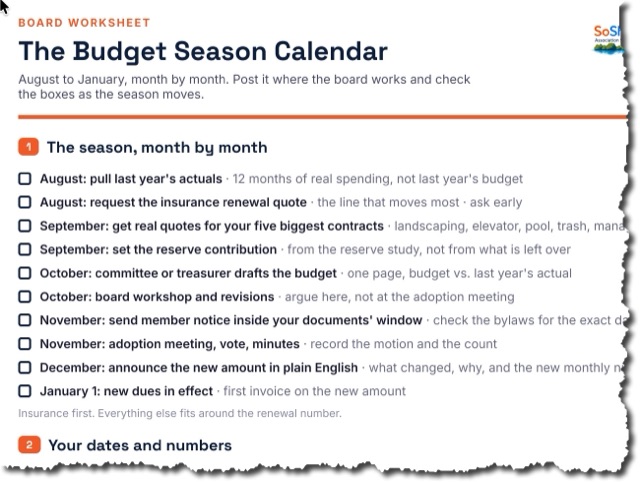
Time the inspection to budget season. Our budget season playbook already has a slot for the insurance quote. Drop the 1802 in that slot.
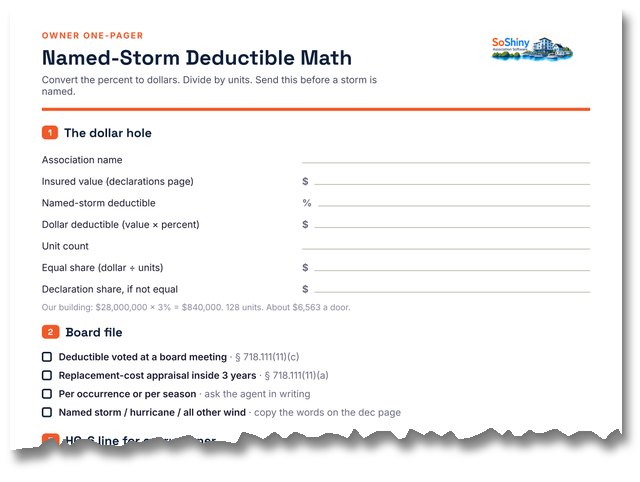
A named-storm deductible still sits under the credits. A building insured for $28 million with a 3 percent named-storm deductible still has an $840,000 hole on hurricane day. The inspection cuts the premium. It does not erase the deductible. Our insurance guide walks through that math, and the special assessment process is how a hole that size gets funded.
Florida's windstorm loss-mitigation construction rules live at §553.844. The form is the insurance side of the same job.
Do this before the next renewal
Start 90 days out. Hire a qualified inspector. Build the packet. Get the signed Rev. 04/26 form. Send it to the agent. File it where the next board can find it. That is the cheapest dues-cut a coastal homeowners association still controls.
If this guide helped, the tools it describes live in SoShiny, and so does everything else a self-managed board needs. The 30-day trial is free.
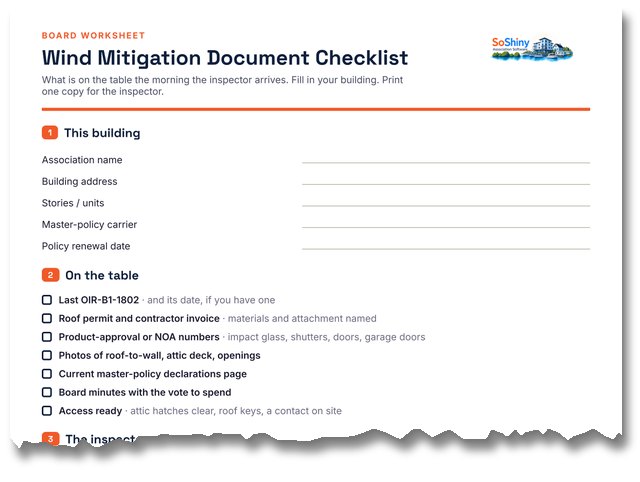
Wind Mitigation Document Checklist (PDF)
What is on the table the morning the inspector arrives: last 1802, roof permit, product numbers, photos, dec page, board vote, and site access. One page, made to print for the inspector.
FAQ about HOA wind mitigation inspections
What is a wind mitigation inspection for an HOA?
What is OIR-B1-1802?
Do we need a new inspection for the 2026 form?
Who can perform a wind mitigation inspection in Florida?
How long is a wind mitigation report valid?
How much does a wind mitigation inspection cost?
Does a condo association use the same form as a house?
Will My Safe Florida Home pay for our condo inspection?
How do the credits get onto the master policy?
Related reading
- From the blogMy Safe Florida Home Will Reject Your Condo. Here Is the fix
- From the blogYour Florida Condo Must Have a Website, says Statute 718.111(12)(g)
- From the blogYour Building's Hurricane Deductible Is $840,000. Here Is Your Share.
- From the blogHOA Insurance Basics: Master Policy, HO-6, and D&O, Explained
- GlossaryOIR-B1-1802
The idea of SoShiny came from a board seat. Kevin joined the board of a large condo HOA and found that one person ran the entire operation from memory. The books lived in Lotus 1-2-3, a program from the 1980s. If that person walked away, the whole community walked away with them. Something had to change. What started as a small fix grew into a full system. SoShiny now runs communities across 23 states and 3 countries.
Kevin has spent his career building teams and turning messy processes into simple products. He ships fast, coaches with candor, and favors action over talk. With SoShiny, he brings that same bias for action to an industry that still runs on spreadsheets, sticky notes, and paper announcements.
An Irish American builder and author, Kevin leads with honesty, grit, and faith. He has three sons and splits his time between Ormond Beach, Florida and Western New York.