
Every unit, every spot, every ownership percentage, in one record.
Units, lots, slips, and pads are the foundation everything else stands on. SoShiny gives each one a structured record: ownership percentage, assessments, occupants, documents, approvals, and every parking spot that belongs to it.

Units, lots, slips, pads, whatever your community calls the thing each member owns, are the foundation every other tool stands on. The directory is unit-anchored. Voting weight is per unit. Assessments derive from ownership percentages. Work orders, violations, architectural requests, and parking enforcement all point back at a unit. Get this record right and everything else works.
Most boards inherit this data as a thirty-year-old binder labeled "Units" and a spreadsheet somebody's brother built in 1996. Then the math stops adding up, nobody knows who owns spot 47, and every question takes three phone calls. SoShiny gives every unit and every parking spot the structured record it should have had on day one.
What lives on each unit record
- Identity. Unit number, building, floor, address, and type, so a 128-unit tower and a 240-lot subdivision both describe themselves the way their residents actually talk.
- Ownership percentage. The share of the common elements this unit carries. This is the number your assessments and your voting weight are both built on.
- Assessments. The annual and monthly amount for the unit, derived from its percentage rather than typed in by hand.
- Occupants. Owners and renters, current and past, with the dates each moved in and out. Past occupants stay attached rather than being deleted.
- Specifications. Bedrooms, baths, square footage, and floor plan, so the office is not measuring anything twice.
- Documents. Deeds, leases, renter insurance certificates, inspection reports, and approvals, filed against the unit instead of a shared drive.
- Photos. Unit and floor-plan images, visible to the owner and the office.
- Board notes. A private log of calls, letters, and conversations about this unit, which is what survives a change of board.
Every parking spot is its own record
- Assignment. Which unit holds the spot, whether it is deeded, assigned, or rented, and what it costs if it is rented.
- Type and location. Garage, covered, surface, or boat and trailer, with the level or zone it sits in.
- Permits. The sticker or decal number and its renewal date, so enforcement is checking a record rather than a memory.
- Accessibility. Handicap-tagged spaces are flagged, which matters both for assignment and for compliance.
- Vehicles. The registered vehicles tied to the unit, so a car in the wrong spot has a name attached in seconds.
Three ways this pays off
The math stops being manual. Monthly assessments derive from ownership percentage. Change one percentage after a subdivision or a plat amendment and every per-unit calculation follows. No spreadsheet that falls out of sync the day after the meeting.
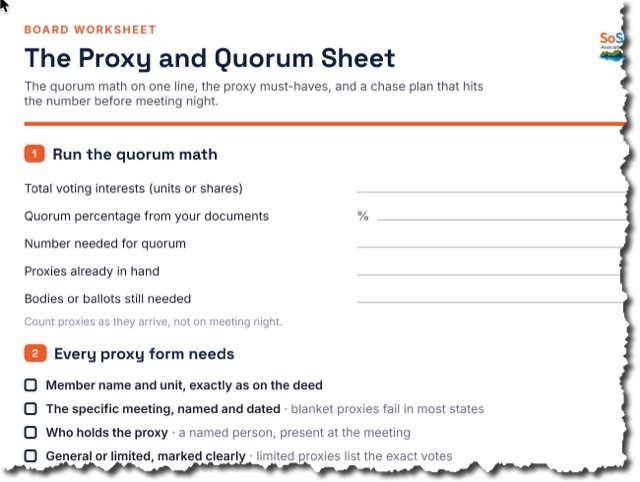
Quorum is calculated, not estimated. Voting counts the real weight per unit under Florida Statute 718.112(2)(b) or your state's equivalent. No vote that unravels a month later because somebody counted wrong, and no mid-meeting argument about whether garage parcels carry a vote.
Unit history outlives every board. The fence approval from 2018, the lease that ended in 2021, the decal issued in 2023, the paint color approved last summer: all still attached to the unit through twenty years of turnover. The next board admin inherits a working record instead of a binder.
How different communities use it
Condominiums. A 156-unit high-rise with a shared garage assigns spots per unit, enforces sticker permits from the record, and lets the ownership-percentage table drive the assessment math. When an owner closes, their dues, voting weight, parking spot, and floor plan are already in the right place.
Homeowners associations. A 240-lot planned community tracks lot-level detail plus every fence, deck, paint, and roof approval of the last decade, so an architectural dispute arrives with its own paperwork attached.
Marinas. A 90-slip marina treats each slip as a unit carrying vessel, owner, lease, and dockage rate, which finally answers "what is the maximum length overall in slip 14?" without opening the binder.
Mobile home parks and ROCs. Each pad is a unit, and the difference between owning the home and leasing the pad is tracked explicitly, so lot rent and ground-lease compliance live in one place. Seasonal occupancy stays visible through Who's Away.
Pairs well with
Member directory · Voting and ballots · Architectural review · Vehicle registry · Documents · Who's away · Violations · General ledger
What you get
How it works
Guides and terms for this feature
- From the blogWhat Does Community Software Cost? A Plain Breakdown
- From the blogThe Hidden Cost of Running Your HOA on Email and Spreadsheets
- GlossaryUnit
FAQ about unit and parking records
What counts as a unit in SoShiny?
How are ownership percentages used?
Can one unit have more than one parking spot?
What happens when a unit sells?
Can owners see their own unit record?
Do we have to enter every unit by hand?
Does this replace our official condominium documents?
Replace the binder. Once. Forever.
Built for

Condo Association Software That Boards Actually Use
Owners can never find the rules and the board lives in a buried email thread. SoShiny puts your declaration, bylaws, votes, and documents in one searchable portal — plus a free pub…
Cooperative Association Software Built for Co-op Boards
Housing co-ops are not condos and not HOAs — shareholders, proprietary leases, and a board of directors that has to actually enforce the bylaws. SoShiny gives your co-op a searchab…

HOA Management Software Without the Manager Markup
Most boards pay a management company per door for software they barely touch. SoShiny gives your HOA the same tools — violations, voting, documents, directory, and a public website…

Marina Management Software for Slips, Members & Boats
Slip assignments live in a spreadsheet and insurance certificates expire without anyone noticing. SoShiny tracks your members, vessels, slips, and COIs in one portal — with amenity…

Software for Mobile Home Parks & ROCs
Resident-owned mobile home communities, manufactured-housing co-ops, and 55+ parks. SoShiny gives the board a single portal for lot management, online voting, park rules, and share…

Software for Deed-Restricted Communities & POAs
Recorded covenants. Architectural review. Per-lot compliance. SoShiny gives your POA or deed-restricted subdivision a single portal for the covenants residents agreed to, the ARC r…

55+ Community Software Residents Can Actually Read
Too much community tech assumes everyone has a smartphone and 20/20 vision. SoShiny meets residents where they are — a lobby announcement TV, plain email broadcasts, and clear, lar…