
HOA Insurance Basics: Master Policy, HO-6, and D&O, Explained


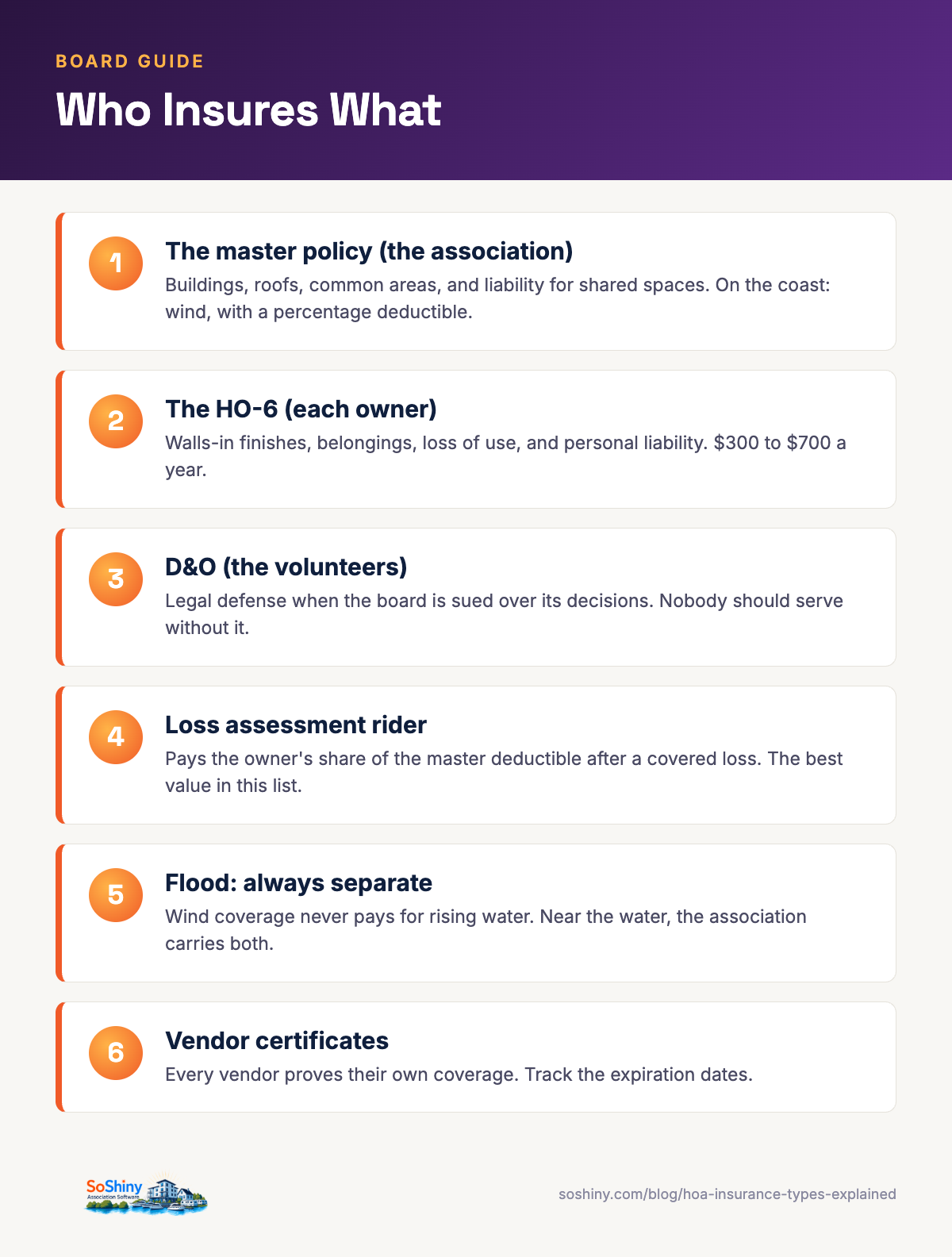
What insurance covers a homeowners association (HOA) or condo community? Three policies, working together: the master policy the association buys, the HO-6 policy each owner buys, and the D&O policy that protects the volunteers making the decisions. I'm a board member and the treasurer of a 128-unit oceanfront condo in Florida, and insurance is the largest line in our budget: $412,000 a year, about 30 cents of every dues dollar. This guide explains what each policy does, where one ends and the next begins, and the two riders that save owners real money.
Key takeaways
- The declaration draws the wall where coverage changes hands. Read it before a claim, not after.
- Every owner needs an HO-6 policy with loss assessment coverage. It is the cheapest protection in this entire guide.
- D&O coverage protects the volunteers. No sensible person should sit on a board without it.
Who insures what? The wall where coverage changes hands
The association's master policy covers the buildings and common areas. The owner's HO-6 covers the inside of the unit and everything in it. The exact boundary comes from your declaration and state law, and it lands in one of three patterns. Bare walls: the master policy stops at the unfinished wall, and the owner insures cabinets, flooring, and fixtures. Single entity: the master policy includes fixtures as originally built, and upgrades are the owner's. All-in: the master policy takes the interior fixtures too, and the HO-6 mostly covers belongings and liability.
Florida condos run close to the single-entity pattern by statute: the association insures the buildings at replacement cost, and owners cover their own flooring, cabinets, appliances, and personal property. The one-sentence version for owners: if you turned the building upside down and shook it, what falls out is yours to insure.
The master policy: what $412,000 a year buys
Our master policy bundles three things. Property coverage rebuilds the buildings after fire, wind, or water from above. General liability pays when a guest slips at the pool. And on the coast, wind is the number that drives the premium.
Coastal wind coverage carries a named-storm deductible written as a percentage of the insured value, commonly 2 to 5 percent. Run that math once and you never forget it: a building insured for $28 million with a 3 percent named-storm deductible has an $840,000 deductible when a hurricane hits. That number is why the loss assessment rider below matters, and why our reserve conversation never stops. Flood is a separate policy entirely: wind coverage does not pay for rising water, and associations near the water carry both.
The premium is not polite about any of this. Ours rose 34 percent in a single renewal, and that one line moved dues more than every other line combined. Our budgets and reserves guide covers how to absorb that honestly.
The HO-6: the owner's half of the handshake
An HO-6 policy typically runs $300 to $700 a year and covers four things: the interior build-out from the walls in, personal property, loss of use if the unit becomes unlivable, and personal liability. Lenders require one. Boards should want every owner to carry one anyway, and the two riders below are where the real protection lives.
- Loss assessment coverage. When a covered loss hits the association and owners are assessed for the master deductible, this rider pays your share, commonly $25,000 to $50,000 of protection for a few dollars a month. After the deductible math above, this is the best value in community insurance.
- Water backup coverage. Sewer and drain backups are a common condo loss and a common exclusion. The rider costs little and ends a very specific argument.
What is D&O insurance, and why serve nowhere without it?
Directors and officers coverage pays the legal defense when the board itself is sued over its decisions: a disputed election, a records fight, an owner who believes a rule was enforced unevenly. The volunteers are not paying that defense from their own pockets, and that is the entire point. A typical association D&O policy costs a few hundred to a couple thousand dollars a year, which is the cheapest way a community will ever recruit a treasurer.
Check three things on the D&O: that it covers non-monetary claims (most board suits ask for actions, not damages), that past board members stay covered after they leave, and that the property manager is included when one acts for the board.
The deductible handshake: how one claim actually flows
A supply line bursts on the fourth floor and soaks three units. The master policy covers the building repairs, minus its deductible. The declaration decides who pays that deductible: often the association as a common expense, sometimes the owner whose unit held the failed part. Each owner's HO-6 picks up their flooring, cabinets, and belongings. And when the association assesses owners for the master deductible, the loss assessment rider on each HO-6 answers.
Every one of those steps goes smoother when the documents were read before the water moved. The boards that fight about claims are the ones discovering their deductible allocation for the first time with wet drywall in the hallway.
Vendor insurance: the certificate file
One more insurance job belongs to the board: proof that every vendor on the property carries their own. An uninsured roofer hurt on your roof can become the association's claim. Collect a certificate of insurance from every vendor, note the expiration date, and re-collect at renewal. Our COI tracker flags expiring certificates so nobody works uncovered.
Renewal season: the treasurer's playbook
Start 90 days before renewal. Request the loss runs, gather the mitigation paperwork that earns credits (roof reports, wind mitigation inspections, secondary water resistance in Florida), and put an independent agent in competition with the incumbent. Budget the increase honestly: pretending insurance will stay flat is how boards end up explaining a mid-year shortfall. Owners can read the whole picture in your official records, and Florida boards should know the statutes that set the insurance floor.
One last habit worth stealing: once a year, put a one-page insurance summary in front of owners. The three policies, the deductibles, and the sentence "here is why you need an HO-6 with loss assessment coverage." Ten minutes of reading prevents the worst day of an owner's life from doubling as a financial surprise.
If this guide helped, the tools it describes live in SoShiny, and so does everything else a self-managed board needs. The 30-day trial is free.
Enjoying this? Get the next one by email.
Practical guides for self-managed boards, written by a board treasurer. About one a month.
FAQ about HOA insurance
What insurance does an HOA or condo association need?
What does the HOA master policy cover?
What does an HO-6 condo policy cover?
What is the difference between bare walls and all-in coverage?
What is D&O insurance for an HOA board?
What is loss assessment coverage?
Who pays the master policy deductible?
Does the master policy cover flood damage?
Why did association insurance get so expensive?
Related reading
- From the blogHOA Budgets and Reserves in Plain Language
- From the blogSpecial Assessments: How Boards Decide, Notice, and Collect Them Fairly
- From the blogHow Florida HOA Board Elections Actually Work — a Plain-English Guide
- From the blogWhat New Board Members Never Get Told Before Their First Meeting
- From the blogThe Florida Board's Compliance Guide: Chapters 718, 719, and 720
The idea of SoShiny came from a board seat. Kevin joined the board of a large condo HOA and found that one person ran the entire operation from memory. The books lived in Lotus 1-2-3, a program from the 1980s. If that person walked away, the whole community walked away with them. Something had to change. What started as a small fix grew into a full system. SoShiny now runs communities across 23 states and 3 countries.
Kevin has spent his career building teams and turning messy processes into simple products. He ships fast, coaches with candor, and favors action over talk. With SoShiny, he brings that same bias for action to an industry that still runs on spreadsheets, sticky notes, and paper announcements.
An Irish American builder and author, Kevin leads with honesty, grit, and faith. He has three sons and splits his time between Ormond Beach, Florida and Western New York.