
The Florida Board's Compliance Guide: Chapters 718, 719, and 720


Florida community boards carry a legal weight many volunteers never signed up for. The state writes specific rules for how you meet, vote, notice owners, and keep records. Miss them and you expose the board. Here is a plain map of the three statutes that matter most.
- Key takeawaysFlorida has three separate community statutes: Chapter 718 for condos, Chapter 719 for cooperatives, Chapter 720 for HOAs. They are not interchangeable.
- Most compliance failures come from missed notice, thin minutes, or fines issued without the required hearing, not from bad intent.
- A board that can pull the right statute section in seconds avoids almost every common slip.
Chapter 718: condominiums
Chapter 718 governs condo associations. It sets rules for board meetings, owner notice, official records, financial reporting, and elections. It spells out how much notice you owe before a meeting and what records an owner can request. If you run a condo, this is your rulebook.
Chapter 719: cooperatives
Chapter 719 covers co-ops, where members own shares rather than units. The structure differs from a condo, and so do parts of the law. Boards often miss this and apply condo rules by habit. Read 719 if your community is a cooperative.
Chapter 720: homeowners associations
Chapter 720 governs HOAs. It covers governing documents, member meetings, fining and suspension, and the rules for amending covenants. The notice and record-keeping duties differ from the condo statute, so an HOA board should not lean on 718.
Where boards slip
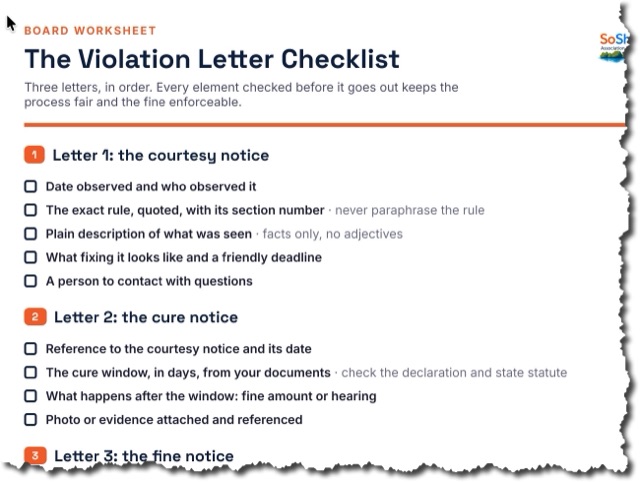
The common failures are simple. Too little notice before a meeting. Minutes that do not capture the motions. Records an owner asked for and never received. A fine issued without the required hearing. None of these are hard to avoid. They happen when the rule is not in front of the board at the right moment.
Keep the statutes at hand
SoShiny indexes all 232 sections of Chapters 718, 719, 720, and 553, and makes them searchable from inside the portal. When a question comes up in a meeting, you find the section in seconds instead of hunting a PDF. The board meeting tool builds an agenda, records motions with per-member votes, and prints a notice and minutes that match the statute's format.
This is general information, not legal advice. For a specific dispute, talk to an attorney. For everyday compliance, keep the rules one search away.
Why this falls on volunteers
Most board members never trained in association law. They volunteered to help their community and inherited a statute book they never asked for. That gap is where trouble starts. A missed notice or a fine issued without a hearing is rarely bad intent. It is a volunteer who did not know the rule, or could not find it in time.
A board does not need to memorize the chapters. It needs the right section in front of it at the right moment, plus tools that build compliant notices and minutes by default. Make the compliant path the easy path and most slips never happen. That is the real value of keeping the statutes inside the same portal where you run the meeting. The rule and the action live in one place, so doing it right takes no extra effort.
Frequently asked questions
Which Florida statute applies to my community?
Chapter 718 governs condominiums, Chapter 719 governs cooperatives (where members own shares rather than units), and Chapter 720 governs homeowners’ associations. Each has its own notice, records, and meeting rules.
How much notice must a Florida board give before a board meeting?
For most board meetings the statute requires at least 48 hours posted notice, and certain meetings (assessments, rules, fines) require longer mailed or hand-delivered notice. The exact rule depends on which chapter applies. The SoShiny board-meeting tool builds notices that match the statute’s format.
Who handles HOA disputes in Florida?
Condo (Chapter 718) and cooperative (Chapter 719) disputes go to the Florida Division of Condominiums, Timeshares, and Mobile Homes (DBPR). HOA (Chapter 720) disputes are not under DBPR. They go to civil court, with §720.311 pre-suit mediation required for many matters.
Do Florida HOAs have to keep meeting minutes?
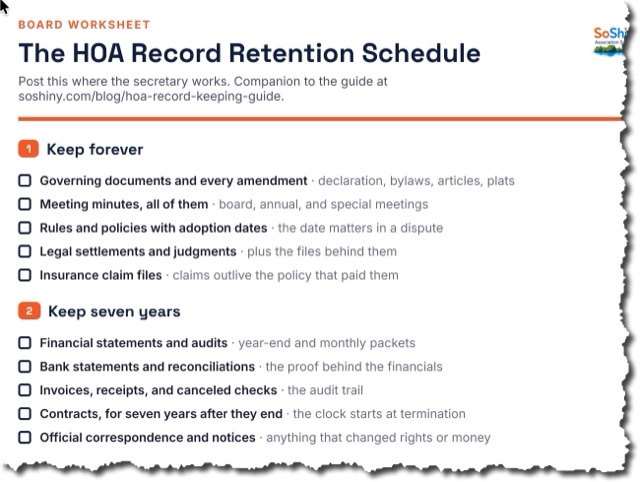
Yes. Each chapter requires the association to keep official records that include meeting minutes, and owners have a statutory right to inspect them. Minutes that fail to capture motions, votes, and notices are a common audit weakness.
Is Chapter 720 the same as Chapter 718?
No. Chapter 720 covers HOAs and uses a different framework from Chapter 718 (condos). The notice, fining, and amendment rules differ. Applying condo rules to an HOA, or the reverse, is one of the most common Florida board mistakes.
Enjoying this? Get the next one by email.
Practical guides for self-managed boards, written by a board treasurer. About one a month.
Related reading
- FeatureFlorida Statutes
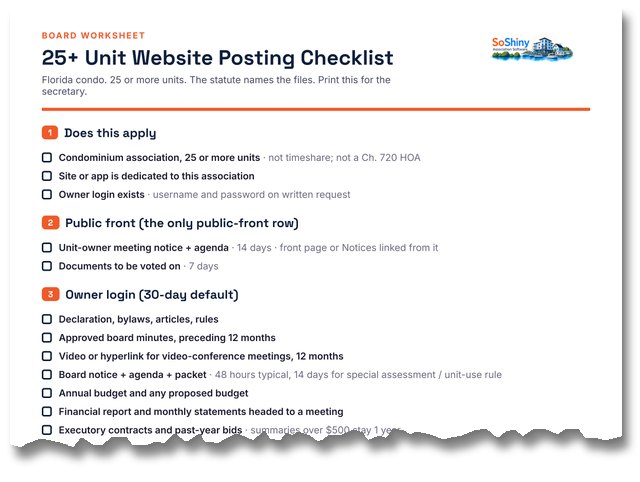
- From the blogYour Florida Condo Must Have a Website, says Statute 718.111(12)(g)
- From the blogHow Florida HOA Board Elections Actually Work — a Plain-English Guide
- From the blogThe Florida Condo Violation Workflow, Step by Step
- From the blogMy Safe Florida Home Will Reject Your Condo. Here Is the fix
SoShiny Software Team is the collective byline for posts written by the people building SoShiny: engineers, designers, and the board members we work with every day.
We write about what actually works for community associations: governance that holds up under scrutiny, communication that residents read, and software that doesn't fight the people using it.
SoShiny is association management software for HOAs, condominium associations, and housing co-operatives anywhere in the United States. Headquartered in Daytona Beach, Florida. Built by people who've sat on a board.