
Late Dues: A Firm, Fair Process for Collecting From Neighbors


The hardest part of collecting late dues is not accounting. It is that the debtor coaches your kid's soccer team. Volunteer boards freeze on delinquencies for exactly this reason, and the freeze is expensive. A 150-unit community with 8 percent delinquency at $250 a month is short $36,000 a year, quietly funded by the neighbors who pay.
Key takeaways
- A written collection policy takes the decision away from personalities: the same timeline for every account, every time.
- The first three notices come from the system, not from a neighbor. Nobody freezes on a form letter.
- Payment plans collect more than lawyers. The lien is the last step, never the first letter.
The way out is to take the decision away from personalities and give it to a process. When the policy decides and the system sends the letters, no board member ever has to choose between a friendship and a fiduciary duty. Here is how to build it.
Why boards freeze, and what it costs
Ask a board why a two-year delinquency was never addressed and you hear the same answers. "We knew they were going through a divorce." "Nobody wanted to be the bad guy." "We figured they would catch up."
Sympathy is human and appropriate. Selective sympathy is a legal problem. A board that waives fees for a friend and pursues a stranger invites a claim of unequal treatment, and courts take those seriously. The paying owners bear the shortfall either way, through thinner reserves or a future assessment. Kindness to one neighbor becomes a tax on ninety others.
A written policy solves both halves. It carries the firmness, so people do not have to, and it applies identically to the coach and the stranger.

The one-page collection policy
Adopt this by board motion, record it in the minutes, and publish it to every owner before it ever gets used:
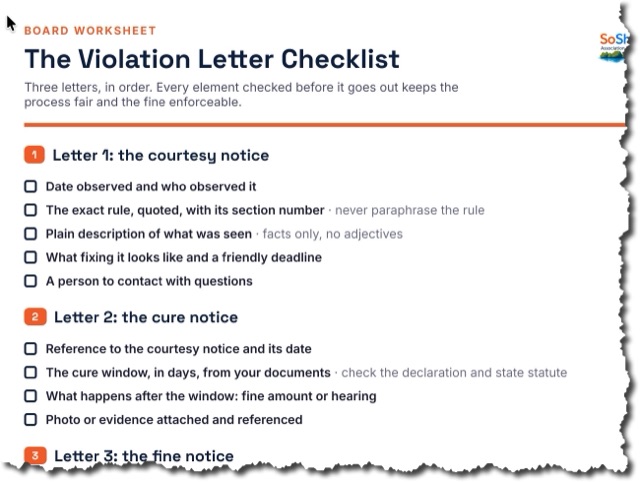
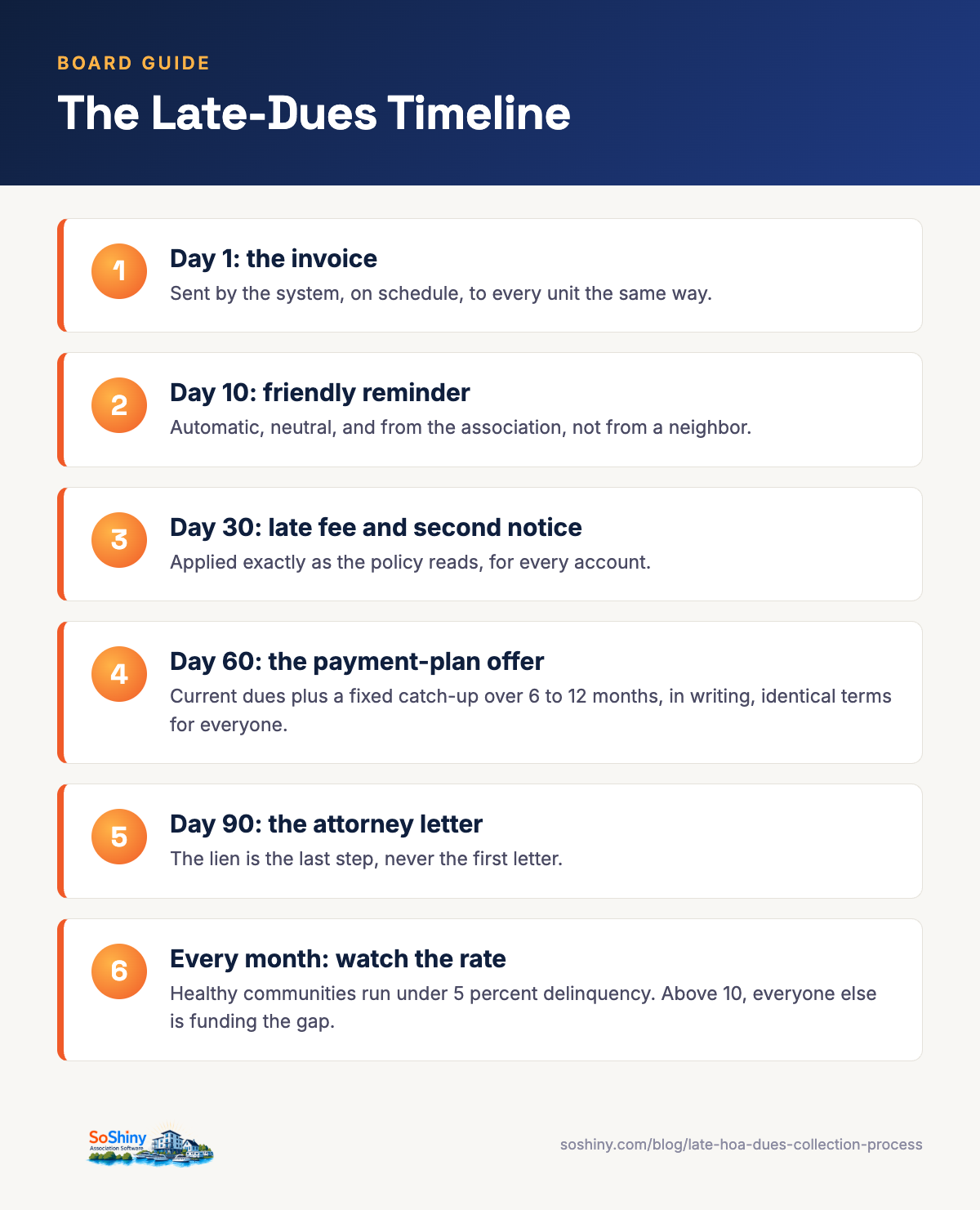
- Day 1: dues are due. Day 10: friendly reminder goes out automatically.
- Day 30: late fee applies, as your documents and state law allow. Second notice names the amount and the payment-plan option.
- Day 60: formal demand letter from the association, sent certified. Amenity privileges suspend where your documents permit.
- Day 90: the account goes to the attorney or a licensed collection path: lien, then the remedies your state allows.
- At any point: a standard payment plan is available, in writing, with the same terms for everyone.
The exact days matter less than the consistency. Every account, every time, no exceptions and no favorites. Boards that follow a published timeline report something surprising: owners get less angry, not more. A known process feels like rules. Discretion feels like judgment.
Let the system send the first three notices
The early steps should involve no human at all. The portal watches the ledger, and unpaid accounts get the day-10 and day-30 notices automatically, in the neighborly tone you wrote once. The treasurer never composes an awkward email, and the debtor never feels personally singled out, since everyone knows the notices are automatic.
Automation adds the thing manual collection never has: a perfect record. Every invoice, notice, fee, and payment carries a date stamp in one account history. If an account ever reaches an attorney or a court, the file is already complete. Boards running on memory and inbox archaeology settle weak cases they should have won.
Payment plans: the tool that collects the most
Here is the practical secret of HOA collections: most delinquent owners are not deadbeats. They are people in a bad year. A job loss, a medical bill, a divorce. They want to pay and cannot, this month.
A standard payment plan collects more than a hard line does, at lower cost than a lawyer. Offer the same terms to everyone: current dues plus a fixed catch-up amount, over six to twelve months, in writing, with the timeline pausing as long as the plan is kept. Miss two payments and the clock resumes where it stopped.
The plan preserves the two things worth preserving: the association's money and the neighbor's dignity. And the uniform terms protect the board from the favoritism trap.
When it goes to the lawyer
Past day 90, hand it off completely. Liens, foreclosure decisions, and statutory notices have technical requirements that vary by state, and errors can void the association's claim. Budget for it: collection attorneys commonly work on flat fees per stage, and in many states the fees get added to the delinquent account rather than borne by the association.
Two rules for the legal stage. The board votes to escalate, in executive session, and the minutes record the vote by account number, never by name. And once escalated, board members stop discussing the account with the owner entirely. Side conversations undo lawyers' work.
The number to watch every month
Track one metric at every meeting: total delinquent dollars and its direction. Healthy communities run under 5 percent of annual assessments. The number belongs in the treasurer's report and the minutes, by totals, never names, in open session.
Communities that adopt the policy, automate the notices, and offer the standard plan report delinquency falling by a third to half within a year. Not through toughness. Through consistency, which is what fairness looks like in bookkeeping.
If this guide helped, the tools it describes live in SoShiny, and so does everything else a self-managed board needs. The 30-day trial is free.
The Late-Dues Collection Timeline (PDF)
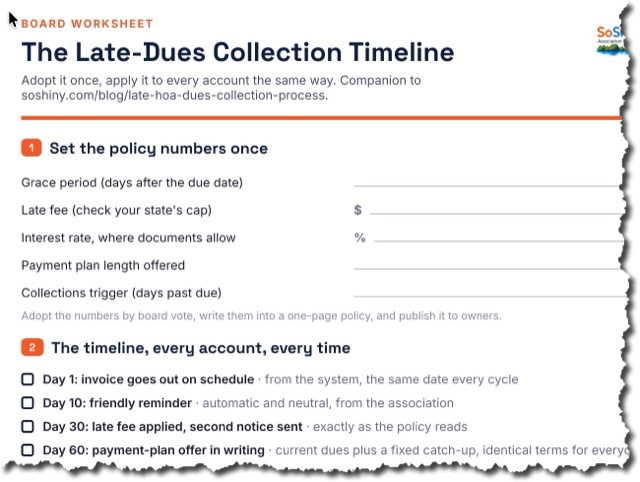
The policy numbers to set once, the day 1 to day 90 timeline for every account, and the guardrails that keep collection fair. One page for the board packet.
FAQ about late HOA dues
What is a normal HOA delinquency rate?
Can an HOA charge late fees and interest?
Can we waive a late fee for a good neighbor?
What is an HOA assessment lien?
Can an HOA really foreclose over unpaid dues?
Should we suspend amenities for delinquent owners?
What makes a good payment plan?
Do we name delinquent owners at meetings?
Who pays the attorney in a collection case?
How does SoShiny handle late dues?
Related reading
- From the blogHow to Collect HOA Dues Without Chasing Your Neighbors
- From the blogSpecial Assessments: How Boards Decide, Notice, and Collect Them Fairly
- From the blogThe HOA Budget Season Playbook: Raise Dues Without a Revolt
- From the blogSelf-Managed HOA or Management Company? Run the Real Numbers
- From the blogElected to an HOA Board, Now What? Your First 30 Days
The idea of SoShiny came from a board seat. Kevin joined the board of a large condo HOA and found that one person ran the entire operation from memory. The books lived in Lotus 1-2-3, a program from the 1980s. If that person walked away, the whole community walked away with them. Something had to change. What started as a small fix grew into a full system. SoShiny now runs communities across 23 states and 3 countries.
Kevin has spent his career building teams and turning messy processes into simple products. He ships fast, coaches with candor, and favors action over talk. With SoShiny, he brings that same bias for action to an industry that still runs on spreadsheets, sticky notes, and paper announcements.
An Irish American builder and author, Kevin leads with honesty, grit, and faith. He has three sons and splits his time between Ormond Beach, Florida and Western New York.