
How to Collect HOA Dues Without Chasing Your Neighbors


The treasurer of a 200-unit community spends about six hours a week on dues. Not on accounting. On chasing. She sends the reminder, waits, sends another, then checks the bank site and updates the spreadsheet by hand.
Key takeaways
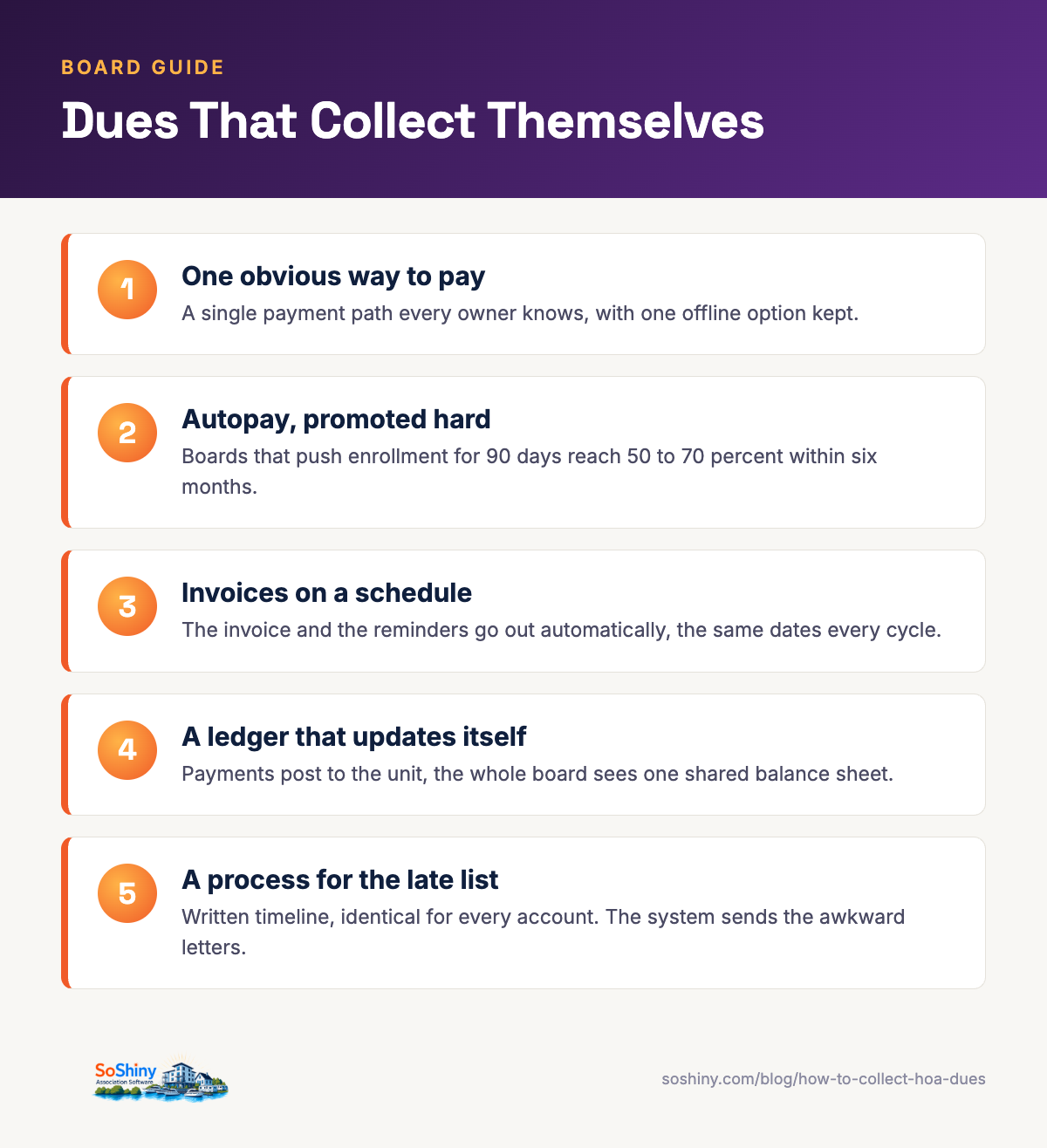
- Chasing is a design problem: one obvious way to pay, autopay promoted hard, invoices and reminders on a schedule.
- Boards that promote autopay for 90 days reach 50 to 70 percent enrollment within six months.
- Handle the late list with a written process. The system sends the awkward letters.
That is 300 hours a year on one job. The job is not hard. It is just built wrong. This post gives you a dues system that runs itself, and it takes one evening to set up.
Why chasing happens in the first place
Most boards collect dues the way they did in 1995. An owner mails a check, or hands one to a board member at the mailbox. Some owners pay through a bank bill-pay service with no memo line. The treasurer then plays detective. Which unit sent $250? Was that for July or for the pool key?
The pattern has three broken parts:
- Owners have no easy way to pay, so they delay.
- Payments arrive with no unit number attached, so matching takes time.
- The record lives in a spreadsheet one person updates by hand, so errors creep in.
- We've even seen HOAs using software from the 1990's like Lotis 123, Peachtree, MS Money and the disk version of Quicken
Fix those three parts and the chasing stops. Here is the order to fix them in.
Step 1: Give every owner one obvious way to pay
Confusion kills collection. When owners can pay five different ways, the treasurer reconciles five different streams. Pick one primary channel: an online portal that accepts cards and bank transfers.
Keep checks as a fallback for the two or three owners who insist. But the letter, the invoice, and the website all point to one link. One channel means one report to check.
A 60-unit board in Arizona made this switch last year. Online payment adoption hit 80 percent in two months. The treasurer's reconciliation time dropped from three hours a month to twenty minutes.
Step 2: Turn on autopay and promote it hard
Autopay is the single biggest lever you have. An owner who enrolls once never pays late again. No reminder needed, no awkward hallway conversation, no late fee dispute.
Promote it three ways:
- Put an enrollment link in every invoice and every newsletter for 90 days.
- Mention it at the annual meeting with one slide and one sentence: "Enroll tonight and never think about dues again."
- Ask new owners to enroll at closing. Title companies will include your welcome sheet if you ask.
A realistic target is 60 percent enrollment within six months. At that level, your late list shrinks from twenty names to five.
Step 3: Automate the invoice and the reminder
The treasurer should never type an invoice. The system generates it on the first of the month, emails it to every owner, and logs the send. Then the reminder schedule runs on rails:
- Day 1: invoice goes out.
- Day 10: friendly reminder to anyone unpaid.
- Day 20: second reminder with the late-fee date named.
- Day 30: late fee applies, and the account shows it automatically.
Write the reminder text once, in a neighborly tone, and let the schedule do the sending. Owners stop feeling singled out, and the treasurer stops feeling like a bill collector. The system sent the note, not a neighbor.
Step 4: Let the ledger update itself
Here is where spreadsheets fail. Every payment requires a human to notice it, match it, and type it. Each step invites a mistake. One wrong cell and an owner gets a late notice she does not deserve. Now the board spends a meeting on an apology instead of on business.
When payments flow through one portal, the ledger updates the moment the money lands. The owner sees her balance from her phone. The treasurer sees the whole community on one screen: paid, pending, late. Nobody types anything.
That visibility matters for trust. An owner who can check her own history stops emailing the board to ask about it. Those emails were four hours a week on their own.
Step 5: Handle the late list with a process, not a personality
Even a great system leaves a few late payers. The board's job is to treat every one of them the same way. A written collection policy protects the board from claims of favoritism, and it protects friendships too.
A simple policy fits on one page:
- Late fee amount and the day it applies.
- When a payment plan is offered, and the standard terms.
- When the account goes to a collection letter.
- When the board involves an attorney, and who votes on that.
Adopt it at a board meeting, record the vote in the minutes, and publish it to owners. Then follow it every time. The policy does the uncomfortable part, so no board member has to improvise on a neighbor's doorstep.
What the numbers look like after the switch
Boards that run this system report the same pattern. Collection rates climb 5 to 10 points. The six weekly hours of chasing drop below one. Late-payment disputes almost vanish, since every invoice, payment, and reminder sits in one record with a date stamp.
The treasurer's job changes shape. She reviews instead of chases. She reports instead of reconciles. And when she someday hands the role to the next volunteer, the system hands over with her. Nothing lives in her inbox.
Set it up in one evening
Pick the portal, load the unit list, set the dues amount, and write the reminder schedule. That is the whole project. One evening of setup buys back 300 hours a year.
If this guide helped, the tools it describes live in SoShiny, and so does everything else a self-managed board needs. The 30-day trial is free.
Enjoying this? Get the next one by email.
Practical guides for self-managed boards, written by a board treasurer. About one a month.
FAQ about collecting HOA dues
Can an HOA require owners to pay dues online?
What percentage of owners typically enroll in autopay?
How much should an HOA late fee be?
When should a board send an account to collections?
Do payment processors charge fees, and who pays them?
Can owners see their own payment history?
What happens to the dues records when the treasurer leaves?
Should the board offer payment plans?
How does SoShiny handle dues collection?
Related reading
- From the blogElected to an HOA Board, Now What? Your First 30 Days
- From the blogThe Confident Self-Managed HOA Board, Part 4: Sharing the Load Without Burning Out
- From the blogThe Confident Self-Managed Board, Part 1: The Fear of Going It Alone
- From the blogSelf-Managed vs. Management Company vs. Software: What's Right for Your Community
- From the blogSpecial Assessments: How Boards Decide, Notice, and Collect Them Fairly
The idea of SoShiny came from a board seat. Kevin joined the board of a large condo HOA and found that one person ran the entire operation from memory. The books lived in Lotus 1-2-3, a program from the 1980s. If that person walked away, the whole community walked away with them. Something had to change. What started as a small fix grew into a full system. SoShiny now runs communities across 23 states and 3 countries.
Kevin has spent his career building teams and turning messy processes into simple products. He ships fast, coaches with candor, and favors action over talk. With SoShiny, he brings that same bias for action to an industry that still runs on spreadsheets, sticky notes, and paper announcements.
An Irish American builder and author, Kevin leads with honesty, grit, and faith. He has three sons and splits his time between Ormond Beach, Florida and Western New York.