
Homeowners Association Reserve Funds in Plain English

A 90-unit community in North Carolina got its roof quote in March: $380,000. The reserve account held $41,000. The board's only option was a special assessment of about $3,800 per unit, due in 90 days. Four owners had to borrow to pay it. Every one of those owners had paid dues on time for a decade.
Key takeaways
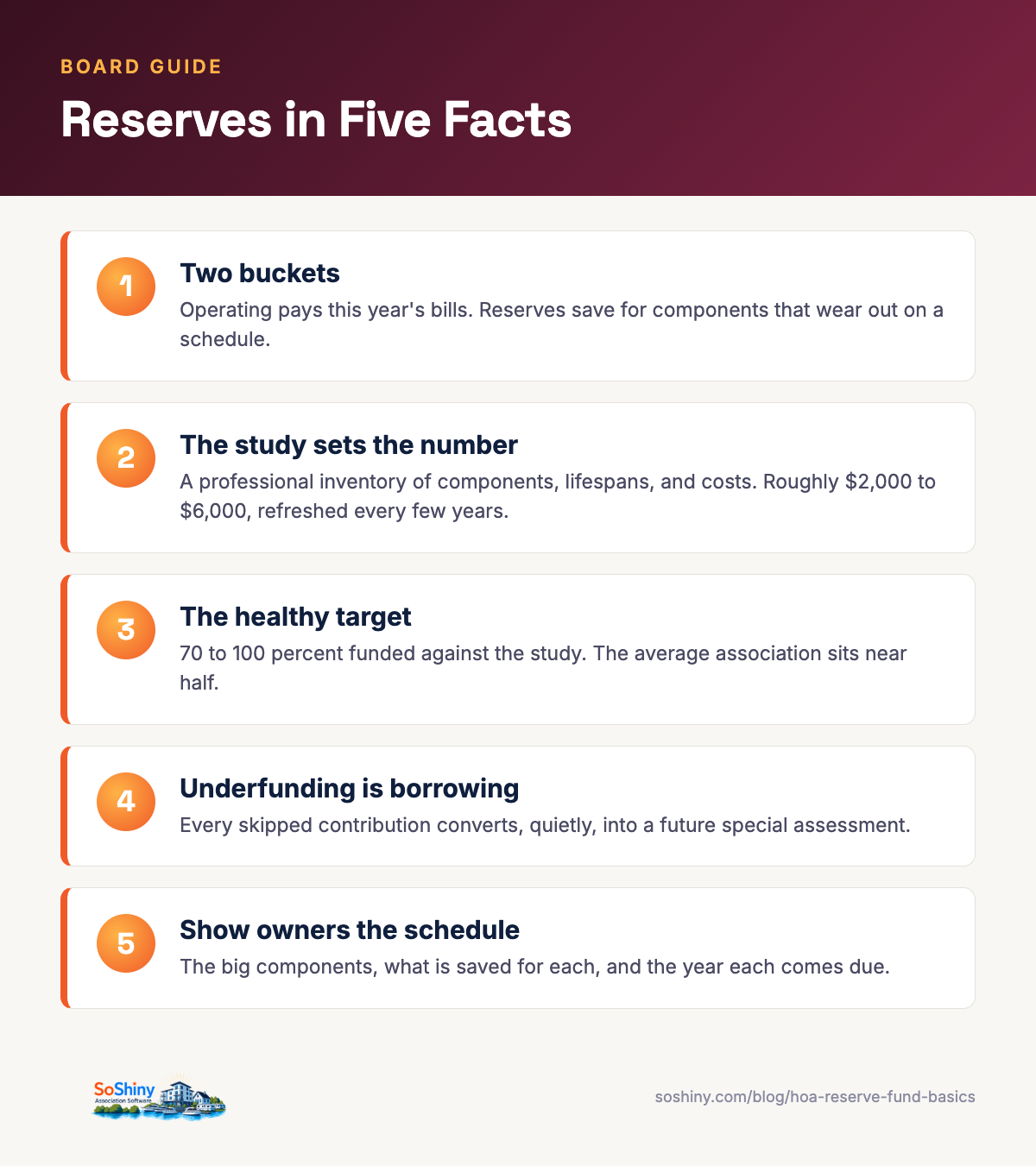
- Reserves are savings for components that wear out on a schedule. The roof is never a surprise, the bill is a choice.
- The target comes from a reserve study: 70 to 100 percent funded is healthy, and the average association sits near half.
- Every year of underfunding converts, quietly, into a future special assessment.
Nothing about that roof was a surprise. Shingles last 20 to 25 years, and these were 24 years old. The surprise was manufactured over two decades of underfunding, one "let's keep dues low" vote at a time. Here is how reserve funds work, in plain English, and how to keep your community off that path.
Two buckets: operating and reserves
An association's money lives in two buckets. The operating fund pays this year's bills: landscaping, insurance, utilities, the pool company. The reserve fund saves for big repairs that arrive on a schedule: roofs, paving, paint, pool resurfacing, fences, elevators.
The core idea is fairness across time. A roof wears out over 25 years, so 25 years of owners should each pay a slice of it. When reserves run empty, the owners who happen to live there in the replacement year pay for everyone who came before. That is what a special assessment is: a bill for past boards' decisions.
The reserve study: your community's crystal ball
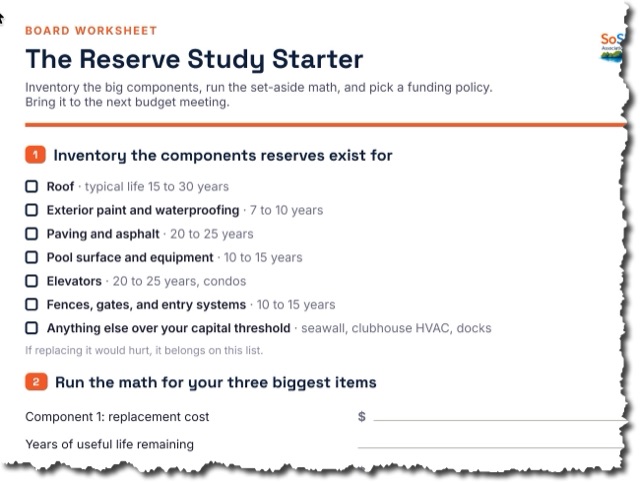
A reserve study is a professional report that answers three questions. What shared components does the community own? When does each one wear out? What must go into savings each year to replace each item on schedule?
A typical study lists 20 to 60 components with a cost and a date for each. Roof, $380,000, year 2031. Paving, $120,000, year 2028. Pool resurfacing, $30,000, year 2027. Add the schedule up and it converts to one number: the annual reserve contribution.
Studies cost roughly $2,000 to $6,000 for most mid-size communities, and the standard advice is a full study every three to five years with yearly updates. Several states now require them. It is the highest-value document a board can buy.
How much should be in the fund?
The industry measures reserve health as "percent funded": the ratio of what you have to what the study says an ideally funded community holds at that point in time.
- 70 to 100 percent funded: strong. Special assessments are rare at this level.
- 30 to 70 percent funded: fair. Some risk of assessments after a bad year.
- Under 30 percent funded: weak. Assessments or loans are close to certain.
The national picture is sobering. Industry surveys put the average association near 50 percent funded, and boards that have never commissioned a study usually sit far lower. If your board does not know its percent funded, that number is the first thing to find out.
Why boards underfund, and how to answer each excuse
"Owners want low dues." Owners want low total cost. Dues of $250 with a $3,800 surprise every decade cost more than dues of $280 with no surprises. Show the math side by side and most rooms come around.
"We'll deal with it when it happens." A component failure does not wait for a good year. Emergency work costs 20 to 40 percent more than planned work, and lenders charge associations real interest.
"The next board's problem." Courts increasingly see reserve funding as part of a director's fiduciary duty. Disclosure laws in many states now put your reserve balance in front of every buyer, so weak reserves already show up in your property values.
Explaining the number to owners
Reserve increases fail at meetings when they arrive as abstractions. They pass when they arrive as pictures. Three moves that work:
- Name the components. "We are saving $60 per unit per month for the 2031 roof and the 2028 paving" beats "we are increasing reserve contributions."
- Show the fork in the road. One slide, two columns. Fund it now: dues rise $30. Wait: a $3,800 assessment in five years. Let owners pick.
- Publish the study. Put the full reserve study in your owner-visible document library, and reference it in every budget mailing. Transparency turns a suspicious vote into an informed one.
The bookkeeping rules that keep you safe
Three simple rules protect the fund and the board:
- Keep reserves in a separate account, never mixed with operating money. Many states require this.
- Borrowing from reserves for operating shortfalls requires a board vote, a repayment plan, and in some states owner notice. Treat it as a last resort.
- Report the reserve balance at every meeting, and record it in the minutes. A number spoken aloud twelve times a year never becomes a scandal.
Good records make all of this easier. When the study, the balances, the minutes, and the budget live in one shared system, every owner question answers itself, and every new treasurer inherits the whole picture on day one.
Start with one number this month
Find your percent funded. If there is no study, get quotes for one this quarter. Then put the number in front of owners with the fork-in-the-road slide, and let fairness across time make your argument.
If this guide helped, the tools it describes live in SoShiny, and so does everything else a self-managed board needs. The 30-day trial is free.
Enjoying this? Get the next one by email.
Practical guides for self-managed boards, written by a board treasurer. About one a month.
FAQ about HOA reserve funds
What is an HOA reserve fund?
How much should our HOA have in reserves?
What is a reserve study and how often do we need one?
What does a reserve study cost?
What is a special assessment?
Can the board borrow from reserves?
Are reserve contributions taxable income to the HOA?
Do buyers see our reserve balance?
Where should we keep the reserve study so owners can read it?
Related reading
- From the blogHOA Budgets and Reserves in Plain Language
- From the blogSpecial Assessments: How Boards Decide, Notice, and Collect Them Fairly
- From the blogHow to Read an HOA Budget as an Owner (Not a Board Member)
- From the blogHow to Collect HOA Dues Without Chasing Your Neighbors
- From the blogHOA Insurance Basics: Master Policy, HO-6, and D&O, Explained
The idea of SoShiny came from a board seat. Kevin joined the board of a large condo HOA and found that one person ran the entire operation from memory. The books lived in Lotus 1-2-3, a program from the 1980s. If that person walked away, the whole community walked away with them. Something had to change. What started as a small fix grew into a full system. SoShiny now runs communities across 23 states and 3 countries.
Kevin has spent his career building teams and turning messy processes into simple products. He ships fast, coaches with candor, and favors action over talk. With SoShiny, he brings that same bias for action to an industry that still runs on spreadsheets, sticky notes, and paper announcements.
An Irish American builder and author, Kevin leads with honesty, grit, and faith. He has three sons and splits his time between Ormond Beach, Florida and Western New York.