
Your Florida Condo Must Have a Website, says Statute 718.111(12)(g)


Our public website used to be a brochure. A photo of the beach. The board emails. A PDF of last year's budget if someone remembered to upload it. Then January 1, 2026 arrived, and that brochure stopped being enough.
I am a board member and the treasurer of a 128-unit oceanfront homeowners association (HOA). We are a condominium association in Florida. We have more than 25 units. Florida Statute 718.111(12)(g) now names a website, or an app owners can download, and it names the documents that have to live there. The deadline was 1 January 2026. This is the list I print for the secretary the week we catch up.
Key takeaways
- A Florida condominium association with 25 or more units, and no timeshare units, must keep a website or a downloadable app. The old 150-unit line is gone.
- The site needs a login wall. Unit owners and association employees get in. The general public does not. The only required public-front row is the unit-owner meeting notice.
- The statute lists 18 files. Governing documents, 12 months of approved board minutes, budgets, the financial report, contracts and bids, inspection reports, the latest SIRS. Post a copy within 30 days after the association creates or receives it. A shorter clock in the statute wins.
- Some clocks are shorter. Owner-meeting notice and agenda go on the front page, or a Notices page linked from it, 14 days out. Documents on that agenda go up 7 days out. Board-meeting notice follows the usual 48-hour rule, behind the owner login.
- Redact personal data before a file goes up. Missing a post does not void a board vote. A website-access complaint can still draw a $5,000 civil penalty.
Who this hits, and who it does not
Copy the test from the statute and from the Division of Condominiums FAQ. The association manages a condominium with 25 or more units. The condominium does not contain timeshare units. Then the website rule applies. The Division timeline calls 1 January 2026 the Online Documents Deadline.
A homeowners association of houses is a different chapter. Chapter 720 uses a 100-parcel website line, not 25 units, and a different posting list. Our Florida compliance map is where 718, 719, and 720 split. This post is the 718 posting list for a condominium association. Do not borrow a 720 checklist.
A cooperative has no statutory website duty. Their documents can still require one. Ours is a condo, so we post. The same 718.111 text sits on our Florida statute hub.
What counts as the website
Two shapes are legal. An independent site the association owns and runs. Or a page, portal, or app from a third-party provider that is dedicated to this association's work. A management company's shared dashboard that is not dedicated to you does not satisfy that sentence.
The site has to be on the Internet. It has to include a protected location the public cannot open. On a written request, the association gives the unit owner a username and password for that protected section.
A pretty brochure with no owner login is not this. A Facebook page is not this. A Google Drive folder the secretary shares by email is not this.
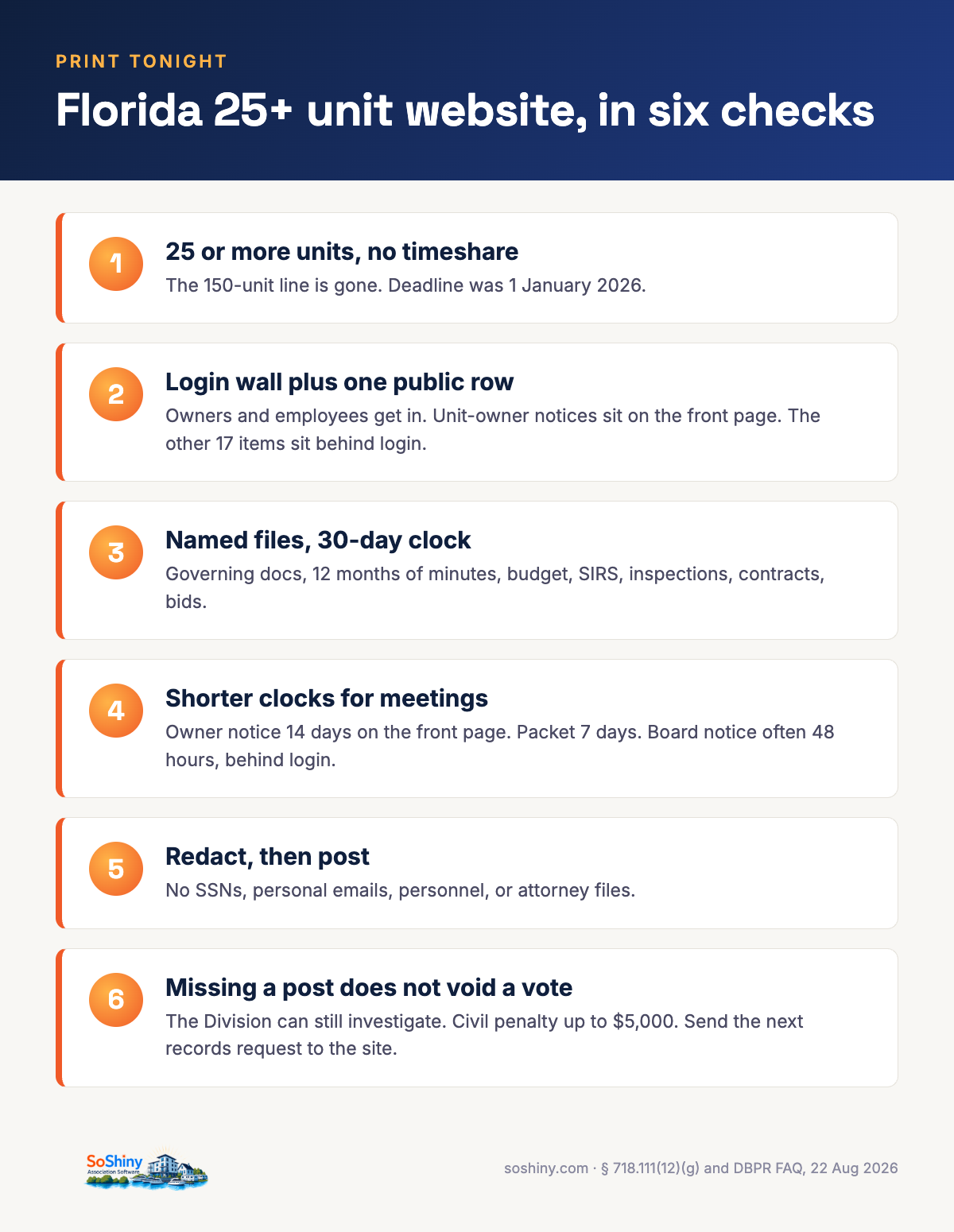 The list. Put these on the site.
This is the current copy the statute wants in digital format. I grouped them the way a secretary actually files them. The letters match § 718.111(12)(g)2. Seventeen of the 18 sit behind the owner login. One sits on the public front.
Governing documents. Recorded declaration and every amendment. Recorded bylaws and every amendment. Articles of incorporation as filed with the Department of State, and every amendment. Current rules.
Meetings. Approved minutes of all board meetings for the preceding 12 months. A video recording, or a hyperlink to it, for every association, board, committee, and unit-owner meeting held by video conference in those 12 months. Owner-meeting notice and agenda, 14 days out, on the front page or a Notices page linked from it. Any document the owners will consider or vote on, 7 days out. Board-meeting notice, agenda, and the packet that notice requires, on the same clock the statute already uses for that meeting, often 48 hours. Board notices go on the site. They do not have to sit on the public front page.
Money. The annual budget, and any proposed budget for the annual meeting. The financial report required by § 718.111(13), and any monthly income or expense statement headed to a meeting.
Contracts and conflicts. A list of executory contracts and other documents that bind the association or the owners. After bidding closes, a list of bids from the past year. Summaries of bids over $500 stay up for a year. Full copies may go up instead. Contracts or deals with a director, an officer, or an entity where a director is an officer and financially interested. Conflict-of-interest contracts and disclosures under the CAM and condominium conflict statutes. Director educational certificates under § 718.112(2)(d)5.b. Affidavits this chapter requires.
The building. Milestone and turnover inspection reports, and any other structural or life-safety inspection of the condominium property. The most recent structural integrity reserve study, if one applies. Building permits for ongoing or planned construction.
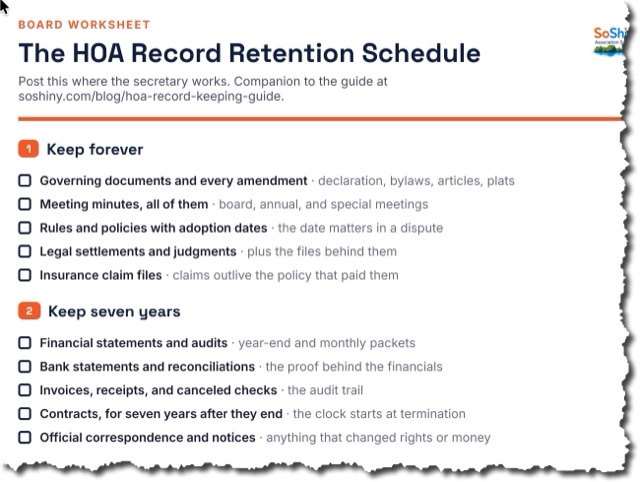
Our records guide is what to keep and for how long. This post is what to put on the owner portal this week. Our minutes guide is how to write the 12 months of minutes that now have a home.
The clocks, in one place
Default: 30 days after the association receives or creates the official record. A shorter clock in the statute wins.
Owner meetings: notice and agenda 14 days before, in plain view on the front page or on a Notices subpage with a conspicuous link from the front page. Packet documents 7 days before.
Board meetings: same notice clock you already use. Regular board meetings are 48 continuous hours on the property. Special-assessment or unit-use rule meetings are 14 days. Mirror that clock on the site, behind the owner login.
Video of a video-conference meeting stays with the approved minutes for at least a year after you post the recording.
What stays off the site
The association must keep records that unit owners cannot inspect off the website. Lawyer-client and work-product files. Personnel records. Medical records. Social security numbers, driver licenses, credit cards, personal emails and phone numbers. Sale and lease approval files. Security passwords and the software that runs the books.
If a required document contains that material, redact it, then post. A homeowners association is not liable for a disclosure of protected information without a knowing or intentional disregard of the restriction. Do the redaction anyway. An owner's email in the minutes is the usual leak.
Failure to post does not, by itself, invalidate a board or committee action. That sentence is not a hall pass. The Division of Condominiums investigates website-access complaints. It can request a login. Civil penalty: up to $5,000 per offense. First they educate and require a fix. Repeat problems draw the penalty. Last fiscal year they took 3,863 complaints.
A refused written records request is a different track. That is the $50-a-day damages and the second-degree misdemeanor. Directing the requester to the site fulfills the inspection duty if the records are actually there. The posting list is the cheap way to answer the next request: send them to the site.
This week, in our 128-unit building
We already had a community site. The gap was the login wall and the 12-month minutes file. The job in one afternoon:
- Confirm unit count. We are 128. The 25-unit test is done.
- Stand up an owner login, or confirm the provider page is dedicated to this homeowners association.
- Upload declaration, bylaws, articles, rules.
- Upload 12 months of approved board minutes. Redact personal emails first.
- Upload the current budget, the last financial report, the SIRS, the milestone report, current permits, the executory-contract list, and director certificates.
- Put a Notices link on the front page. The next unit-owner meeting goes there 14 days out. Board-meeting notice goes behind the owner login on the 48-hour clock.
- Write the one-line rule in the minutes: every new official record on this list is posted within 30 days, with the secretary as the named owner of the clock.
After that, the site is the filing cabinet. The next treasurer does not hunt a laptop.
If this guide helped, the tools it describes live in SoShiny, and so does everything else a self-managed board needs. The 30-day trial is free.
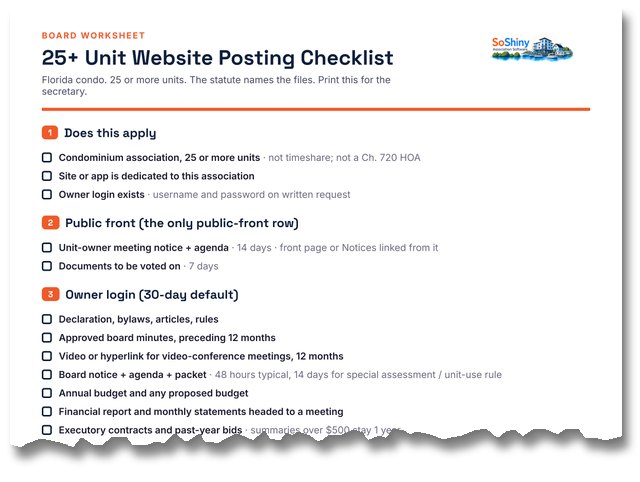
25+ Unit Website Posting Checklist (PDF)
The 18-item Florida list, public-front vs owner-login, and the 30-day clock. One page, made to print for the secretary.
FAQ about Florida condo website posting
Does my Florida condo association need a website in 2026?
What documents must a Florida condo post online?
How fast do new records have to go on the website?
Does the website have to be password protected?
Do board meeting notices have to sit on the public front page?
Can we use our management company's portal?
What happens if we do not post?
Do Chapter 720 HOAs have the same 25-unit website rule?
What should not go on the association website?
Related reading
- From the blogThe Florida Board's Compliance Guide: Chapters 718, 719, and 720
- From the blogMy Safe Florida Home Will Reject Your Condo. Here Is the fix
- From the blogThe Wind Mitigation Inspection: How a Florida Board Turns Form 1802 into Insurance Credits
- From the blogYour Building's Hurricane Deductible Is $840,000. Here Is Your Share.
- From the blogDoes a Licensed CAM Still Need Florida Board Certification?
Copie Leigh is the staff writer behind the SoShiny blog. She drafts the treasurer playbooks Kevin publishes: first-person, numbers from a real 128-unit Florida building, no fluff.
The board seat and the "I" are Kevin's. The sentences are Copie's.