
From Group Text to Work Order: Fix How Your HOA Handles Repairs


The gate light by the north entrance burned out in February. An owner texted a board member, who meant to forward it. In March a second owner emailed the president about it. In April someone raised it at the meeting, and nobody could say whether the electrician had ever been called. The light got fixed in May. Ninety days, for a $75 repair.
Key takeaways
- A $75 repair took 90 days over group texts. The fix is one intake channel with a status anyone can check.
- Set the triage rules once: what counts as an emergency, what waits for the meeting.
- A year of closed tickets with costs is next year's maintenance budget, already sorted by category.
Multiply that gate light by everything a community owns and you get the second-biggest time drain on volunteer boards: about four hours a week spent digging repair requests out of texts, emails, and memories. The fix is a work-order habit, and it takes one evening to set up.
Why repairs fall through the cracks
Repair requests fail for one structural reason: they arrive through five doors. A text to whichever board member an owner knows. An email to a shared inbox nobody owns. A comment at a meeting. A hallway conversation. A note under a door.
Five doors means no list. No list means no owner sees status, no board member knows who is handling what, and no one can say what the community spent on repairs last year. Every request depends on one person's memory, and memory is the one tool that always fails.
The work-order system, in four stages
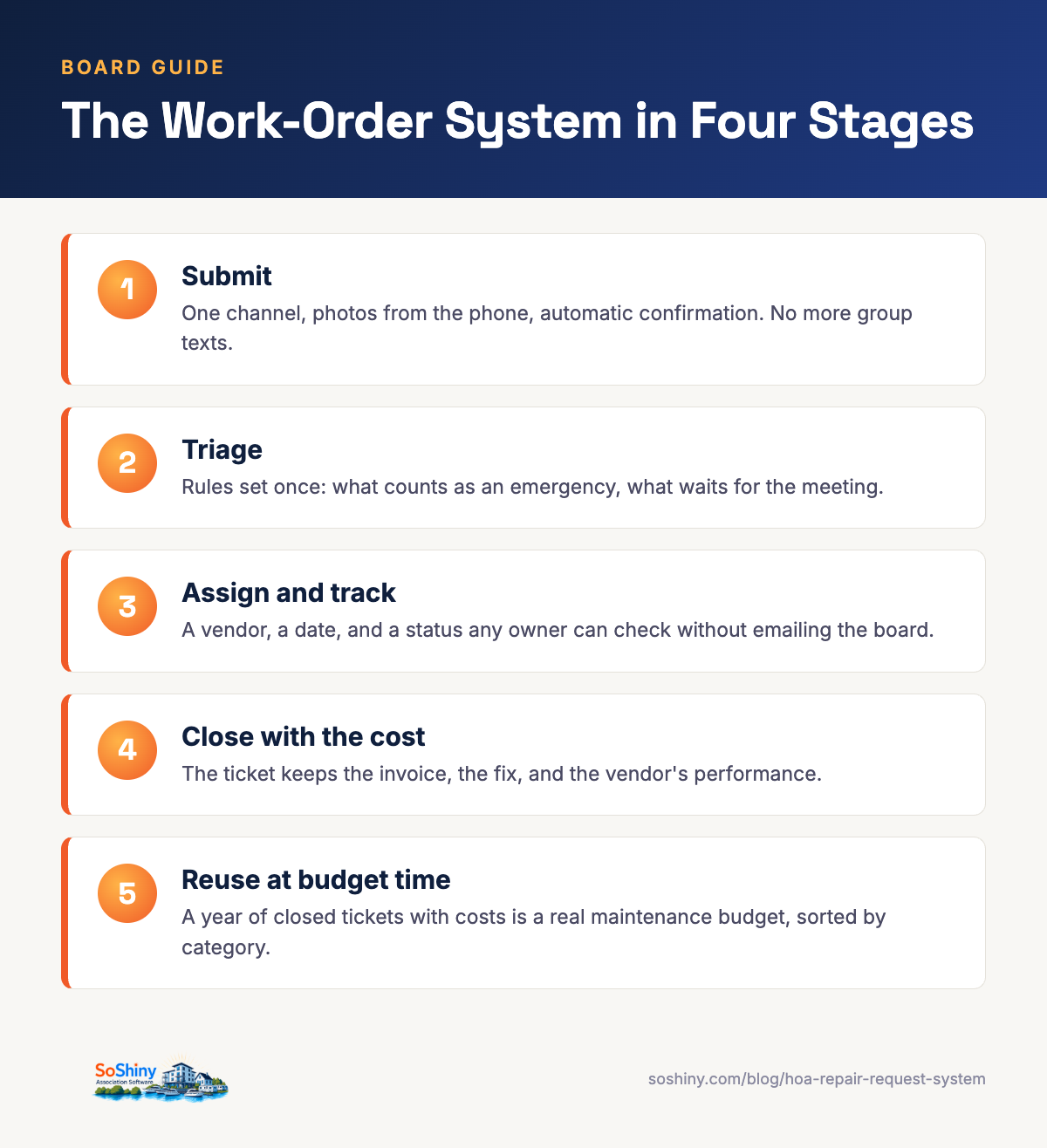
Stage 1: One intake door. Every request enters the same way: a simple form owners reach from their phones. Location, description, photo. The photo matters more than people expect. "Broken sprinkler head, north lawn, near unit 12" with a picture saves the vendor a diagnostic trip.
Stage 2: A numbered ticket. The moment a request lands, it becomes ticket #147 with a date stamp and a status: new, assigned, scheduled, done. The owner gets an automatic confirmation. That one message kills the follow-up emails, since "did anyone see my note?" has an answer the moment it is asked.
Stage 3: An owner for every ticket. One board member, usually the maintenance chair, reviews new tickets weekly. Each ticket gets a decision: fix now, get quotes, defer with a reason, or decline with a reason. The decision is typed on the ticket, where the whole board can see it.
Stage 4: Close the loop in public. When the work finishes, the ticket closes and the owner gets a note. Communities that close loops this way report a strange side effect: owners start submitting more requests, earlier, so small problems get caught before they become roof leaks.
Set the triage rules once
Volunteer boards argue about repairs when the rules live in nobody's head but the president's. Write four categories on one page and let the categories decide:
- Emergency, act within 24 hours: active water, no heat, safety hazards, security failures. Pre-authorize the maintenance chair to spend up to a set amount, say $500, without a meeting.
- Urgent, act within a week: broken gates, dead common-area lighting, pool equipment.
- Routine, next vendor visit or 30 days: cracked sidewalk sections, irrigation heads, fence boards.
- Project, next budget cycle: anything over a set threshold, say $2,500, which goes to the board with quotes.
Adopt the page by motion, record it in the minutes, and triage stops being a debate.
The vendor file: your other missing list
Every mature community has a quiet asset: the knowledge of which plumber shows up and which one overcharges. On most boards, that asset lives in one person's contacts app and leaves when they do.
Build a shared vendor file with name, trade, phone, rate notes, insurance certificate, and a one-line performance history. Attach vendors to tickets, and the file writes itself over time. Ticket #147 shows the electrician, the cost, and the date. Three years later, when the same light fails, the answer to "who fixed this last time, and what did we pay?" takes ten seconds.
Track certificates of insurance in the same file. An expired COI on a vendor who gets hurt on your property becomes the association's problem. A tracker that flags expirations 30 days out closes that hole.
What the paper trail is worth
The ticket history quietly becomes three valuable things:
- A budget. Last year's tickets, sorted by cost, are next year's maintenance line item. Boards stop guessing.
- A defense. When an owner claims the board ignored a hazard, the ticket shows the report date, the action, and the completion. Documentation is the board's best liability shield.
- A handoff. A new maintenance chair inherits every open ticket, every vendor, and every price paid. The job transfers in an afternoon.
One evening to set up
Create the intake form, post the link on your community site, write the four triage categories, and load your top ten vendors. Announce one rule to owners: requests through the form get tracked, and requests through texts get a polite redirect to the form.
Within a month the gate-light story becomes impossible. Every request has a number, every number has an owner, and nothing depends on anyone's memory.
If this guide helped, the tools it describes live in SoShiny, and so does everything else a self-managed board needs. The 30-day trial is free.
Enjoying this? Get the next one by email.
Practical guides for self-managed boards, written by a board treasurer. About one a month.
FAQ about HOA repair requests
What counts as an HOA maintenance emergency?
Who is responsible for a repair, the association or the owner?
How fast should a board respond to repair requests?
Should owners be able to see the status of their request?
How do we handle a request the board declines?
What should a shared vendor file include?
Why track vendor certificates of insurance?
How does a ticket history help at budget time?
Does SoShiny include repair-request tracking?
Related reading
- From the blog5 Systems That Replace Your HOA Management Company
- From the blogHow to Run an HOA Vote Online and Hit Quorum on the First Try
- From the blogHOA Meeting Minutes: What to Record, What to Leave Out
- From the blogHOA Records: What to Keep, How Long, and Where
- From the blogThe Hidden Cost of Running Your HOA on Email and Spreadsheets
SoShiny Software Team is the collective byline for posts written by the people building SoShiny: engineers, designers, and the board members we work with every day.
We write about what actually works for community associations: governance that holds up under scrutiny, communication that residents read, and software that doesn't fight the people using it.
SoShiny is association management software for HOAs, condominium associations, and housing co-operatives anywhere in the United States. Headquartered in Daytona Beach, Florida. Built by people who've sat on a board.