

Arizona · Title 10-NP
Title 10 — Nonprofit Corporations — Plain-English Summary
Official title: Nonprofit Corporations. Translated into plain English for board members and homeowners.
General Provisions
-
§10-3101
Names this part of Title 10 the 'Arizona Nonprofit Corporation Act.'
-
§10-3140
Defines key terms used in AZ nonprofit corporation law.
Incorporation
-
§10-3202
Required content of articles of incorporation: name, members or no members designation, purpose.
-
§10-3203
Sets requirements for incorporators.
-
§10-3206
Organizational meeting requirements after filing.
Purposes and Powers
-
§10-3301
Nonprofits may have any lawful purpose.
-
§10-3302
Lists general corporate powers including the power to sue and be sued, contract, hold property, adopt bylaws, and engage in lawful activities.
Corporate Name
-
§10-3401
Sets requirements for the corporate name.
Office and Agent
-
§10-3501
Every nonprofit must continuously maintain a registered office and registered agent.
-
§10-3502
Procedure to change the registered office or agent.
-
§10-3504
Service may be made on the registered agent.
Members and Membership
-
§10-3601
Membership classes and admission rules are set in the articles or bylaws.
-
§10-3603
Members may have different rights and obligations as set in the articles or bylaws.
-
§10-3610
A member is not personally liable for the corporation's debts solely because of membership.
-
§10-3611
Members are liable for dues, assessments, and fees as set in the articles or bylaws.
-
§10-3615
Members may resign as provided in the articles or bylaws.
-
§10-3621
Termination, expulsion, or suspension must follow a fair and reasonable procedure carried out in good faith.
Members' Meetings and Voting
-
§10-3701
Annual meetings must be held as set in the bylaws.
-
§10-3702
Special meetings may be called by the board, certain officers, or members holding at least 10 percent of voting power.
-
§10-3705
Written notice of every meeting required 10 to 60 days in advance.
-
§10-3708
Member action without a meeting requires written consent of all members entitled to vote unless the articles allow a lesser threshold.
-
§10-3720
Members entitled to vote may inspect the members list before and at the meeting.
-
§10-3722
Default: one vote per member unless otherwise provided.
-
§10-3724
Members may vote by written proxy unless the articles or bylaws prohibit it.
-
§10-3725
Cumulative voting allowed only if the articles or bylaws expressly authorize.
-
§10-3727
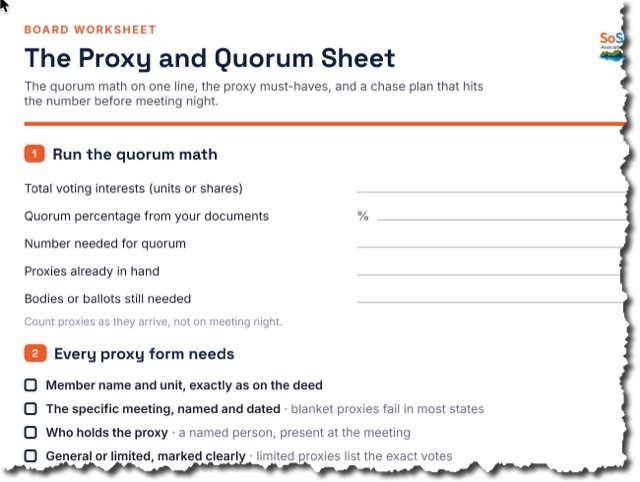
Default quorum is 10 percent of votes entitled to be cast, unless the articles or bylaws set otherwise.
-
§10-3730
Directors are elected by a plurality unless cumulative voting is authorized.
Directors and Officers
-
§10-3801
Every nonprofit must have a board. The board manages or directs the management of the affairs of the corporation.
-
§10-3803
Number of directors set in the articles or bylaws (minimum one).
-
§10-3805
Director term set by bylaws.
-
§10-3807
A director may resign at any time by written notice.
-
§10-3808
Members may remove directors with or without cause.
-
§10-3810
Vacancies may be filled by the board or members as the bylaws provide.
-
§10-3820
Board meetings may be regular (no notice required) or special (notice required).
-
§10-3821
Board action without a meeting requires unanimous written consent.
-
§10-3822
Notice of special board meetings required (typically 48 hours).
-
§10-3824
Majority of directors is a quorum unless bylaws set otherwise.
-
§10-3825
Board may create committees with delegated authority.
-
§10-3830
Directors must discharge their duties in good faith, with care of an ordinarily prudent person, and in the best interests of the corporation.
-
§10-3831
Conflict transactions are not voidable solely because of the conflict if disclosed and approved by disinterested directors.
-
§10-3833
Loans to directors and officers are generally prohibited.
-
§10-3840
Required officers and their duties.
-
§10-3842
Officers must act in good faith and with the care of an ordinarily prudent person.
-
§10-3843
An officer may resign by written notice. The board may remove an officer at any time.
-
§10-3850
Definitions for indemnification provisions.
-
§10-3851
Authorized indemnification of directors against expenses.
-
§10-3856
A nonprofit may purchase D&O insurance for directors and officers.
-
§10-3862
Uncompensated volunteer directors and officers are immune from civil liability for ordinary negligence, but not for gross negligence or intentional misconduct.
Frequently asked about Title 10-NP
- What is Arizona Title 10-NP?
- Arizona Title 10-NP — the Title 10 — Nonprofit Corporations — is the body of law that governs how every Arizona nonprofit corporation is structured, operated, and held accountable. It covers governance, voting, records, assessments, fining, and most of the day-to-day legal questions a board will face.
- How many sections are in Title 10-NP?
- Title 10-NP contains 48 sections in this reference. Each is summarized in plain English on its own page, with links to the official text at azleg.gov.
- Is the summary on this site legal advice?
- No. These pages are plain-English summaries prepared by SoShiny for board members and managers. For binding legal advice or interpretation of how a section applies to your specific situation, consult a Arizona-licensed attorney.
- How often does Arizona Title 10-NP change?
- The Arizona Legislature can amend any chapter in any session. We update these summaries when we re-import the official text — see the 'Last updated' date on each section page.
- Does SoShiny enforce Title 10-NP for me?
- No software 'enforces' a statute — but SoShiny is built around it. Voting, meeting minutes, records access, fining workflow, and audit trails are designed to meet this body of law's requirements out of the box, so the board can demonstrate good-faith compliance if challenged.
Running a nonprofit corporation in Arizona?
SoShiny is built around Title 10-NP from day one — every feature on every plan.
Start your community free →