
Free printable cheat sheet for Colorado community-association boards.

⬇ Download PDF ← Back to Colorado statutes
SoShiny
soshiny.com/colorado
Page 1 of 2
Last updated: September 2, 2026

Colorado CCIOA Quick Reference

A board member’s plain-English cheat sheet for the statute that governs every Colorado condo, planned community, and co-op — the Colorado Common Interest Ownership Act (C.R.S. §§ 38-33.3-101 to 401) — plus the Nonprofit Corporation Act underneath the corporate body.

Part 3 — Meetings, records, budget

  • §308Owner meeting at least once a year. Notice not less than 10 nor more than 50 days, mailed, plus posting if feasible. Special meetings: president, a majority of the board, or owners with 20 percent of the votes. Board meetings are open; owners may speak on an issue before the board votes.
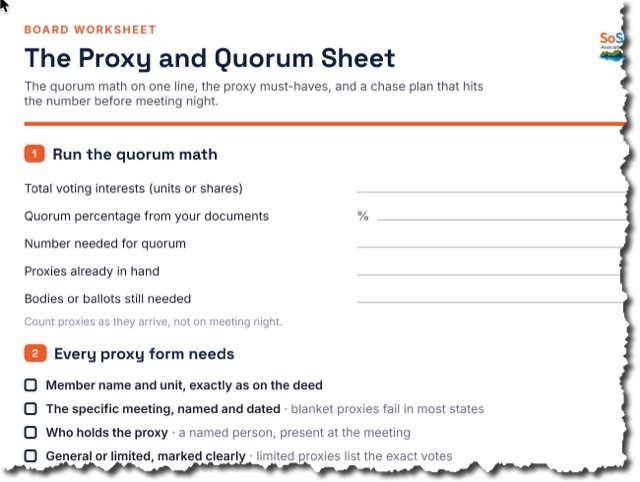
  • §309Owner quorum defaults to 20 percent (10 percent if more than 1,000 units), in person or by proxy. Board quorum defaults to 50 percent of the board.
  • §317Records production — written request at least 10 days before inspection. The association may not demand a “proper purpose” for the listed records. Membership list may not be used to solicit money without board consent.
  • §303Budget summary to owners within 90 days of adoption, then a meeting. Unless the declaration requires owner approval, the budget is deemed approved unless a majority of all unit owners veto it.
  • §209.4Annual public disclosures within 90 days after fiscal year-end: budget, assessments by unit type, financials and reserves, insurance list, governing documents, prior-year minutes, governance policies.

Part 2 / 3 — Fines, collections, the lien

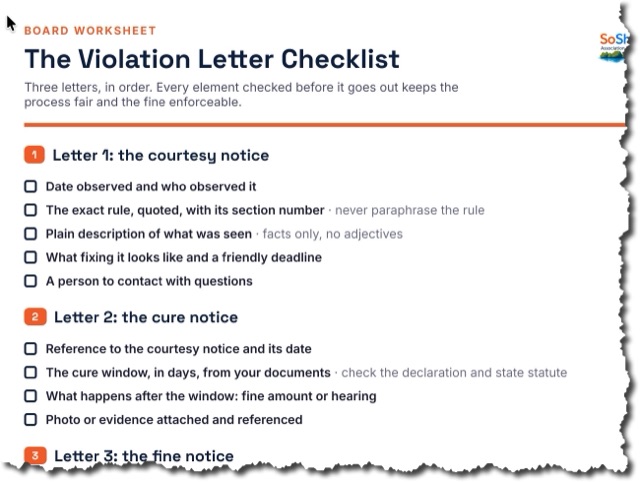
  • §209.5Ordinary covenant violation: certified-mail notice, a 30-day cure, then a second 30-day cure. Fines for that violation may not exceed $500. Safety/health: 72 hours, then fines every other day. No foreclosure on fines.
  • §315Assessments at least annually, based on a budget adopted at least annually. Past-due assessments: interest not more than 8 percent per year.
  • §316.3Good-faith offer of a payment plan in equal installments over at least 18 months before collecting. Payments go to assessments before fines. Foreclosure-law violations: owner may sue within 5 years for up to $25,000.
  • §316Statutory assessment lien. Fines and fees may be in the lien but cannot be foreclosed under this article. No lawsuit on monthly installments until the owner has missed at least three. Payoff statement due in 14 calendar days. Thirty days’ notice (and a mediation offer) before filing a foreclosure.
  • §123Association attorney fees on a collection matter: the lesser of $5,000 or 50 percent of what is owed (court may exceed the cap in the cases the statute lists).

Part 4 — Registration, and the one-Act rule

  • §401Register the association every year with the Division of Real Estate. Unregistered = assessment-lien and §123 enforcement rights pause until you are validly registered. Fee waived if annual revenue is $5,000 or less.
  • §115Communities created on or after July 1, 1992 are under the whole Act (small-community exceptions in §116). Pre-1992 communities get a listed set, including disclosures, governance policies, records, and registration.
  • §106.5Do not prohibit flags, political signs, religious items on an entry door, xeriscaping, solar, fire-hardened materials, or licensed child care. Content-neutral size and location rules are allowed.
One Act covers three community types: Florida splits condos, co-ops, and HOAs across three chapters. Colorado does not. CCIOA (C.R.S. §§ 38-33.3-101 to 401) governs condominiums, planned communities, and cooperatives in one statute. The Colorado Revised Nonprofit Corporation Act (Title 7, Arts. 121–137) fills corporate gaps: director duties (§7-128-401), member-meeting notice (§7-127-104), records inspection (§7-136-102). When the two conflict on meetings or records, CCIOA wins (§38-33.3-319).
Prepared by So Shiny Software, LLC · Daytona Beach, FL · soshiny.com
General information only — not legal advice. Verify current statutory text with the official source.
QR code linking to soshiny.com/colorado
soshiny.com/colorado
SoShiny
Colorado board meeting checklist
Page 2 of 2
Last updated: September 2, 2026

Colorado Board Meeting Checklist

Notice, records, budget, fines, and the DRE registration — what your Colorado board needs to get right every time. All citations are to C.R.S. §38-33.3 unless marked Title 7. Confirm against your declaration and bylaws.

Notice Requirements by Meeting Type

  • Owners meetingNot less than 10 nor more than 50 days (§308). Mail to each unit (or the address the owner designated), plus posting in a conspicuous place if feasible. Agenda must flag declaration/bylaw amendments, budget changes, and any proposal to remove a director or officer.
  • Board meetingOpen to every owner (§308). Agenda reasonably available. Owners may speak on an issue before the board votes, with reasonable time limits. Closed session only for the listed topics (employees, legal advice, criminal investigation, privacy including a disciplinary hearing). Rules may not be adopted in closed session.
  • BudgetSummary to owners within 90 days of adoption; meeting to consider it. Deemed approved unless a majority of all unit owners veto (§303). Last non-vetoed budget continues if this one is vetoed.
  • Discipline / finesOrdinary violation: certified mail, 30 days to cure, then a second 30 days; $500 cap; no foreclosure on fines (§209.5). Safety/health: 72 hours.
  • Pre-foreclosureWritten and electronic notice at least 30 days before filing, plus a mediation offer (§316). 18-month payment plan first (§316.3).

Quorum & Voting

Board

  • Quorum: 50 percent of the board votes unless the bylaws set a larger percentage (§309)
  • Open to owners except the closed-session list (§308)
  • No rule adopted in executive session
  • Minutes must note that a closed session was held and the general subject

Owners

  • Annual meeting required (§308)
  • Quorum: 20 percent (10 percent if more than 1,000 units) unless the bylaws differ (§309)
  • Contested board seats: secret ballot. Any owner-wide vote: secret ballot on request of 20 percent present (§310)
  • Nonprofit Act notice default (if CCIOA is silent): 10 to 60 days (§7-127-104)

Records, Minutes & Disclosures

  • Inspection clockWritten request at least 10 days before inspection or production (§317). Normal business hours, or the next board meeting if it is within 30 days. No proper-purpose demand for the listed association records.
  • Annual packetWithin 90 days after fiscal year-end (§209.4): budget, assessments by unit type, financials and reserves, insurance list, governing documents, prior-year minutes, governance policies.
  • Reserves / auditReserve-study policy required (§209.5). Audit required only if annual revenues or expenditures are at least $250,000 and one-third of owners request it (§303). Declarant must fund a 30-year independent reserve study before turnover (§209.2, new in 2026).
  • DRE registrationAnnual. Unregistered associations cannot enforce an assessment lien or use §123 remedies until they are validly registered (§401).
When you need a specific section: scan the QR below or visit soshiny.com/colorado. Every active section of CCIOA (C.R.S. §§ 38-33.3-101 to 401) and the supporting Nonprofit Corporation Act fill-in is plain-English-summarized with the official source link, related sections, and a board-ready FAQ.
Prepared by So Shiny Software, LLC · Daytona Beach, FL · soshiny.com
General information only — not legal advice. Verify current statutory text with the official source.
QR code linking to soshiny.com/colorado
soshiny.com/colorado

Run your Colorado community on a platform built around these statutes. Every feature on every plan, $25/month base + $0.33/unit. No contract.

Start free Browse all CO statutes

Want a Quick Reference Card for a different state? Email success@soshiny.com — we’ll add it.