
Association records
- Statute:
- North Carolina §47F-3-118 · Chapter 47F (North Carolina Planned Community Act)
- Topic:
- Records & Disclosure · Inspection, annual financials, payoff statement
- Applies to:
- HOA associations
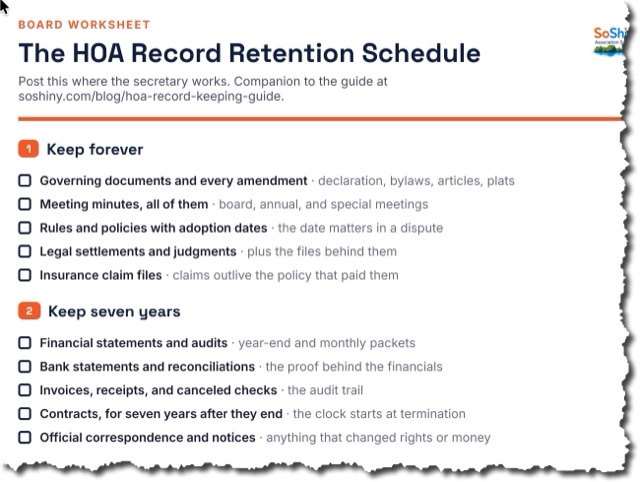
Financial and other records, including meeting records, must be reasonably available to any lot owner and the owner's agents as the bylaws and Chapter 55A require. If the bylaws are silent, keep accurate cash receipts, expenditures, assets, and liabilities. An annual income-and-expense statement and balance sheet must go to every lot owner at no charge within 75 days after fiscal year-end. A written request for a statement of unpaid assessments must be answered within 10 business days; the fee may not exceed $200, plus up to $100 to expedite a request made within 48 hours of closing. Also applies to pre-1999 planned communities unless the instruments say otherwise.
📄 Read the official text at ncleg.gov →
How SoShiny helps with Association records
SoShiny gives every owner instant, permissioned access to the official records this statute requires — searchable, audit-logged, and exportable for state inspections. The records survive every board turnover because they live in one place, not in someone's inbox.
See the feature → Start freeFrequently asked
- What does North Carolina §47F-3-118 require?
- Financial and other records, including meeting records, must be reasonably available to any lot owner and the owner's agents as the bylaws and Chapter 55A require. If the bylaws are silent, keep accurate cash receipts, expenditures, assets, and liabilities. An annual income-and-expense statement and balance sheet must go to every lot owner at no charge within 75 days after fiscal year-end.
- Who does North Carolina §47F-3-118 apply to?
- North Carolina §47F-3-118 applies to HOA associations in North Carolina.
- What happens if our HOA doesn't comply with §47F-3-118?
- Non-compliance can expose the association and individual directors to disputes in the governing forum for North Carolina community associations. SoShiny's audit trail and documented workflows are designed to demonstrate good-faith compliance.
- Where can I read the official text of North Carolina §47F-3-118?
- The official text is published by the North Carolina General Assembly at ncleg.gov. The summary on this page is for plain-English reference only and is not legal advice.
- How does SoShiny help with Association records?
- SoShiny gives every owner instant, permissioned access to the official records this statute requires — searchable, audit-logged, and exportable for state inspections. The records survive every board turnover because they live in one place, not in someone's inbox. Learn more →
Not legal advice. This page is a plain-English summary of North Carolina §47F-3-118 prepared by SoShiny for board members and managers. For binding legal advice or interpretation, consult a North Carolina-licensed attorney. For the official statutory text, see the link above.
Stay current on North Carolina association law.
Get the free quick-reference guide plus a heads-up when the statutes that govern your community change.
Don’t run your HOA on spreadsheets.
Start your community free →