
California · Chapter CIV-8
Davis-Stirling Act Ch. 8 — Assessments and Collection — Plain-English Summary
Every section of this body of law translated into plain English for California board members and homeowners.
Establish and Impose Assessments
-
§5600
The association shall levy regular and special assessments sufficient to perform its obligations under the governing documents and this Act. The board may no…
-
§5605
Without a majority of a quorum of members, the board may not raise regular assessments more than 20 percent over the prior year, or levy special assessments …
-
§5610
The 20 percent / 5 percent caps do not apply to assessments needed for an emergency: an extraordinary expense required by a court order, a threat to personal…
-
§5615
The association shall provide individual notice of any increase in regular or special assessments at least 30 days before the increase takes effect.
-
§5620
Assessments levied by the association are exempt from execution by a judgment creditor of the association, so a vendor with a judgment cannot seize the asses…
-
§5625
Regular assessments shall not be based on the taxable value of a separate interest unless the declaration provided for that method before December 31, 2009, …
Assessment Payment and Delinquency
-
§5650
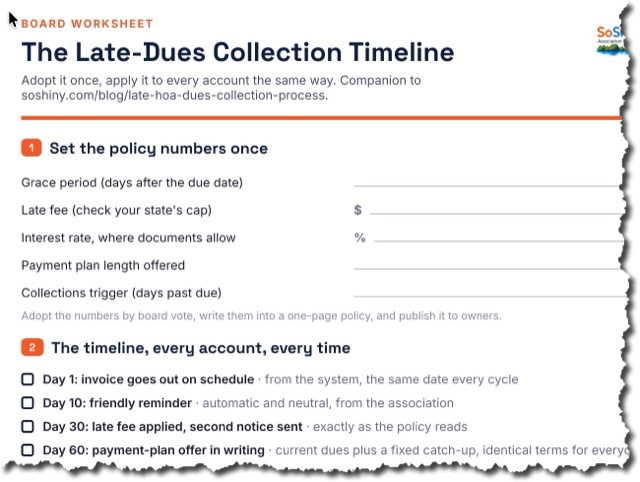
An assessment is delinquent 15 days after it is due, unless the declaration says a longer period. The association may recover a late charge of the greater of…
-
§5655
Payments are applied first to the assessments owed, then to late charges, interest, and collection costs — regardless of any contrary legend the owner writes…
-
§5658
An owner may pay under protest and then dispute the debt through the association's IDR program and, if needed, ADR. Payment under protest preserves the right…
-
§5660
At least 30 days before recording a lien, the association must send the owner a certified-mail notice that includes an itemized statement, the collection pro…
-
§5665
An owner may submit a written request to meet with the board to discuss a payment plan. The board shall meet with the owner in executive session within 45 da…
-
§5670
Before recording a lien, the association shall offer IDR under the meet-and-confer program in §§5900–5920.
-
§5673
The decision to record a lien for a delinquent assessment shall be made by the board, by a majority vote, in an open meeting. The vote is recorded in the min…
-
§5675
The amount of a delinquent assessment, plus costs, late charges, and interest, becomes a lien when the association records a notice of delinquent assessment …
-
§5680
A recorded assessment lien has priority from the date of recording over later liens, but is subordinate to an earlier first mortgage or deed of trust, except…
-
§5685
Within 21 days of payment of the full sum specified in the notice of delinquent assessment, the association shall record a lien release or notice of rescissi…
-
§5690
If the association records a lien in a way that does not comply with this article, the association may be required to restart the process. A willful violatio…
Assessment Collection
-
§5700
After the lien is recorded, the association may enforce it by judicial foreclosure, nonjudicial foreclosure, or a suit for money, subject to the dollar and t…
-
§5705
The decision to initiate foreclosure of a lien shall be made by the board, by a majority vote, in executive session. The board shall record the vote in the m…
-
§5710
Nonjudicial foreclosure of an assessment lien follows Civil Code §2924 and this section, including the right-to-request-IDR and other owner protections this …
-
§5715
A separate interest sold through nonjudicial foreclosure of an assessment lien is subject to a 90-day right of redemption.
-
§5720
The association may not foreclose an assessment lien unless the amount of delinquent assessments (excluding collection costs, attorney fees, late charges, an…
-
§5725
Monetary penalties (fines) for violation of the governing documents shall not be characterized as assessments that may become a lien enforced by foreclosure.…
-
§5730
The association's collection-policy notice — the one distributed with the annual policy statement — must contain the statutory language in this section descr…
-
§5735
The association may not assign or pledge its right to collect assessments to a third party except to a lender for money the association borrowed, or as this …
-
§5740
This article applies to liens recorded on or after January 1, 2003. Older liens follow the law in effect when they were recorded.
Frequently asked about Chapter CIV-8
- What is California Chapter CIV-8?
- California Chapter CIV-8 — the Davis-Stirling Act Ch. 8 — Assessments and Collection — is the body of law that governs how every California CID is structured, operated, and held accountable. It covers governance, voting, records, assessments, fining, and most of the day-to-day legal questions a board will face.
- How many sections are in Chapter CIV-8?
- Chapter CIV-8 contains 26 sections in this reference. Each is summarized in plain English on its own page, with links to the official text at leginfo.legislature.ca.gov.
- Is the summary on this site legal advice?
- No. These pages are plain-English summaries prepared by SoShiny for board members and managers. For binding legal advice or interpretation of how a section applies to your specific situation, consult a California-licensed attorney.
- How often does California Chapter CIV-8 change?
- The California Legislature can amend any chapter in any session. We update these summaries when we re-import the official text — see the 'Last updated' date on each section page.
- Does SoShiny enforce Chapter CIV-8 for me?
- No software 'enforces' a statute — but SoShiny is built around it. Voting, meeting minutes, records access, fining workflow, and audit trails are designed to meet this body of law's requirements out of the box, so the board can demonstrate good-faith compliance if challenged.
Running a CID in California?
SoShiny is built around Chapter CIV-8 from day one — every feature on every plan.
Start your community free →