
Robert's Rules Made Simple: A Free Guide for Condo & HOA Boards


Most HOA and condo board members never asked to learn parliamentary procedure. You volunteered to fix the pool gate. Then the first meeting ran three hours and nobody could say what passed.
I serve as a condo board secretary and treasurer. This is the short version of Robert's Rules I wish someone had handed me: quorum, the agenda, motions, amendments, voting, and minutes, in plain English.
This is a plain-English summary, not legal advice. Your bylaws and state statute come first. Ask your association counsel when it matters.
Download the free PDF guide More free board resources →
No email, no login. Print it, put it in the board binder, share it with the new member.
1. Why boards use Robert’s Rules
You volunteered for a board seat. You did not volunteer for a three-hour argument with no vote at the end.
Robert’s Rules is a shared playbook. One speaker. One motion. A clear yes or no. Owners can follow what happened. The next board can read the minutes and know what you decided.
Boards that skip process spend the next meeting re-litigating the last one. Fair and short beats loud and endless.
2. Quorum
Quorum is the minimum number of board members who must be present to do official business.
Your bylaws set the number. Sometimes statute weighs in. Do not invent a number in the parking lot.
Without quorum: you can talk and take notes. You cannot pass motions that bind the association. Call the meeting to order, note no quorum, adjourn, and reset. “Voting anyway” creates a mess you will clean up later, sometimes in court, often at the next owner meeting.
Have the secretary announce quorum out loud after roll call. Put it in the minutes.
3. Order of business
A standard spine keeps the agenda honest:
- Call to order
- Roll call / quorum check
- Approve prior minutes
- Officer, manager, and committee reports
- Unfinished (old) business
- New business
- Owner comments (if your rules allow a slot)
- Adjourn
Match the posted agenda. Owners trust a meeting that does what the notice said it would do. Florida boards: check your chapter for notice rules before you lean on Robert’s alone.
4. Main motions: the basic loop
This is the engine of the meeting:
- A member gets the floor and makes a main motion: “I move that we…”
- Another member seconds (at least two people want it heard).
- The chair states the motion.
- The board debates. Stay on this motion.
- The chair puts the question.
- The board votes.
- The chair announces the result.
No second when one is required → the motion dies. Do not run three topics at once. If the discussion drifts, the chair pulls it back: “We are on the motion to hire ACME Roofing. Is there further debate on that motion?”
5. Amendments
Friendly change: the mover accepts a small fix. If no one objects, update the motion. Still write down the exact text you vote on.
Formal amendment: three flavors:
- Add: “I move to amend by adding ‘not to exceed $12,000’.”
- Strike: “I move to amend by striking ‘and gutters’.”
- Substitute (strike and insert): “I move to amend by striking ‘ACME’ and inserting ‘Coastal Roofing’.” You can also substitute a whole new motion text.
Needs a second. Debatable. Vote the amendment first. Then vote the main motion as amended (or as original if the amendment fails).
Word amendments tight. Vague amendments burn the clock and confuse the minutes.
6. Common motions, by type
Robert’s sorts motions into four families. Higher families take priority over lower ones.
Main motion: brings new business. Only one at a time.
- Main motion: “I move that we…”
Subsidiary motions: change or dispose of the main motion.
- Amend: change the wording (section 5).
- Refer to a committee or the manager: say what you want back and by when.
- Postpone to a time certain: wait for a bid or report.
- Call the question (previous question): end debate now. Second, not debatable, two-thirds. One member saying “Question!” does not end debate.
- Lay on the table: set aside temporarily. Easy to abuse; prefer postpone.
Privileged motions: about the meeting itself, not the topic.
- Recess: short break. Majority.
- Adjourn: end the meeting. Second, not debatable, majority.
Incidental motions: about process.
- Point of order: “We don’t have a second.” Chair rules. No second, no vote.
- Point of information: a question, not a speech. “Is this bid within the reserve line?”
- Appeal the chair’s ruling: the board decides. Rare; keep it civil.
See the cheat sheet below.
7. Small-board simplifications
Robert’s Rules itself relaxes things for small boards (roughly a dozen members or fewer). For a 5–7 person HOA or condo board, that usually means:
- No standing. Raise a hand, get the chair’s nod, talk.
- Seconds are not required for motions in small-board practice. Many boards still ask for one. Pick a habit and stick to it.
- Members may speak more than twice on a motion. Keep it short anyway.
- Informal discussion is OK before a motion is made. Just end with a clear motion and vote.
- The chair can talk and vote like any other member.
- Unanimous consent: “If there’s no objection, we’ll approve the minutes as corrected.” Any one member can object and force a vote.
Your bylaws or board rules can say otherwise. They win. Owner meetings (bigger crowd) should run more formally.
8. Voting methods and thresholds
Methods
- Voice vote: “All in favor, say aye… opposed, no.” Fine for most items.
- Show of hands: when a voice vote is close or someone doubts the result.
- Roll call: each member’s name and vote go in the minutes. Use it when the record matters (big contracts, assessments) or when someone asks.
- Unanimous consent: “If there’s no objection…” Any one objection means you take a real vote.
- Ballot: written and secret. Rare at board meetings; more common for owner elections.
Thresholds
- Majority of votes cast: more than half of those who voted. Under Robert’s, abstentions don’t count. The default for most motions.
- Two-thirds of votes cast: to cut off debate (call the question) and a few other motions that limit members’ rights.
- Majority of the entire membership: more than half of all seats, present or not. On a 7-seat board that is 4, even if only 5 show up. Bylaws sometimes require this for big decisions.
Chair announces clearly: “The motion carries” or “The motion fails.” That sentence belongs in the minutes.
Check your documents. Bylaws or state law may require a recorded (roll-call) vote, a specific threshold, or a ban on secret or proxy votes at board meetings. In Florida, look at Chapters 718 and 720 where they apply. This is a summary, not counsel.
9. Minutes and common mistakes
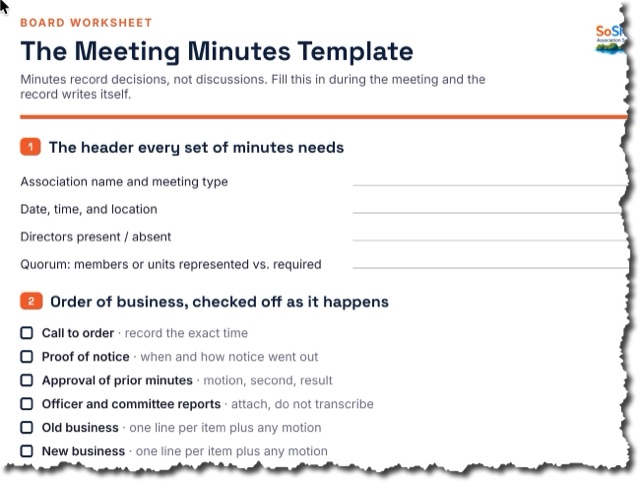
Record: date and time, who attended, whether quorum was met, the exact motion text, who moved (and who seconded if you track it), and the result of the vote.
Skip: play-by-play debate, insults, and every side comment. Minutes are a decision log, not a novel.
Draft within a week. Approve at the next meeting. Next year’s secretary will thank you.
Common mistakes I see:
- Voting with no quorum, or never recording that quorum was met.
- Deciding in a group text or email chain instead of at a noticed meeting.
- Voting on a vague motion (“let’s look into the roof”). Nobody knows what passed.
- Treating “Question!” from one member as the end of debate.
- Acting on items that were not on the posted agenda when your rules require notice.
- Minutes that say “discussed” but never say what was decided.
Cheat sheet: the floor, who speaks, and how you vote
Getting the floor
- Raise your hand and wait for the chair to recognize you. Then speak.
- Talk to the chair, not across the table.
- Whoever made the motion usually gets to speak first.
- Nobody speaks twice until everyone who wants a first turn has had one.
Who can speak
- Board members make motions, debate, and vote.
- Owners can attend board meetings but don’t make motions or vote at them. Many states, including Florida, give owners a right to speak on agenda items, subject to reasonable written rules (time limits, sign-up). What your bylaws and state law say is what applies.
- Manager, attorney, guests: speak when the chair invites them.
Taking and announcing the vote
- Chair: “Is there any further debate?” (Pause.)
- Chair restates the exact motion.
- “All in favor, say aye (or raise a hand)… Opposed…”
- Roll call if anyone asks for names on the record or your rules require it.
- Chair announces the result and the effect: “The ayes have it. The motion carries, and we will hire Coastal Roofing for up to $12,000.”
- Secretary writes it down word for word.
Chair’s pocket lines
- “Is there a second?”
- “It is moved and seconded that… Is there debate?”
- “Are you ready for the question?”
- “All in favor… opposed… The motion carries / fails.”
- “Point of order noted. The chair rules…”
Motion cheat sheet
| Motion Second? Debatable? Vote needed Board note | ||||
| Main motion | Yes | Yes | Majority | “I move that…” One topic. |
| Amend (add / strike / substitute) | Yes | Yes | Majority | Vote amendment, then main motion. |
| Postpone to a certain time | Yes | Yes | Majority | Prefer over “table” for next meeting. |
| Refer to committee / manager | Yes | Yes | Majority | Say deliverable and deadline. |
| Call the question (previous question) | Yes | No | Two-thirds | Ends debate. “Question!” alone doesn’t. |
| Lay on the table | Yes | No | Majority | Easy to abuse; prefer postpone. |
| Recess | Yes | No | Majority | Short break. |
| Adjourn | Yes | No | Majority | Ends the meeting. |
| Point of order | No | No | Chair rules | Fixes process breaks. |
| Point of information | No | No | None | A question to the chair, not a speech. |
| Appeal chair’s ruling | Yes | Usually | Majority to overturn | Rare; keep it civil. |
Small boards: seconds are optional under Robert’s small-board rules. Details vary by edition of Robert’s Rules and by the authority your documents adopt. When unsure, follow bylaws and counsel.
Resources and disclaimer
- Robert’s Rules of Order Newly Revised (RONR), current edition: the full rulebook. The official site is robertsrules.com.
- Your bylaws and declaration: they set quorum, thresholds, and which parliamentary authority you follow.
- Your state statute: in Florida, Chapter 718 (condos) or 720 (HOAs).
- Your association counsel: for anything in dispute, contested, or with money or liability attached.
This guide is a plain-English summary by a volunteer board member. It is not legal advice and does not replace your documents or a lawyer.
Get the printable version
The PDF has the same content plus both cheat sheets on their own pages, ready to print for the meeting table. Download Robert's Rules Made Simple (PDF, free).
Want agendas, motions, and minutes in one place? Start free on SoShiny Find and claim your association's free listing →
Software is not a parliamentarian. It just keeps the record straight.
Enjoying this? Get the next one by email.
Practical guides for self-managed boards, written by a board treasurer. About one a month.
FAQ about Robert's Rules for HOA and condo boards
Do HOA and condo boards have to follow Robert's Rules of Order?
What is a quorum for an HOA board meeting?
Does a motion need a second on a small board?
What is the difference between a majority vote and a two-thirds vote?
Do abstentions count as no votes?
When should a board use a roll call vote?
What should HOA board minutes include?
Is there a free Robert's Rules cheat sheet for HOA boards?
Related reading
- From the blogHow to Run an HOA Vote Online and Hit Quorum on the First Try
- From the blogHow Florida HOA Board Elections Actually Work — a Plain-English Guide
- From the blog5 Systems That Replace Your HOA Management Company
- From the blogHow to Actually Reach a Quorum: Running Board Votes Online
- FeatureBoard Meetings & Minutes
Copie Leigh is the staff writer behind the SoShiny blog. She drafts the treasurer playbooks Kevin publishes: first-person, numbers from a real 128-unit Florida building, no fluff.
The board seat and the "I" are Kevin's. The sentences are Copie's.