

Hawaii · Chapter NP
Hawaii Nonprofit Corporations Act (HRS Chapter 414D) — Plain-English Summary
Every section of this body of law translated into plain English for Hawaii board members and homeowners.
General provisions
-
§414D-1
Names this chapter the Hawaii Nonprofit Corporations Act. Most incorporated 514B associations and 421J planned communities live here for meetings, directors,…
-
§414D-14
Defines articles, board, bylaws, member, department (DCCA), and the other corporate words this chapter uses.
-
§414D-15
How corporate notice is given and when it is effective (mail, in person, electronic with consent). 514B and 421J meeting-notice clocks control association ow…
Organization
-
§414D-31
One or more individuals may incorporate a Hawaii nonprofit by delivering articles of incorporation to the DCCA director.
-
§414D-32
Articles must state the name, principal-office / registered-agent information, incorporators, whether the corporation will have members, and how assets are d…
-
§414D-33
Corporate existence begins when the articles are filed, unless a delayed effective date is stated.
-
§414D-36
The incorporators or the board adopt the initial bylaws. Bylaws may regulate anything that is not inconsistent with law or the articles. 514B-108 and 421J st…
Purposes and powers
-
§414D-51
A nonprofit may be organized for any lawful purpose. An association's purpose is typically operating the community.
-
§414D-52
Unless the articles limit them, a nonprofit has the listed corporate powers (sue, contract, hold property, elect directors). 514B-104 and 421J are the associ…
Members and memberships
-
§414D-81
The articles or bylaws may establish criteria or procedures for admission of members. In a 514B association, membership is all unit owners (§514B-102).
-
§414D-85
A member is not personally liable for the corporation's acts, debts, or obligations merely by being a member. Assessment liability comes from 514B / 421J and…
-
§414D-86
A member may be liable for dues, assessments, or fees, but the articles, bylaws, or a board resolution authorizing them does not, by itself, create that liab…
-
§414D-89
Expulsion or suspension must be fair and reasonable and carried out in good faith. A safe harbor is 15 days' prior written notice and a chance to be heard at…
Members' meetings and voting
-
§414D-101
A corporation with members holds an annual membership meeting. Failure to hold it on the bylaw date does not kill corporate action. The board may authorize r…
-
§414D-102
A special members' meeting is called by the board (or anyone the documents authorize), or by written demand of 5 percent of the voting power unless the docum…
-
§414D-104.5
Unless the articles or bylaws restrict it, any member action that could be taken at a meeting may be taken by written or electronic ballot delivered to every…
-
§414D-105
Member-meeting notice is fair and reasonable if it states place, date, and time and is given no fewer than 10 and no more than 60 days before the meeting. Sp…
-
§414D-109
After the record date the corporation prepares an alphabetical list of members entitled to notice, with addresses and votes. The list is inspectable from two…
-
§414D-110
Unless the articles limit, enlarge, or deny it, each member has one vote. For a 514B association the declaration's common interest, not this default, controls.
-
§414D-111
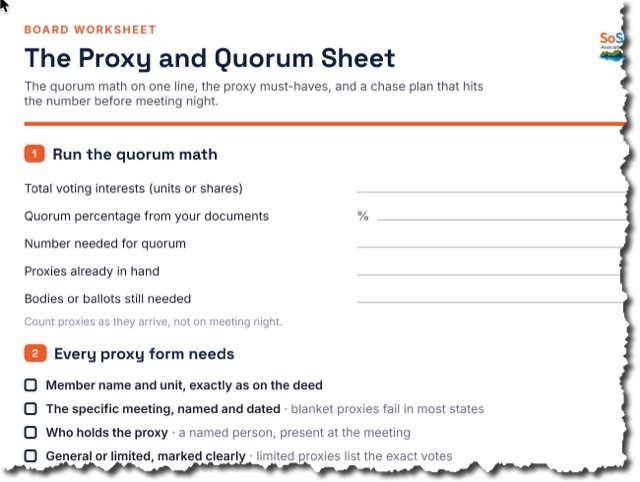
Unless the articles, bylaws, or this chapter set a different number, member quorum is 10 percent of the votes entitled to be cast on the matter. If fewer tha…
-
§414D-112
If a quorum is present, the act of the members is the affirmative vote of the votes represented and voting — which must also be a majority of the required qu…
-
§414D-113
Unless the articles or bylaws prohibit proxies, a member may appoint a proxy in writing or by electronic transmission. Default life is 11 months, never more …
Directors and officers
-
§414D-131
Every nonprofit has a board. Corporate powers are exercised by or under the board unless the articles hand some of those powers to another person. For an ass…
-
§414D-133
The board has three or more individuals, with the number fixed in the articles or bylaws. 514B-106 overlays a three-director floor (nine for many 100-plus-un…
-
§414D-138
Members may remove a director they elected, without cause unless the articles or bylaws say otherwise, at a meeting called for that purpose. This section doe…
-
§414D-141
Unless the articles or bylaws provide otherwise, the remaining directors may fill a vacancy. 514B-106 says a condo board may fill vacancies only until the ne…
-
§414D-143
Directors may meet in or out of state. Unless the articles or bylaws say otherwise, they may meet by any means by which all participating directors can hear …
-
§414D-145
Regular board meetings may be held without notice if the time and place are fixed. Special board meetings need at least two days' notice of date, time, and p…
-
§414D-147
Board quorum defaults to a majority of the directors in office immediately before the meeting. The articles or bylaws may not set a quorum below the greater …
-
§414D-149
A director acts in good faith, with loyalty, with ordinary-prudent-person care, and in what the director reasonably believes is the corporation's best intere…
-
§414D-150
A conflicted transaction is not void solely because of the director's interest if it was fair, or if it was disclosed and approved by disinterested directors…
-
§414D-153
The corporation has the officers the bylaws (or the board) describe. One officer is responsible for minutes and authenticating records. Default term is not m…
-
§414D-160
The corporation may indemnify a director who acted in good faith and in (or not opposed to) the corporation's interest, except where the director was found l…
Records and reports
-
§414D-301
Keep permanent minutes, accounting records, and a membership list with votes. At the principal office keep current articles and bylaws, three years of member…
-
§414D-302
A member may inspect the principal-office packet on five business days' written notice. Accounting records and the membership list also need a good-faith pro…
-
§414D-305
Without board consent, a membership list may not be used for an unrelated purpose, to solicit money except for a corporation election, for a commercial purpo…
-
§414D-306
On written demand a member gets the latest annual financial statements (balance sheet and operations). 514B-150's audit and 421J-7's financials overlay this …
-
§414D-308
Every domestic nonprofit files a DCCA annual report with the principal office, registered-agent information, directors and officers, and a brief description …
Frequently asked about Chapter NP
- What is Hawaii Chapter NP?
- Hawaii Chapter NP — the Hawaii Nonprofit Corporations Act (HRS Chapter 414D) — is the body of law that governs how every Hawaii nonprofit corporation is structured, operated, and held accountable. It covers governance, voting, records, assessments, fining, and most of the day-to-day legal questions a board will face.
- How many sections are in Chapter NP?
- Chapter NP contains 38 sections in this reference. Each is summarized in plain English on its own page, with links to the official text at capitol.hawaii.gov.
- Is the summary on this site legal advice?
- No. These pages are plain-English summaries prepared by SoShiny for board members and managers. For binding legal advice or interpretation of how a section applies to your specific situation, consult a Hawaii-licensed attorney.
- How often does Hawaii Chapter NP change?
- The Hawaii State Legislature can amend any chapter in any session. We update these summaries when we re-import the official text — see the 'Last updated' date on each section page.
- Does SoShiny enforce Chapter NP for me?
- No software 'enforces' a statute — but SoShiny is built around it. Voting, meeting minutes, records access, fining workflow, and audit trails are designed to meet this body of law's requirements out of the box, so the board can demonstrate good-faith compliance if challenged.
Running a nonprofit corporation in Hawaii?
SoShiny is built around Chapter NP from day one — every feature on every plan.
Start your community free →