
California · Chapter CIV-6
Davis-Stirling Act Ch. 6 — Association Governance — Plain-English Summary
Every section of this body of law translated into plain English for California board members and homeowners.
Association
-
§4800
A common interest development shall be managed by an association, which may be incorporated or unincorporated.
-
§4805
Unless the governing documents provide otherwise, the association may exercise the powers of a nonprofit mutual benefit corporation (Corp. Code §7140) and an…
-
§4820
Two or more associations may have a joint neighborhood association to manage shared facilities, with the powers this section describes.
Emergency Powers
-
§5450
During a state of emergency that affects the CID, the association may notice meetings, collect assessments, and conduct elections under the relaxed procedure…
Board Meeting
-
§4900
This article is the Common Interest Development Open Meeting Act. California HOA boards meet in the open, with listed exceptions.
-
§4910
The board may not take action on any item of business outside a board meeting, except unanimous written consent (including email) and the emergency and execu…
-
§4920
Regular board meetings require at least 4 days' general notice with the agenda. A meeting held solely in executive session requires at least 2 days' notice. …
-
§4923
An emergency board meeting may be called if there are circumstances that could not have been reasonably foreseen that require immediate attention and possibl…
-
§4925
Any member may attend board meetings except the executive-session portion. The board must permit any member to speak at any board meeting, subject to a reaso…
-
§4926
The board may conduct a meeting entirely by teleconference or videoconference if it follows this section: a telephone number or digital-meeting identifier in…
-
§4930
The board may not discuss or take action on any item not on the agenda, except for emergency items, brief responses to member comments, and the other narrow …
-
§4935
The board may meet in executive session only for litigation, formation of contracts with third parties, member discipline, personnel matters, or a member's r…
-
§4950
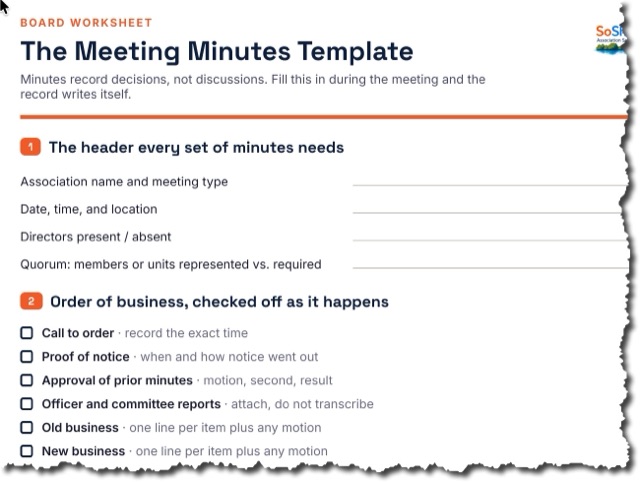
Minutes of board meetings (except executive-session minutes) must be made available to members within 30 days of the meeting. Members may receive a copy on r…
-
§4955
A member may sue to enforce the Open Meeting Act. A court may void a board action taken in violation, award the member up to $500 per violation, and award re…
Member Meeting
-
§5000
Membership meetings are conducted in accordance with the association's governing documents and the Corporations Code (typically §7510). A regular membership …
Member Election
-
§5100
Director elections and recalls, assessments, governing-document amendments, and grants of exclusive use of common area must be conducted by secret written ba…
-
§5103
If the number of qualified candidates is not more than the number of open seats, the association may declare the candidates elected by acclamation after foll…
-
§5105
The association must adopt election rules that specify the qualifications for candidates and voters, the nomination procedure, the inspector of elections, ba…
-
§5110
The association must select one or three independent inspectors of elections to receive ballots, determine the number of memberships entitled to vote, determ…
-
§5115
Nomination notice goes out at least 30 days before the nomination deadline. Candidate list and voting instructions go out at least 30 days before ballots. Ba…
-
§5120
Ballots are counted by the inspector in public at a noticed meeting. Results are promptly reported to the board and recorded in the minutes. The tabulated re…
-
§5125
The sealed ballots, signed voter envelopes, voter list, and candidate list stay in the inspector's custody until after the tabulation, then with the associat…
-
§5130
A proxy is not a substitute for a secret ballot. Any instruction on a proxy that directs the proxyholder how to cast a secret ballot is valid, but the proxyh…
-
§5135
Association funds shall not be used for campaign purposes in connection with any association election. The association may use funds for the notice, ballot, …
-
§5145
A member may sue to enforce this article. The court may void an election, impose a civil penalty of up to $10 per membership (capped), and award attorney fee…
Record Inspection
-
§5200
Defines 'association records' (financials, invoices, check registers, contracts, governing documents, minutes, agendas, and more) and 'enhanced association r…
-
§5205
A member, or a designated representative, may inspect and copy association records at the association's on-site office or another agreed place. The associati…
-
§5210
Current-fiscal-year records: 10 business days. Prior two fiscal years: 30 calendar days. Minutes: as in §4950 (board minutes within 30 days of the meeting). …
-
§5215
The association may withhold or redact records that are privileged, that would reveal a member's personal information (account numbers, Social Security numbe…
-
§5216
A member in the Secretary of State's Safe at Home program may keep their true address off association records that would otherwise be inspectable. The associ…
-
§5220
A member may opt out of sharing their name, property address, mailing address, and email on the membership list. The opt-out does not apply to documents the …
-
§5225
A member may request a copy of the membership list stating a purpose reasonably related to the requester's interest as a member. The association must provide…
-
§5230
Association records, including the membership list, may not be used for commercial purposes, for any purpose unrelated to a member's interest as a member, or…
-
§5235
A member may sue to enforce inspection rights. A court may award the member $500 for each denial, plus attorney fees. A request made in bad faith can shift f…
-
§5240
This article supersedes the Corporations Code to the extent of any inconsistency on association-record inspection, except as this article itself incorporates…
Written Requests
-
§5260
Lists the member requests that must be in writing (inspection of records, the membership list, copies of minutes, and the other items this section enumerates…
Annual Reports
-
§5300
30 to 90 days before the fiscal year ends, the association must distribute an annual budget report: pro forma operating budget, reserve summary, reserve fund…
-
§5305
If the association's gross income in a fiscal year exceeds $75,000, a CPA must perform a review of the financial statement for that year, and the review is d…
-
§5310
Distributed with the budget report, the annual policy statement tells members where to send overnight assessment payments, the name of the person designated …
-
§5320
The annual budget report and annual policy statement are delivered by individual notice. The association may send a summary with instructions on how to reque…
Conflicts of Interest
-
§5350
A director or committee member shall not vote on certain items in which the person has a material financial interest — including a contract with the associat…
-
§5375
Before entering a management contract, a prospective managing agent must disclose in writing to the board any relationships or interests this section lists (…
-
§5375.5
A managing agent shall not receive any referral fee, kickback, or other compensation from a third-party vendor in connection with the association without wri…
-
§5376
On termination, a managing agent must return association documents, records, and funds within the time this section requires.
-
§5380
A managing agent who receives association funds must deposit them in a trust account or in an account in the association's name, and shall not commingle them…
-
§5385
A full-time employee of the association is not a 'managing agent' for purposes of the managing-agent disclosure and trust-account sections.
Government Assistance
-
§5400
The Legislature encourages directors to complete a course covering the role of a board member, fiduciary duty, and the Davis-Stirling Act. Completion is not …
-
§5405
Every association shall file a Common Interest Development Statement with the Secretary of State every two years (the CID registry), with the association's n…
Frequently asked about Chapter CIV-6
- What is California Chapter CIV-6?
- California Chapter CIV-6 — the Davis-Stirling Act Ch. 6 — Association Governance — is the body of law that governs how every California CID is structured, operated, and held accountable. It covers governance, voting, records, assessments, fining, and most of the day-to-day legal questions a board will face.
- How many sections are in Chapter CIV-6?
- Chapter CIV-6 contains 48 sections in this reference. Each is summarized in plain English on its own page, with links to the official text at leginfo.legislature.ca.gov.
- Is the summary on this site legal advice?
- No. These pages are plain-English summaries prepared by SoShiny for board members and managers. For binding legal advice or interpretation of how a section applies to your specific situation, consult a California-licensed attorney.
- How often does California Chapter CIV-6 change?
- The California Legislature can amend any chapter in any session. We update these summaries when we re-import the official text — see the 'Last updated' date on each section page.
- Does SoShiny enforce Chapter CIV-6 for me?
- No software 'enforces' a statute — but SoShiny is built around it. Voting, meeting minutes, records access, fining workflow, and audit trails are designed to meet this body of law's requirements out of the box, so the board can demonstrate good-faith compliance if challenged.
Running a CID in California?
SoShiny is built around Chapter CIV-6 from day one — every feature on every plan.
Start your community free →