
Hawaii · Chapter PCA
Hawaii Planned Community Associations Act (HRS Chapter 421J) — Plain-English Summary
Every section of this body of law translated into plain English for Hawaii board members and homeowners.
General
-
§421J-1
Chapter 421J applies to every Hawaii planned community association existing on June 16, 1997 and every one created after that. Condos stay under 514B; co-ops…
-
§421J-1.5
This chapter and the association documents under it are liberally construed to make the planned community association work.
-
§421J-2
Defines association (including a 10-or-more-parcel HOA whose unpaid assessments may become a lien), planned community (not a condo, co-op, or time share), de…
Board
-
§421J-3
Every director must be an association member, except a developer may appoint directors under reserved rights. One unit, one board seat, other than the master…
-
§421J-3.2
Cumulative voting is allowed only if the association documents say so. Multiply votes by open seats and pile them or split them. Default is no cumulative vot…
-
§421J-3.3
Members may remove a director they elected, with or without cause, unless the documents say otherwise. Removal can start with a board recommendation or a pet…
Meetings
-
§421J-14
The first annual meeting happens as the documents say, but no later than one year after the first unit is conveyed to someone other than a developer.
-
§421J-3.5
Owner-meeting notice is at least 14 days, by hand, mail, email, or a members-only website posting, and must list date, time, place, and agenda (amendments, s…
-
§421J-4
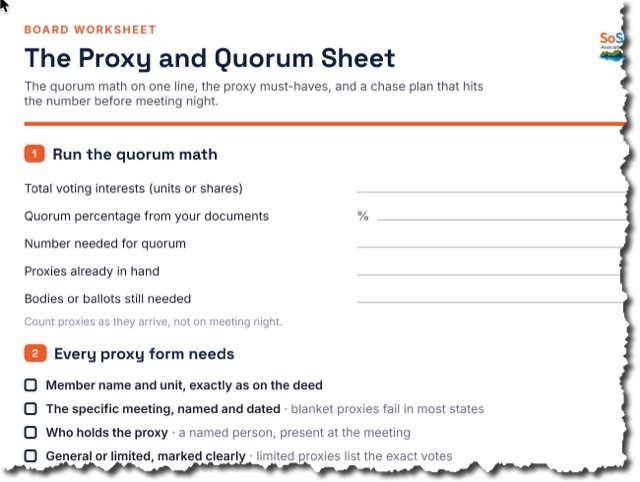
A proxy is good only for that meeting. To be valid it must reach the secretary or managing agent by 4:30 p.m. on the second business day before, and name the…
-
§421J-5
Board meetings are open except listed executive-session topics (personnel, litigation, attorney-client). The board meets at least once a year. Directors may …
-
§421J-6
Association and board meetings are conducted under the current Robert's Rules of Order, Newly Revised.
Records
-
§421J-7
Governing documents, the current financials, and the latest non-executive board minutes are available at no cost on 24-hour loan or during reasonable hours. …
-
§421J-7.5
The board may restate the association documents to fold in amendments, or to conform them to this chapter or other law, by resolution. A restatement of a rec…
-
§421J-8
The association uses good-faith efforts to keep a current member name-and-address list. If it does not hand the list to members, it must have a reasonable wa…
Assessments
-
§421J-10
The association recovers reasonable collection, foreclosure, and enforcement fees from the person it proceeds against; if it is not the prevailing party, it …
-
§421J-10.5
Unpaid assessments are a lien on the unit. A recorded association lien expires in six years unless enforcement is started. After a first-mortgage foreclosure…
-
§421J-10.6
If an owner who rents the unit is 30 days or more behind on regular assessments, the board may, after notice, demand the tenant's rent up to the amount owed …
-
§421J-9
The board must notify members in writing at least 30 days before any increase in regular assessments.
Other law
-
§421J-11
This chapter does not excuse anyone from other law, but if another law conflicts with this chapter, 421J governs.
-
§421J-12
A document that can be amended by a member vote may also be amended by written consent of the same percentage. If neither the documents nor other law supply …
-
§421J-13
At any party's request, a documents or chapter 421J dispute first goes to mediation. Exceptions: threatened property damage, health/safety, assessment collec…
-
§421J-15
The board must adopt a policy giving process servers reasonable access, as HRS §634-21.5 requires.
-
§421J-16
A documents clause that discriminates against a resident with a valid medical-cannabis certificate is void, unless the documents already ban tobacco smoking …
-
§421J-17
The association may not prohibit or unreasonably restrict personal agriculture (lawful edible crops for personal use or donation) in a unit owner's exclusive…
Frequently asked about Chapter PCA
- What is Hawaii Chapter PCA?
- Hawaii Chapter PCA — the Hawaii Planned Community Associations Act (HRS Chapter 421J) — is the body of law that governs how every Hawaii HOA is structured, operated, and held accountable. It covers governance, voting, records, assessments, fining, and most of the day-to-day legal questions a board will face.
- How many sections are in Chapter PCA?
- Chapter PCA contains 24 sections in this reference. Each is summarized in plain English on its own page, with links to the official text at capitol.hawaii.gov.
- Is the summary on this site legal advice?
- No. These pages are plain-English summaries prepared by SoShiny for board members and managers. For binding legal advice or interpretation of how a section applies to your specific situation, consult a Hawaii-licensed attorney.
- How often does Hawaii Chapter PCA change?
- The Hawaii State Legislature can amend any chapter in any session. We update these summaries when we re-import the official text — see the 'Last updated' date on each section page.
- Does SoShiny enforce Chapter PCA for me?
- No software 'enforces' a statute — but SoShiny is built around it. Voting, meeting minutes, records access, fining workflow, and audit trails are designed to meet this body of law's requirements out of the box, so the board can demonstrate good-faith compliance if challenged.
Running a HOA in Hawaii?
SoShiny is built around Chapter PCA from day one — every feature on every plan.
Start your community free →