

Illinois · Act CPA
Condominium Property Act (765 ILCS 605) — Plain-English Summary
Every section of this body of law translated into plain English for Illinois board members and homeowners.
Creation and ownership
-
§1
Names this Act the Condominium Property Act. Illinois condominiums live here — not under the Common Interest Community Association Act, which covers HOAs and…
-
§2
Defines declaration, unit, common elements, limited common elements, association, board of managers, developer, conversion condominium, electronic transmissi…
-
§2.1
Unless another section says otherwise, this Act applies to every Illinois condominium. A condominium instrument that conflicts with the Act is void as agains…
-
§3
The owner records a declaration that expressly submits the property to this Act and covers the particulars in §4. A leasehold condominium also needs the less…
-
§4
Every declaration must include the legal description of the parcel and each unit, a name that includes 'Condominium,' the city and county, each unit's percen…
-
§4.1
Default rules for unit boundaries (finished surfaces are the unit; structure is common), limited common elements (balconies, patios, perimeter doors), and co…
-
§5
A Registered Illinois Land Surveyor plat is recorded with the declaration, showing the parcel, buildings, and three-dimensional unit boundaries. As-built cer…
-
§6
Once the declaration and plat are recorded, units can be owned, sold, and mortgaged like other real property, but a unit cannot be split from its percentage …
-
§7
A deed, lease, or mortgage may describe a unit by its plat number or symbol. That description automatically includes the owner's percentage of the common ele…
-
§8
As long as the property is under this Act, no owner may sue to partition the common elements. An agreement to the contrary is void. (Sale of the whole proper…
Money, liens, and insurance
-
§9
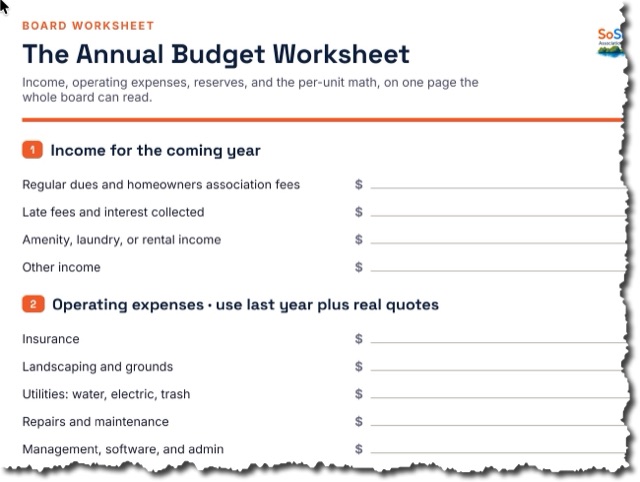
Each owner pays common expenses in the same ratio as the declaration's percentage of ownership. The board must prepare a detailed annual budget and, unless t…
-
§9.1
After the declaration is recorded, liens attach only to individual units, not the whole property. A contractor hired by one owner cannot lien a neighbor's un…
-
§9.2
The board may evict a defaulting owner or tenant under Article IX of the Code of Civil Procedure. Association attorney fees from a default are added to that …
-
§9.3
When a taking involves only common elements (no units or limited common elements), the association is named as defendant on behalf of all owners. An individu…
-
§9.4
After the association is served in a taking of a common element, it gives the plaintiff the owner and mortgagee list, and the plaintiff mails certified notic…
-
§9.5
An assignment of a developer's interest is not effective until it is in writing and recorded.
-
§10
Real-estate taxes are assessed against each unit plus its percentage of the common elements, not against the property as a whole. Recreational land used excl…
-
§11
Anyone who takes a unit by tax deed takes it subject to this Act and to the declaration, plat, and bylaws then in force.
-
§12
Every condo policy must include: special-form property insurance at full insurable replacement cost (including code-upgrade coverages B and C); commercial ge…
-
§12.1
Two or more condominium or common-interest-community boards may form a trust to pool property and liability risk. This section is the Condominium and Common …
-
§13
Insurance proceeds for damage to the property are applied to reconstruction unless the owners vote to remove the property from the Act under the rules in §14…
-
§14
If insurance is not enough to rebuild, the board assesses the shortfall as a common expense unless the owners vote to sell or remove the property as the Act …
-
§14.1
The association may dispose of or remove a portion of the property from the Act by the vote and recorded instruments this section requires, with percentages …
-
§14.2
The board may dedicate streets, roads, or utilities to a public body without a unit-owner vote, on the terms this section sets.
-
§14.3
The board may grant an easement for cable television or high-speed Internet cable across the common elements.
-
§14.4
The board may grant an easement to a governmental body to protect against water damage or erosion.
-
§14.5
A court may appoint a receiver for a distressed condominium (habitability failures, unpaid taxes, collapsed board) and order rehabilitation on the terms this…
Governance and sales
-
§15
The owners may sell the property free of this Act by the vote the instruments require, documented in a recorded instrument. Proceeds are split by common-elem…
-
§16
All unit owners, with every lienholder's consent, may remove the property from this Act by a recorded instrument. The property is then owned in common in the…
-
§17
Bylaws govern administration and may live in the declaration or a separate recorded instrument. An amendment is not valid until it is set out in an amendment…
-
§18
The bylaws must cover elections (at-large; at least one-third of seats expire each year; board terms no more than 2 years), a proposed annual budget to every…
-
§18.1
The owners or the board may incorporate a not-for-profit corporation under the General Not For Profit Corporation Act to run the property. The corporation's …
-
§18.10
An association of 100 or more units must use generally accepted accounting principles for any accounting obligation under this Act.
-
§18.11
Where a building-wide system serves the units: cooling must run 1 June–30 September when the heat index exceeds 80°F. Heat must register at least 68°F from 6…
-
§18.12
The association must administer accessible parking as this section and applicable disability law require, including reasonable accommodation for an owner who…
-
§18.14
An association may not ban a marked law-enforcement or firefighter vehicle that is assigned to an owner or occupant who is a law-enforcement officer or firef…
-
§18.2
Until the first board with a majority of non-developer owners is elected, the developer (or developer-appointed board) administers the property. This section…
-
§18.3
The association administers the property through the elected board. Every unit owner is a member. Whether or not it is incorporated, the association has the …
-
§18.4
The board exercises every association power the law or the instruments do not reserve to the owners: operate and repair the common elements, adopt a budget a…
-
§18.5
When recorded covenants put some association powers in a nonprofit that serves one or more condominiums, that body is a master association. It must follow th…
-
§18.6
An association may not prohibit display of the American flag or a military flag. Reasonable rules on placement, size, and manner are allowed.
-
§18.7
Defines 'community association' and 'community association manager' for the Condominium Property Act. Paid managers are separately licensed under the Communi…
-
§18.8
Notices, signatures, votes, consents, and approvals under the instruments or this Act may be done by acceptable technological means if a record is kept. A pe…
-
§18.9
A provision that requires owner consent before the board can sue, or that forces the board to arbitrate with the developer before going to court, is void as …
Records and remaining duties
-
§19
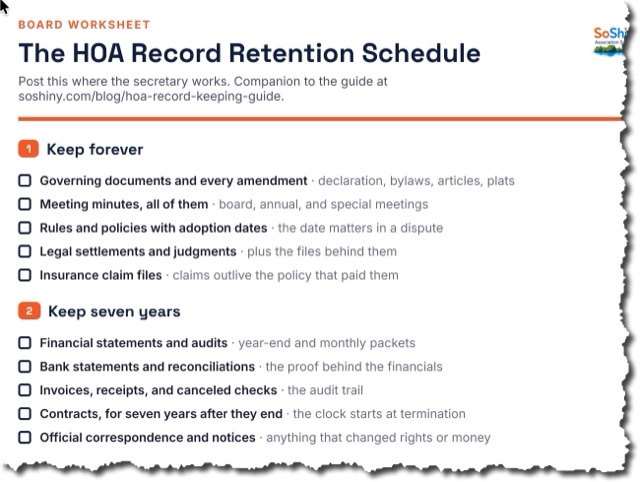
The board keeps, at the principal office: declaration, bylaws, plats, rules, articles, 7 years of minutes, current insurance, current contracts, the current …
-
§20
The rule against perpetuities and similar common-law property rules do not defeat a condominium created under this Act.
-
§21
If any provision of this Act is held invalid, the rest of the Act still applies.
-
§22
Before the first sale of a unit, the developer must give the purchaser the disclosure this section requires (instruments, budget, planned expenses, identity …
-
§22.1
On any resale by an owner other than the developer, the seller must get from the board and make available to the buyer: the instruments and rules; a statemen…
-
§22.2
If the instruments require association approval of a resale, the association may not unreasonably withhold or delay that approval.
-
§23
If a unit or common element encroaches because of construction, reconstruction, or settling, an easement for that encroachment exists for as long as it conti…
-
§24
Earnest-money and similar deposits paid to a developer are held and applied as this section requires so the purchaser's money is not treated as the developer…
-
§25
A declaration may reserve the right to add land. When property is added, percentages are reallocated and an amended declaration and plat are recorded as this…
-
§26
A limited common element may be transferred between units on the vote and recorded amendment this section requires. The transfer does not change common-eleme…
-
§27
Once there is any non-developer owner, the instruments are amended by an affirmative vote of two-thirds of those voting, or the majority the instruments spec…
-
§29
An owner may alter the interior of the unit if the work does not impair the structural integrity or mechanical systems of the building or damage a common ele…
-
§30
A conversion condominium (occupied building turned into condos) must give the tenant notices and follow the recording steps this section requires before unit…
-
§30.5
Extra protections for apartment-to-condo conversions, including tenant notice and purchase-opportunity rules this section sets.
-
§31
Units may be subdivided or combined only by the vote, amended declaration, and amended plat this section requires, with common-element percentages reallocate…
-
§32
The declaration or bylaws may require mediation or arbitration of disputes with no specific dollar value, or a value of $10,000 or less, other than levying a…
-
§33
The association may reasonably restrict smoking cannabis in common elements and, on the terms this section sets, in units. This is not a blanket ban on lawfu…
-
§35
Every condominium association must comply with the Condominium and Common Interest Community Ombudsperson Act (765 ILCS 615). Public Act 104-0377, effective …
Frequently asked about Act CPA
- What is Illinois Act CPA?
- Illinois Act CPA — the Condominium Property Act (765 ILCS 605) — is the body of law that governs how every Illinois condo is structured, operated, and held accountable. It covers governance, voting, records, assessments, fining, and most of the day-to-day legal questions a board will face.
- How many sections are in Act CPA?
- Act CPA contains 62 sections in this reference. Each is summarized in plain English on its own page, with links to the official text at ilga.gov.
- Is the summary on this site legal advice?
- No. These pages are plain-English summaries prepared by SoShiny for board members and managers. For binding legal advice or interpretation of how a section applies to your specific situation, consult a Illinois-licensed attorney.
- How often does Illinois Act CPA change?
- The Illinois General Assembly can amend any chapter in any session. We update these summaries when we re-import the official text — see the 'Last updated' date on each section page.
- Does SoShiny enforce Act CPA for me?
- No software 'enforces' a statute — but SoShiny is built around it. Voting, meeting minutes, records access, fining workflow, and audit trails are designed to meet this body of law's requirements out of the box, so the board can demonstrate good-faith compliance if challenged.
Running a condo in Illinois?
SoShiny is built around Act CPA from day one — every feature on every plan.
Start your community free →