Auto-pulled from Buzzsprout. Times mark where each stretch starts in the audio.
0:00
The HOA management company stole how much? Welcome to the HOA Case Files. A fun but serious look at running a self-managed board. Each week we cover one real problem with two opinions and ways to tame the craziness. Things like dues, repairs, reserves, vendors, software, meetings, and the neighbor who will not stop emailing you at 1 a.m. We argue the cost, debate the risk, and which fights are worth the trouble. The volunteer boards who have to decide something quickly and need advice on real-world association concerns. Let's
0:38
get right into it. Picture this.
0:54
It's the best feeling, right? Right, absolutely. And you pull up to your new neighborhood, and it is just flawless. You know, you've got those perfectly manicured lawns that look like a literal golf course, the community pool that's always sparkling blue, and uh that heavy wrought iron security gate at the front entrance. Right. The one that keeps the chaos of the outside world firmly on the outside. Exactly. And every single month you write a check to your homeowners association, $400, maybe $500
1:22
maybe more, depending on where you live. And you don't really overthink it. No, nobody does. It's just a bill. Yeah, it's just part of the social contract, right? You live in a well-maintained, desirable place, you pay the fee, you just operate on this fundamental assumption that your hard-earned money is going into a communal pot, you know, to repair the community center roof, pave the aging asphalt, or maybe plant some fresh hydrangeas around the clubhouse. Which is what it's supposed to do. Right.
1:46
But what if I told you that your monthly HOA fees aren't actually fixing that front security gate at all? What if the gate is broken because the money earmarked for its motor is quietly being siphoned off? It's a terrifying thought. It is. Because what if, instead of paving your roads, your money is actively funding someone else's luxury Disney World vacations? Or, you know, high-end cosmetic surgery. Exactly. Or honestly, in the most extreme terrifying scenario, what if your monthly dues are financing a multimillion dollar highly organized
2:20
criminal syndicate and it's operating right under your nose, run by the very people you elected to protect your neighborhood? The initial reaction most people have to this concept is absolute disbelief. I mean, it sounds like the plot of Daytime Soap Opera, right? Or like a really poorly written financial thriller. Yeah, exactly. The cognitive dissonance of looking at your seemingly boring, mundane neighborhood board and imagining a literal criminal enterprise is massive. But this is not fiction. The data, the recent indictments, they all show
2:51
that this is happening right now. In master planned communities just like yours. Yes. Condos, subdivisions, you name it. And the scale of this, um, it is just difficult to wrap your head around. Let's look at the raw numbers from our sources today. Over $16 million was stolen from Florida homeowners associations in just a six-month period in 2025. That number is staggering. $16 million gone. In six months. And we need to be incredibly clear about this, right? That astronomical figure is only counting the individuals who actually
3:24
got caught. Right. By law enforcement. The real number is likely way higher. Oh, without a doubt. And to put the scope of this vulnerability into perspective, Florida alone has roughly 48,000 homeowners associations. 60% of the entire population of Florida lives under this specific type of governance model. Wow. Over half the state. Yeah. So if you live in Florida, or frankly, any state with a high density of planned communities, like Texas, California, Arizona, the odds are incredibly high that you're financially tethered to one of these volunteer
3:59
boards. Your money is basically in their hands. And the structural reality of that tethering is exactly what makes this so dangerous. Because when you buy into a deed restricted community, your personal financial health is no longer entirely your own. Wait, what do you mean by that? Well, it becomes directly tied to the financial hygiene of your community association. Right. If they go bankrupt because of theft, your property value plummets, and then you are hit with massive special assessments to cover the deficit. Oh wow.
4:26
So you're basically on the hook for their mistakes. Exactly. You are essentially entering into a forced financial partnership with your neighbors. Okay, let's unpack this because today we are going on a massive, comprehensive mission. We have a mountain of sources in front of us, and I mean a literal mountain. It really is. We are looking at deep dive investigative journalism reports, comprehensive legal playbooks, raw sheriff's office transcripts, press conferences, technical software implementation guides, even actual local government meeting minutes. We've got it all. Yeah, we are
5:00
going to figure out exactly how these mega frauds are executed down to the smallest detail. We'll look at how state law is finally stepping up to fight back by actually throwing people in prison. And most importantly, and this is the entire crux of our deep dive today, we're going to look at how self-managed boards and everyday owners could have completely prevented these absolute disasters. Yes, prevention is the key here. Right. Because the solution isn't just hoping you elect a good person. The solution is implementing strict
5:27
software controls and easily audited digital systems. Because, as it turns out, the old shoebox of physical receipts method isn't just inefficient, it's essentially an open invitation to thieves. I completely agree. And my core belief here is that knowledge in this specific arena is only valuable when a homeowner takes it and applies it to their own neighborhood. Fraud, by its very nature, does not happen in the daylight. It thrives in darkness, administrative chaos, confusion. A community's best defense against embezzlement is not, you know, a charismatic board
6:01
president. Or a property manager with a trustworthy smile. Exactly. The only actual mathematical defense is an unbendable digital system of checks and balances that removes human temptation from the equation entirely. So let's look at the absolute worst case scenario to understand just how bad that darkness can get. Let's look at the megafrauds. And the absolute crown jewel of HOA heists, the one that really broke the mold, has to be the hammocks case. Oh, the hammocks, yes. This is officially recorded as the largest HOA fraud in
6:32
South Florida history. The numbers are just staggering. We are talking about $11 million, and actually some of the forensic accounting sources estimated closer to $12 million. $12 million stolen from a neighborhood. It's wild. Stolen over a multi-year period. And this wasn't a small condo building. This affected roughly 18,000 residents living in West Kendall. And the entire operation centered around the former board president, Margali Gallego, who was finally sentenced in 2026 to seven years in state prison. And that seven-year sentence is a landmark moment. It really
7:06
is. It is the longest prison sentence ever handed down to an HOA board president in the United States.
7:30
Yeah, because she didn't just like stumble into a position of power and decide to take a little off the top. The sources show this was a highly calculated infiltration from day one. Very calculated. Back in 2015, she deliberately purchased a 1% share in a single hammocks condo. She didn't even buy the whole unit to live in. She bought a 1% fractional ownership for the sole, specific purpose of legally qualifying to run for the board of directors. Which is a terrifying loophole. She basically identified the vulnerability
7:59
and bought her way into the governance structure for a fraction of the cost of a normal home. That is just so bold. Right. And once she secured the presidency in 2017, she didn't just mismanage the funds. She systematically weaponized the association's treasury. When forensic accountants finally got their hands on the books, they revealed three distinct, highly organized mechanics to the theft. Okay, lay them out for us. What was the first one? The first was the use of sham vendors. She and her co-conspirators created this massive
8:28
web of shell companies. One prominent example in the indictment was a company called IS Service and Repair Corps. IS Service and Repair. Right. And these companies were run by her family members or close friends. They would generate massive official-looking bills and submit them to the HOA for work that was entirely fictitious. Let me stop you right there because the mechanics of this are wild to me. They aren't just making up a company on a napkin. No, not at all. They are actually filing corporate paperwork with
8:55
the state, setting up real bank accounts, and making it look completely legitimate on the surface. So that if a casual observer looks at the ledger, it just says, you know, I as service in repair, $45,000 for sidewalk maintenance. Exactly. The illusion of legitimacy is the whole game here. And the second mechanic was ghost employees. Ghost employees in an HOA. Yes. They placed individuals on the official HOA payroll, complete with W-2s or 1099s, who did absolutely no work for the community. The HOA was just bleeding payroll
9:29
taxes and wages to phantoms. Unbelievable. And the third mechanic was perhaps the most insidious: inflated invoices with kickbacks. Ah, the classic kickback. Right. They would find legitimate third-party vendors, maybe a real landscaping company or a real roofer, and they would overpay them drastically for their services. So the vendor gets a massive check. The vendor gets the check, keeps their normal fee, and then kicks the fraudulent surplus back to Gallego and the other board members in cash or untraceable transfers. And here is the part
10:01
of the hammock story that literally sounds like a movie script. When residents inevitably started asking questions, you know, when they started demanding to see the financial records because their community was literally falling apart, where were the records? They certainly weren't in the clubhouse. No. The board took the community's financial documents, boxed them up, and hid them in a fake spa. A fake spa? A fake spa located inside a vacant commercial building in a Tamrak strip mall. That is fifty miles away from the community itself. It's
10:31
so brazen. Imagine wanting to see your own neighborhood's budget, and the board tells you that you have to drive an hour into another county to look at it in a fake day spa. They even use the HOA's own money to hire aggressive defense attorneys to sue the Miami Dade police officers who were trying to investigate them. Yeah, that's where it really crossed the line. But when you look closely at how the money moves in these scenarios, you realize it is fundamentally different from traditional theft. How
10:58
so? Well, a bank robber walks into a vault with a weapon and demands a lump sum. This HOA fraud is death by a thousand paper cuts. Or rather, a thousand invoices. The money bleeds out of the operating account slowly, month after month. Just a slow drip. Exactly. A perfectly legitimate sounding request for hurricane debris cleanup is generated. A check is cut with the proper signatures, but the funds are quietly diverted into the personal accounts of the board members. The paperwork always looks pristine. Which is exactly
11:30
what happened in Operation Sundown. Another massive case in our sources. Operation Sundown was huge. Yeah, the Miami-Dade Sheriff's Office spent two years meticulously investigating a 60-year-old property manager named Juana Wise and five of his associates. This crew scammed $5.8 million from five different condo associations across the region. Places like Mira Villa, Los Sueños, Samari Lake East. And law enforcement was not holding back on this one. No. Miami Dade Sheriff Rosie Cordero Stutz held a press conference and did not mince words. She explicitly called it a
12:05
brazen criminal enterprise. They submitted contracts for security upgrades, general renovations, plumbing, you name it. No work was ever done. Falsified invoices were blindly paid by the associations, and the money went straight into a wise's pockets. The most devastating detail from Operation Sundown, though, involved a massive insurance payout. Well, this part makes me sick. Following the destruction of Hurricane Irma, one of the associations received hundreds of thousands of dollars from their insurance carrier. Money that was desperately needed to fix devastated homes, repair leaking roofs, and make
12:37
the community livable again. Real disaster relief money. Yes. And that entire payout was simply pocketed by the conspirators. They stole the disaster relief funds of their own clients. And the thing is, it isn't always a massive sprawling ring of conspirators like a mafia family, right? Sometimes it's just one single person sitting at a desk with way too much access. Like the case in Martin County. Exactly. Look at the case of the bookkeeper in Martin County, Alexandra Del Caridad Gonzalez. She was hit with 124 felony charges.
13:09
124. Let that sink in. She managed to steal nearly $200,000 from two different HOAs that were managed by Avant Garde property management. She didn't have a complex web of shell companies. She just wrote checks to herself. She forged the necessary signatures, altered the general ledger to hide the missing cash, and where did the residents' money go? Disney World, right. Yes. It went to funding her luxury Disney World vacations, New York City shopping sprees, and her own cosmetic surgery. It's infuriating. But the common denominator in every
13:42
single one of these cases, from the $11 million syndicate to the rogue bookkeeper, is unchecked administrative access combined with a complete lack of real-time owner visibility. Okay, I have to step in here and challenge this narrative a bit because looking at these numbers is driving me crazy. Go ahead. How does eleven million dollars just vanish? How does 5.8 million disappear without anyone in a 500-home community noticing? It's like handing a stranger your wallet, turning your back for five years, and then acting shocked, literally shocked, when
14:17
your credit cards are completely maxed out and your identity is stolen. I get that frustration. I just struggle to feel purely sympathetic here. How are the residents of these communities not seeing this happen in real time? It is their money. It is incredibly easy from the outside to blame the residents and accuse them of willful ignorance, but put yourself in their actual shoes for a moment. They did see it. Yes. If you read the granular reporting from the hammocks, the residents saw the red flags everywhere.
14:43
The landscaping, which they were paying premium rights for, was actively dying. The grass was brown, the bushes were dead. Well, yeah, because the money was going to the fake spot in Tamarack. Exactly. And the highly qualified professional security staff was suddenly fired and replaced with completely unqualified friends of the board members who just, you know, sat in their cars. The residents knew something was horribly wrong. So why didn't they stop it? I mean, if you see the
15:10
grass dying and the security guard sleeping, you march into the board meeting and demand answers. They tried. But when you walk into a board meeting to demand answers, what happens? The people committing the fraud are the ones holding the gavel. Right. When homeowners in the hammocks tried to speak out during the public comment section, they were routinely bullied, shouted down, harassed, or formally silenced. And it goes far beyond just a nasty argument at a Tuesday night meeting. How so? If you push too
15:38
hard, a corrupt board can weaponize the bylaws against you. They will suddenly find a minor infraction on your property. You know, your trash can is out too long, your driveway needs pressure washing, and they will fine you into oblivion. They use your own rules against you. Exactly. They will tow your car from your own driveway. It is not ignorance on the part of the residents, it is systemic intimidation. But surely you can just go to the police. You could just call the
16:06
cops and say, hey, I think the HOA president is stealing. The police need evidence of a crime, not just a complaint about bad landscaping. You can't go to the local precinct and say, the grass is dying, arrest the board president for embezzlement. They just laugh you out of the station. They will tell you it's a civil matter, a neighborhood dispute. To prove theft, you need the financial ledger. You need the bank statements and the canceled checks. But the corrupt board controls the paper records. If you
16:32
suspect fraud, but the people committing the fraud are the only ones with the key to the filing cabinet or the key to the fake SMA 50 miles away, you are completely paralyzed. If the ledger is hidden, the fraud continues indefinitely and the police can't help you. Wow. That structural trap leads us directly into understanding who is actually being targeted here and why the traditional paper-based, trust-based system of running a neighborhood is fundamentally broken. We have to look at the psychology of the volunteer board. The data
17:03
on this vulnerability is highly revealing and frankly quite depressing. Lay it on us. The Association of Certified Fraud Examiners, or ACFE, conducts massive global studies on occupational fraud. Their data shows that nearly half, 48% of all HOA theft is committed by the board members themselves. 48%. Almost half. Not outside hackers, not rogue vendors, but the neighbors you elected. And on average, this embezzlement runs for 18 solid months before anyone even detects it. 18 months. A year and a half of just quietly writing checks to yourself
17:36
taking vacations on the neighborhood's dime before a single alarm bell rings. That 18-month window exists because of the structural absurdity of how these associations govern themselves. Think about what an HOA or a condo board actually is in practice. Right, it's just regular people. Exactly. It is a small group of elected, completely unpaid volunteers who are suddenly handed control over massive sums of shared funds, often operating budgets in the millions of dollars, and they have virtually zero independent oversight. We take people with absolutely no background in
18:11
corporate finance or legal compliance, and we hand them the keys to a multimillion dollar corporation. And these are exhausted people. They have demanding full-time day jobs, they are raising kids, they are dealing with their own life stress. When they volunteer for the board, they aren't looking to become forensic accountants. No, definitely not. They just want the community pool to be clean for their kids and the front gate to actually open when they swipe their fob. And that exhaustion is the exact vector for the disease. Exhaustion
18:38
creates blind trust. When a smooth talking property manager or a highly charismatic board president who seems to have it all together, puts a massive stack of papers in front of a tired volunteer director at 9.0 BM on a Tuesday. Just sign here. Yes. They say these are just the routine vendor payments for the month. I need your signature to get the landscaper paid. They just sign it. They don't have the energy, the time, or the technical expertise to audit every single attached invoice or verify the
19:09
tax ID of the landscaping company. And that psychological exploitation was heavily documented in Operation Sundown. The Sheriff's Office specifically noted in their findings that Wano A's targeted elderly, primarily Spanish-speaking volunteer board members. He knew exactly what he was doing. He didn't approach them like a corporate shark. He used deep cultural connections, spoke to them in their native language, shared stories, built a profound level of personal trust. And then once that emotional bridge was built, he got them to sign financial documents they didn't fully comprehend. It
19:39
is vital to contextualize that detail, though. This is not an indictment of Spanish-speaking boards, and it's certainly not an indictment of elderly volunteers. Right, of course. The predators in these scenarios will use whatever leverage is available, whether it's language, age, shared religion, or just a shared hobby. The vulnerability here isn't a language barrier. The vulnerability is invisible books. Invisible books, I like that phrase. It is an indictment of any neighborhood board where financial control relies entirely on a physical signature on a piece of paper that
20:11
immediately vanishes into a filing cabinet. If your system relies on human beings never lying to each other, you don't have a system. I love how one of our sources framed this. There is a story about a self-managed board in Daytona Beach. They read the terrifying news about the Miami Date arrest, and they had this massive internal realization about their own vulnerability. That's a great example. One of the board members wrote a memo to the community with this brilliant analogy. He said that if a community operates
20:39
out of a shoebox of PDFs, messy physical receipts, and personal Yahoo! email inboxes, they aren't a functioning governing body. They are a piggy bank with a doorbell. A piggy bank with a doorbell. That is the most accurate description of a paper-based HOA I have ever heard. Right. This episode brought to you by So Shiny Association Portal. Dial up your volunteer board compliance and build a better community the easy way. From payments, digital signatures, vetting of vendors, digital document storage, voting, and assessments, we've got you covered.
21:13
Go to SoShiny.com for details. Now, let's get back to the show. If the only thing standing between a seasoned fraudster and your community's operating account is an exhausted volunteer signature on a PDF, you are painting a target on your own back. Human trust is the absolute weakest link in the financial chain. So if human trust is failing us on a catastrophic scale, how is the state stepping in? Because Florida lawmakers didn't just sit back and watch $16 million evaporate while shrugging their shoulders. They brought the
21:43
legislative hammer down hard. The legislative response to these mega crimes has been unprecedented. In twenty twenty four, the Florida legislature realized the civil system was failing, so they passed two major sweeping bills that went into effect in July of that year. HB 2021 and H B twelve oh three. Yes. HB 1021, which the industry often refers to as Condo 3.0, and HB 1203, which focus specifically on HOA reform. And the biggest, most fundamental shift here is the move from civil penalties to criminal penalties. They are
22:17
finally putting people in handcuffs. Exactly. Historically, the law treated HOA disputes like petty neighborhood squabbles. If a board member hid the financial records from an owner or took a shady $20,000 kickback from a roofing company, it was mostly treated as a civil dispute. So you basically had to sue your neighbor. You, the aggrieved homeowner, had to dip into your own pocket, hire an expensive attorney, and sue the board in civil court. It was incredibly expensive, dragged on for years, and heavily favored the people who already
22:47
controlled the association's money. Because they were using your HOA dues to pay for their defense lawyers? Yes. It was a rigged game. But now taking a kickback is classified as a third-degree felony. That carries up to five years in state prison. Five years, that's real time. And if you intentionally destroy, alter, or hide accounting records with the intent to harm the association or avoid detection of a crime, that is a first-degree misdemeanor, which can easily and quickly escalate to a third-degree felony depending on the severity.
23:18
That statutory change completely alters the landscape. It gives local law enforcement a direct, undeniable path to investigate. Going back to our earlier point, if a board is stonewalling an owner and refusing to hand over the bank statements, the police no longer have to say, oh, it's a civil matter. Right. They can step in, demand the records under threat of arrest, and treat the clubhouse as a potential crime scene.
23:47
And the sources detail their incredibly strict 90-day playbook for handling complaints against associations. It's very strict. But this is where it gets incredibly frustrating for homeowners because there is a massive difference between how the DBPR handles condos versus how they handle single-family HOAs, right? Yeah, yeah. We really need to explain this because people get very confused. It is a critical difference that leaves a lot of single-family homeowners feeling abandoned by the state. You have to look at the statutes. Okay, let's break it down.
24:15
For condominiums, which are governed under Chapter 718 of the Florida statutes, the DBPR has incredibly broad, full investigative authority. If you live in a condo and suspect fraud, the DBPR can look into financial reporting, commingling of funds, structural reserves, records access, elections, virtually everything. Wow. So they have a ton of power there. And if they find the condo board at fault, they can hit the association with massive civil penalties capped at $5,000 per violation per day. $5,000 a day. That will bankrupt a small
24:49
community in a week. Yes, it is a severe deterrent. But for HOAs, which are typically single-family home communities governed under Chapter 720, the DVPR's regulatory reach is severely limited. Historically, they primarily only handled election disputes and the licensing of the property managers. So they couldn't even touch the money issues. Not directly. Now, thanks to the new laws, they can handle criminal referrals for things like kickbacks. But if you live in an HOA and you call the state hotline because your board
25:17
is just poorly managing the funds or hiding general records, the DBPR will often tell you they don't have a jurisdiction. That is wild. Your main path is still forced pre-suit mediation or going straight to the police to report a felony. Imagine the sheer frustration of that homeowner. You read the news, you see these laws passed, you call the state hotline thinking you are protected, and a bureaucrat tells you, sorry, you live under Chapter 720, not 718. Go hire a lawyer. It's a huge gap in the
25:46
system. But let's focus on the condo side, because that DBPR timeline for Chapter 718 complaints is aggressively fast. If an owner files a legally sufficient complaint, the clock starts instantly. It is a rapid-fire administrative process. The condo board usually has a 20-day window to respond once the state investigator reaches out. Then there is a 30-day document production window. And this 30-day window is where amateur volunteer boards completely hang themselves. Why do they fail? I mean, it's just handing over documents, isn't it? Because they don't have
26:16
systems. Let's say the DBPR asks for your community's official records request log for the past two years. Okay. The state law requires you to maintain a log of every time an owner asks for a document and when you provided it. If your board has been operating out of a shoebox, relying on sticky notes and verbal conversations at the pool, you don't have a log. Oh wow. Missing that log during a state audit is fatal. You can't just tell the investigator, oh, we forgot to write it
26:44
down. Right, they don't care. Or let's say you want to withhold certain legal documents because of attorney client privilege. If you fail to provide a properly formatted, legally compliant privilege log detailing exactly why each document is withheld, the investigator treats it as a blanket failure to produce records. And if the investigator finds a reasonable basis for the complaint, they issue something called a notice to show cause, which basically means the friendly part of the investigation is over, right? Exactly. You are entering a formal adversarial administrative
27:16
process that can end with those massive daily fines, public disciplinary records for the board members, or a forced consent order. Which leads to a really important, almost existential question about these laws. The intention of making these crimes felonies and imposing $5,000 a day fines is obviously to deter the Marglega egos of the world. Right. But you have to wonder about the collateral mammage. Will the threat of third-degree felonies and financial ruin actually scare the sophisticated fraudsters? Or will it just terrify honest, well-meaning volunteers into resigning
27:52
and never serving on a board again? It is the number one fear of every volunteer director, and they really need to understand the nuances of their protection. Because honestly, put yourself in the shoes of a normal person. If I'm on my neighborhood board volunteering my Tuesday nights for free to argue with my neighbors about the color of the pool furniture, right? Which happens constantly. And a disgruntled neighbor who just happens to hate me files a completely bogus DBPR complaint alleging Iid financial records. Am I going
28:20
to prison? Am I going to go personally bankrupt, paying for defense lawyers to prove I didn't do it? Generally speaking, the DBPR civil penalties and fines target the association as a corporate entity, not the individual director's personal bank account. Unless there's proven willful misconduct. Okay, that's a relief. And your community should have directors and officers' insurance, a DNO policy. Yeah. That will typically cover the massive legal defense cost for the association during one of these investigations. There's a but, isn't there? There is a massive but.
28:52
If you are formally charged criminally with fraud or taking kickbacks, that criminal charge instantly nullifies your DNO insurance entirely. The insurance company walks away. Oh my gosh. So you are completely on your own. You are paying for your criminal defense out of your own pocket. So how on earth do you protect yourself from the bogus complaint? If a crazy neighbor wants to ruin your life, how do you stop them? The absolute best defense against a bogus complaint or a very real state investigation is
29:19
a flawless, unalterable digital paper trail. A digital paper trail. Yes. If a neighbor complains that you ignored their records request, and you can instantly pull up a timestamped, digitally verified log showing exactly when the owner requested the records, exactly when the online portal granted them access, and exactly how many seconds they spent looking at the document. Oh wow. The investigator sees that and what? The DBPR investigator looks at that data and immediately closes the case as no reasonable basis. The digital trail is your
29:52
ultimate shield. But to have that digital shield, you need the right tools. Which means we have finally arrived at the core mission of this deep dive. We've seen the multimillion dollar crimes, we've dissected the heavy-handed state laws, but how do you actually stop the theft from happening in the first place? This is where we get into the real solutions. Right. How do you replace the dangerous shoebox of receipts with an impenetrable system? We have to look back at that Daytona Beach Board story you
30:17
mentioned earlier. They are such a good example. They are a self-managed community, meaning they don't hire a massive, expensive property management firm to run their lives. When they read the news about the Miami data rests, they didn't just cross their fingers and hope their board members were honest. They took action. They went into their community management software and they locked it down with military precision. They implemented seven strict, non-negotiable software controls that essentially remove human trust and human temptation from the equation entirely. We
30:49
need to go through these seven controls in extreme detail because this is literally the survival playbook for any community in America. Let's start with control number one, the vendor desk. I don't want to just list this. I want to know how it physically stops a criminal. The rule of the vendor desk is absolute. No W9 tax form, no valid certificate of insurance, a COI means no payment. Period. In a paper-based system, a corrupt board member can just write a check to their cousin's fake
31:16
landscaping company. But with a software vendor desk, the system physically prevents a check from being generated or a digital transfer from initiating if the vendor isn't fully verified. So let's apply this to the hammock's case. Margley Gallego was using that fade shell company, Aya Service and Repair Corps, run by her family. If the hammocks had used this software, what would have happened when she tried to pay Aya? The software would have stopped her cold. Oh. Because a fake shell company wouldn't have a legitimate underwritten commercial
31:47
insurance policy. When Gallego tried to upload a forged certificate of insurance, the software's OCR, optical character recognition, would scan the document, fail to verify it with an actual insurance carrier's database, and the system would flag the vendor as invalid. Oh, that's brilliant. It actually checks the database. Exactly. The pay invoice button would remain grayed out and unclickable. The software acts as an interlocking vault door. If the COI gear hasn't been turned by a third-party underwriter, the payment lever physically cannot be pulled by the board member.
32:20
That is just incredible. Okay, control number two. Bills and payables must be tied directly to the general ledger with strict separation of funds. This control forces accounting discipline that volunteers often lack. Every single vendor bill must post directly to the ledger in real time. But the critical feature is the hard segregation of operating cash and reserve cash. Break that down for me. Operating cash is for mowing the lawn, paying the electric bill. Reserve cash is the massive savings account for replacing the roof in 10 years.
32:52
Fraudsters love to dip into the reserves because there is so much money sitting there. So if a corrupt treasurer tries to pay a fake $20,000 plumbing bill out of the roof reserve account just to get the cash out of the community. The software will trigger an immediate alert and block the transaction. It just blocks it. Completely. It will state that routine maintenance categories cannot be funded from restricted reserve accounts without a multi-step recorded override process that notifies the entire board and the community. You cannot accidentally
33:23
or intentionally bleed the reserves for daily operations. Okay, control number three might be the most important one for catching theft early, the bank reconciliation. And the golden rule here is that it must balance to zero at the end of every single month. Right, because human nature loves leniency. Oh, for sure. In a paper system, a volunteer treasurer might look at the bank statement, see they are off by a few thousand dollars, and say, Oh, I'm tired, I'll figure it out next month. Let's just close the
33:50
books. Yeah, who wants to do math at 10 PM on a weeknight? Exactly. And fraudsters rely entirely on that leniency to hide their early thefts. Strict software controls force the bank reconciliation to zero out. It matches the community's internal ledger to the actual bank statement down to the absolute penny. And if it doesn't, if it doesn't zero out, the software refuses to close the financial month, and the discrepancy is highlighted in bright red on the dashboard for everyone to see. This perfectly connects to a case
34:18
study in our sources about the Quail Meadow community. We have to talk about this because it shows how the bank reconciliation catches sophisticated digital theft. What exactly happened in Quail Meadow? In the Quail Meadow case, the fraudster didn't use paper checks. They manipulated the community's property management software, a program called App Folio, to initiate a fraudulent electronic transfer of funds directly out of the HOA's account. So it was a slick, modern digital heist. Very slick. But if you have the zero balance bank reconciliation rule turned
34:51
on, how does the software catch that Epfolio transfer? Because the software demands a matching ticket for every single dollar that moves. When the end of the month arrived, the actual bank statement showed, say, $10,000 leaving the account via that fraudulent Epfolio transfer. But the internal software ledger had no corresponding approved invoice or work order for that $10,000. The reconciliation failed. It didn't balance to zero. Ah, so it flags it. The software immediately threw a red flag, refusing to close the month, which forced the board to
35:23
investigate the missing $10,000 instantly rather than discovering it 18 months later. That is huge. Which brings us directly to control number four. Work orders. Okay, so the math is perfect, the bank reconciles, and the vendor is insured. Right. But what if the invoice is for a massive $15,000 hurricane cleanup job that simply never happened? The software can't physically walk outside, climb a ladder, and check the shingles. How do you solve the phantom work problem that we saw in Operation Sundown? You solve it by logically linking
35:55
the payables to the physical work orders. A bill cannot be paid by the software unless it is mathematically matched to a completed verified work order ticket. So how does that work in actual practice? Let's say a vendor submits that $15,000 invoice for Hurricane Cleanup. The software receives the invoice but places a hard hold on the funds. Okay. It then requires a designated board member or a property manager to physically go to the site, take a photograph of the cleaned up debris on their smartphone, upload that
36:26
photo into the software, and digitally sign a verification statement that the work was completed to standard. Wow. Only after that verified work order is matched to the invoice does the software unlock the funds for payment. You completely eliminate the ability to pay for thin air. That is incredibly robust. Control number five is the activity log. This is your unalterable digital footprint. Every single click, every login, every approval is permanently recorded. No more guessing who did what. Exactly. It records exactly who logged in from what IP
36:57
address, who approved the vendor, who generated the invoice, and who authorized the payment. It utilizes cryptographic electronic signatures that cannot be forged, altered, or backdated by a panicked board member trying to cover their tracks. So if the DBPR investigator or a Miami Day detective ever comes knocking on your door asking who authorized the transfer to the fake Tamarak Spa. You don't have to rely on someone's faulty memory and you don't have to point fingers. You simply hand the detective the exported activity log. The software says
37:28
unequivocally, Board President Gallego logged in at 2.14 AM on a Tuesday and authorized this payment. The log is the ultimate impartial witness. But even with all these internal software locks, the vault doors, the OCR scanning, if the owners living in the community can't see the numbers, you still have a black box, right? The board is just policing itself. How do we open the hood for the residents? That's control number six, owner transparency. The Daytona board really recognize this. They realize that pushing information out is vastly
37:58
better than forcing owners to pull it out through hostile records requests. Make it public by default. Yes. They set up their software system so that comprehensive financial reports, the balance sheet, the income statement, the budget versus actuals, they are automatically pushed out to the community via email blasts, text message alerts, and even displayed dynamically on monitors in the condominium lobby. In the lobby. So you can't even walk to your mailbox without seeing the balance sheet. Exactly. The owners see exactly what the board sees
38:28
in real time. And this isn't just a good idea anymore. This is actually becoming the law, right? Yes. The new HB 121 and 1203 mandates legally require associations of a certain size to maintain secure, centralized online portals where all of these financial and structural records are permanently accessible to the owners. You completely eliminate the excuse of we lost the paper. You eliminate the ability of a rogue board president to hide the ledger in a vacant strip mall. The final control, number seven, board meetings
39:00
and minutes. How does this software integrate with a Tuesday night meeting? The rule is that money only moves on a recorded agenda vote. You don't just decide to spend $50,000 on a new playground over a private phone call with the treasurer. Right. None of these backroom deals. Exactly. The software requires the expenditure to be placed on a public agenda, it gets debated and voted on in a public meeting, and the exact vote tally is recorded in the official minutes within the software. The payment cannot be
39:27
generated until the minutes reflecting the affirmative vote are published. That's a great safeguard. We actually have a fascinating primary source document that illustrates what a well-run, fully compliant community looks like. It's the actual real-world meeting minutes from the islands at Doral Community Development District from late 2024. Reading this document is honestly like taking a masterclass in healthy, transparent governance. It really is a breath of fresh air compared to all the fraud cases we've been discussing. The minutes detail their process of appointing an audit committee to
39:57
select an independent financial auditor for the year. And notice what they didn't do. The President didn't just pick his college buddy's accounting firm and hand him a check. Exactly. They appointed the entire board as the committee to ensure full visibility. They reviewed objective, standardized evaluation criteria. They utilized a formal, public request or proposals process, and they publicly ranked the bidding accounting firms based on their proven ability to perform under strict government auditing standards. And their internal performance measures are equally impressive. They actively track and publicly
40:31
report on metrics like all meetings publicly noticed as required by law and district records retained as required by law. They are holding themselves accountable in the public record. But the absolute best part of the Doral CDD minutes, the part that every community should strive for, is when they publicly note that their annual financial audit came back with no findings. No findings is the absolute gold standard in accounting. It means the independent auditor came in, looked at every single ledger entry, tested the bank reconciliations, stress tested
41:01
the software controls, and found absolutely no discrepancies, no missing funds, and no weaknesses in their internal controls. Then it's just huge. It proves a vital point. A self-managed board doesn't have to mean an unsupervised board. Software and strict protocols force a segregation of duties, like requiring dual digital signatures on large checks that human nature naturally tries to bypass for the sake of convenience. Okay, we've talked extensively about how a good board protects itself, but let's look at the dark flip side. The nightmare scenario. Exactly. What
41:34
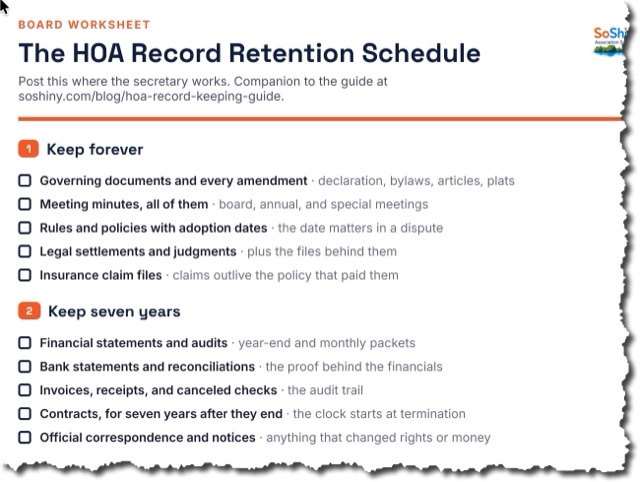
if you are listening to this right now and you are just a regular owner? You're not on the board, you strongly suspect fraud is happening, your board flat out refuses to use software, they operate out of a messy shoebox in the president's garage, and they aggressively refuse to show you the books when you ask.
42:08
If you do, you will waste tens of thousands of dollars and likely lose. You have to meticulously build the paper trail first. Step one, document absolutely everything. Don't just ask the president at the mailboxes. Verbal requests do not exist in the eyes of the law. You must make a formal written request to inspect the official records of the association, and you must send it via certified mail with a return receipt requested. This proves they received it. Okay. And then what? Under Florida law, once they sign
42:36
that receipt, the board has exactly 10 business days to provide access to the records. If they refuse or simply ignore you, they face a statutory penalty of $50 per day. And more importantly, they become liable for your attorney's fees if you have to sue them to get the documents. That's a powerful tool. Step two is where it gets incredibly real for the board. File a police report. Right. If you finally get the records, or if you have independent documented evidence of suspected theft, like photographs of
43:06
the fake Tamar X-Ba, proof of fake vendors, or documented refusal to provide records specifically to cover up a crime, you go directly to local law enforcement. Do they actually care though? They do now. As we saw with Operations Sundown and the Hammocks, filing a police report and presenting organized evidence is the most direct path to triggering a criminal probe. Step three.
43:30
And this is a fascinating development in our sources because the Miami-Dade State Attorney's Office actually filed a formal funding request with the Florida Senate for $500,000 specifically to create a dedicated specialized condo in HOA criminal fraud task force. Which highlights just how seriously the state is taking this epidemic now. The state attorney is explicitly asking for funding to hire specialized investigators and forensic accountants because these crimes, the shell companies, the inflated invoices, they are Incredibly complex to unravel. Yeah, standard beat cop can't do that. Exactly.
44:04
A standard beat cop cannot unwind a $12 million forensic accounting fraud. They need the task force. If the local authorities are bogged down and are moving fast enough, step four is escalating to the state level. The Florida Attorney General and the DBPR. Yes. The Florida Attorney General operates a dedicated fraud hotline. And if you live in a condominium, this is when you file that formal, legally sufficient complaint with the DBPR to trigger that aggressive 90-day investigation playbook and the massive civil fines we discussed earlier. And
44:35
step five, the absolute nuclear option. The FBI. If the fraud involves wire fraud across state lines, mail fraud, or massive scale embezzlement that crosses into federal jurisdiction, the FBI will absolutely get involved. They take this so seriously that they actually have a dedicated HOA and condo fraud cases page on the Department of Justice website to track these massive syndicates. Let's address a common misconception, though. What if you don't have hard proof of theft, but you just know the books are a mess and you want to
45:05
force an audit? Can one angry owner stand up at a meeting and unilaterally demand a forensic audit of the entire association? No, an individual owner cannot unilaterally force an audit. Forensic audits are incredibly expensive, often costing tens of thousands of dollars, and one angry neighbor cannot force the community to spend that money. So what can they do? Well, Florida law provides a democratic mechanism called the 20% petition rule. If 20% of the voting interests in a community sign a formal petition demanding a higher level of
45:34
financial reporting, for example, moving from a basic unverified cash report to a fully audited financial statement prepared by an independent CPA, the board is legally required to hold a special meeting and put it to a community vote. And if the majority of the community approves it at that meeting, the board has to execute the audit, even if it means levying a special assessment on everyone to pay the accountants. Precisely. The community can force transparency if they organize. And this is why we highly recommend what the
46:02
sources call the Monday morning checklist. This is a rapid-fire checklist of basic financial controls that both board members and concerned owners can use to evaluate their community's health today. Let's walk through that Monday morning checklist. These are the things you can and should check right now. Number one, are your bank reconciliations actually zeroing out at the end of the month, or is the board just estimating? Number two, are your daily operating funds and your long-term reserve funds sitting in completely separate restricted bank accounts? Both critical.
46:33
And number three, does every single director on the board and the property manager have their own unique traceable login to the accounting software? That last point about unique logins is perhaps the most crucial and honestly the most often violated rule in small communities. Really? Just sharing passwords. Oh, all the time. If your board shares one master password to the accounting software, let's say they all log in as admin HOA, you do not have an activity log. You have completely destroyed the digital footprint. Because you don't
47:03
know who is who. Exactly. If $10,000 goes missing, you have absolutely no idea which of the five board members actually authorized the payment because they all use the exact same name. Sharing one password means you aren't really a functioning governance board. You are a massive walking liability. Wow. As we wrap up this massive investigation, we really have to reiterate the profound human cost of all this. It's so easy for us to get lost in the millions of dollars, the DBPR timelines, and the third degree felony
47:36
charges. It's just numbers on a page to sum. Right. But think about the actual people living in these communities. Think about Balthazar Martin, a resident we came across in the reporting surrounding the Daytona story. He is just a normal guy. He pays his $340 monthly dues religiously. Then, because the board mismanaged the funds, he gets hit with a $200 special assessment on top of his dues. Which hurts. It does. He pays it because he has to. And then he's standing there in his driveway, staring at
48:01
a front security gate that is still broken, a pool that is still green, and he is wondering where his hard-earned money actually went. That feeling of helplessness is the real tragedy of HOA fraud. A special assessment levied to cover stolen funds feels like a second government-sanctioned theft. The homeowner is victimized by the fraudster and then victimized again by the association needing to balance the books. Exactly. It is a profound violation of trust that destroys the social fabric of a neighborhood. Which brings me to a question
48:32
I want you, the listener, to ask yourself right now. Think about your own neighborhood. When was the last time your community's bank reconciliation actually zeroed out? Do you even know where to look on your community portal to find that document? Most people probably don't. Right. If the answer is no, if you have no idea where your neighborhood's ledger is, you have a vulnerability. And if you don't know where to look for the money, you can guarantee a sophisticated fraudster knows exactly where to hide it. We
48:59
have been on quite a journey today. We started in the darkest corners, looking at Margoli Gallego and the $12 million hammock syndicate. We looked at Wano Eyes and the $5.8 million Operation Sundown. We unpacked the heavy-handed, felony-level legislative crackdown from the state of Florida. It's been a lot to cover. It has. And most importantly, we walked through the absolute non-negotiable necessity of rigorous software controls, like automated vendor desks, unalterable digital activity logs, and forced bank reconciliations that balance to zero to protect self-managed boards. The ultimate
49:36
takeaway here is that living in a community association inherently means accepting shared risk and shared financial exposure. You are quite literally trusting your neighbors with your net worth. The absolute best neighbor you can be is not just the one who waves at the mailbox. The best neighbor is an informed, actively nosy neighbor who demands digital transparency and unbendable financial controls from their board. But I want to leave you with a final, slightly provocative thought to mull over. We've spent this entire deep dive talking about how
50:04
to catch bad actors, how to implement unyielding software, and the very real threat of sending corrupt volunteers to prison. Right. But consider this secondary effect. As the state laws get stricter and the penalties become felonies, and as the software requires more rigorous zero-tolerance data entry, we are essentially demanding professional-level corporate accounting and strict legal compliance from unpaid, exhausted volunteers who just wanted to help plan the neighborhood block party. It's a huge burden. It is.