Auto-pulled from Buzzsprout. Times mark where each stretch starts in the audio.
0:00
Your minutes are a lie because a robot wrote them. Welcome to the HOA Case Files, a fun but serious look at running a self-managed board. Each week we cover one real problem with two opinions and ways to tame the craziness. Things like dues, repairs, reserves, vendors, software, meetings, and the neighbor who will not stop emailing you at 1 a.m. We argue the cost, debate the risk, and which fights are worth the trouble. For volunteer boards who have to decide something quickly and need advice on real-world
0:35
association concerns. Let's get right into it. Yeah, you're already stressed, you're working for free. Exactly. But then you hit a button, and an artificial intelligence tool writes your draft meeting minutes in exactly nine seconds. I mean, that sounds like an absolute dream scenario for any volunteer who, you know, just wants to get their Tuesday nights back. It really does. Right up until you read the actual document and realize the AI accidentally credited a crucial motion for a massive roof repair to a board member it confidently
1:08
named, uh Speaker 3. And let me guess, speaker 3 wasn't actually on the board. Not even close. Speaker 3 was the HVAC unit outside the clubhouse window, just rumbling to life. Oh wow. Yeah. The software literally couldn't tell the difference between a low mechanical hum and a human being. That is wild. And that is the exact trap hundreds of volunteer boards are falling into right now. People are trying to use AI transcription tools to magically condense these three-hour grueling meetings into like 40 minutes of actual
1:39
work. But they're inadvertently creating legal disasters instead. Exactly. Okay, let's unpack this. Because if you are serving on a board, you really need to know about the catastrophic mistakes people are making with this technology. Yeah, but also the perfect setup to actually get it right. Right. So we're diving deep into a bunch of case studies today from Florida to California, looking at how boards are deploying this stuff. We should probably start with the software itself, because
2:03
there is a massive gap between what a slick transcription tool promises on its landing page and what it actually delivers when you drop it into the middle of a crowded, echoey room. Oh, totally. The goal of a board meeting isn't just, you know, getting out of there as fast as possible. The goal is creating an accurate, legally sound record of actions taken by an association. Right, which brings me to this fascinating breakdown I was reading of a two twelve unit HOA in Daytona
2:29
Beach. Okay. The secretary there had inherited this absolute nightmare folder of just handwritten legal pads from the previous board. Oh, that's the worst. Trying to decipher someone else's handwriting. Exactly. So to Trent and fix this mess, she starts using Notions AI meeting notes. She literally just opens a page, hits transcribe, and sets her laptop right in the middle of a massive boardroom table. And I imagine the output, at least on the surface, is initially very impressive. It is. It gives you a running transcript, but more
3:01
importantly, it leverages the AI to produce a summary with an actionable list right at the very top of the page. Now see, that action list is pure gold for a volunteer. Totally. Think about it. In a three-hour meeting, you might have six or seven loose ends just floating around, like uh get three bids on the pool pump, or ask the attorney about the fence variants. And usually no one writes those down because it's 9 p.m., everyone is exhausted, and you just want to go home. Right.
3:27
But Notion actually parses the text, pulls those action items out, and stacks them at the top of the page with the owners of those tasks attached. Yes. And the best part is it links directly back to the exact audio citation. That citation feature is vital. You click the summary line, the software jumps to that exact moment in the recording, and you hear the original sentence. Which completely eliminates the scenario where, you know, three weeks later, board members are arguing from
3:55
memory about what was actually agreed upon. Exactly. Now obviously there's a financial cost to this, right? Yeah. AI meeting notes requires a notion business plan. And for a volunteer board operating on tight margins, a recurring monthly subscription is a real line item on the budget. True. But if you analyze the cost against the value, it's a massive win. How so? Well, you're comparing a relatively small monthly software fee against saving hours of a volunteer's time every single month. Or worse, you're comparing it to the cost
4:26
of paying an attorney $300 an hour to untangle a messy, inaccurate legal record. That is a very fair point. But hold on, we have to talk about the catch. The giant glaring trap in all of this. The speaker labels. Yes. The speaker labels. So I was looking at granola, which is another incredibly popular AI note taker right now, and comparing it to Notion. Granola is fantastic. It is, but it is explicitly built to capture device audio for your personal one-on-one note-taking. It is incredibly light on
4:58
the actual transcript side. And it is definitely not built to handle a room of eight people passionately talking over each other. Right. And that highlights the shared flaw across almost all these platforms when you try to use them in a physical room. Yeah. When you have a group setting all sharing a single microphone on a laptop, the software can detect that a new voice started talking. So it knows to hit enter and start a fresh line of
5:20
text. Exactly. But it has absolutely no idea whose voice it is. It is just guessing based on a single flattened stream of audio. It's like it's like hiring a brilliant executive assistant who works at lightning speed but absolutely refuses to learn anyone's name. That's a great way to put it. Right. They just hand you a note saying, someone said we need to fix the roof, but I don't know who. Well, technically this happens because the AI is
5:42
trying to solve what audio engineers call a diorization problem. Diorization. Yeah. It's trying to separate speakers based purely on subtle differences in kitchen tone. And in a sterile studio, that works. But in a real room, those acoustic signatures just get muddy. Right. But honestly, the psychological danger here is actually far worse than the technical one. Wait, how do you mean? Well, think about human nature. If a secretary hands you a messy, scribbled legal pad, it naturally invites scrutiny. You read it carefully. Yeah, maybe
6:13
even cynically, because it looks fallible. A human clearly rushed through it, but an AI generates a clean, beautifully formatted, grammatically perfect paragraph.
6:23
Exactly. It looks authoritative. So people just trust it blindly. A fluent, confident, but entirely incorrect AI sentence travels fast and causes chaos before anyone catches the error. And that is scary. Which means the humans have to intervene. Because if the software can't flawlessly name people in a crowded room, the humans have to physically change how they run the meeting to aid the software. Yes. I was looking at some of the essential habits for a successful secretary, and the single most effective fix is shockingly low-tech. It's
6:55
called the call-out hack. It's brilliant in its simplicity. Right. The chair of the meeting just has to announce names before anyone speaks. So instead of someone just blurting out an opinion, the chair says, the chair recognizes Tom. And the board should also do a verbal roll call at the very top of the meeting where everyone clearly states their own name and title right into the mic. But how does that actually fix the AI problem? Aaron Ross
7:19
Powell By doing that, you're actively embedding the person's name right into the text, slightly ahead of the words they are about to speak. Oh, I see. The AI doesn't have to guess the acoustic signature of the voice anymore, it just transcribes the spoken word Tom, and any basic AI on earth can transcribe the word Tom perfectly. Okay, wait, let me push back on this for a second. The whole pitch of AI is that it's supposed to do the work for me. Why am I suddenly restructuring
7:45
my entire community meeting, policing how my neighbors talk, and still having to read a massive document line by line before I publish it? It feels like we're serving the tech, not the other way around. What's fascinating here is that adapting to the AI actually enforces better parliamentary procedure. It essentially forces a board to strictly follow Robert's rules of order. That's the standard parliamentary rule book, right? Exactly. The core of Robert's rules is that only one person speaks at a time, and
8:14
they must be formally recognized by the chair. Okay. Yeah. When boards actually do this, meetings run smoother, faster, and with far less conflict. The AI isn't forcing you to do something unnatural, it's just giving you a structural excuse to stop people from shouting over each other. That makes a lot of sense. Like, sorry guys, you have to wait your turn. The AI is listening. Exactly. It takes the heat off the chair. And it ties into the next big habit I
8:38
saw condense, don't copy. This is huge. The AI is going to give you a verbatim transcript of a two-hour, highly emotional argument about a beige fence. But the secretary's job is to strip all of that out. Meeting minutes are a record of actions taken, not everything that was said. And this is a critical legal distinction. A verbatim transcript of an argument is a terrible thing to keep as an official corporate record. It is an absolute gift to a plaintiff in a lawsuit. Because
9:07
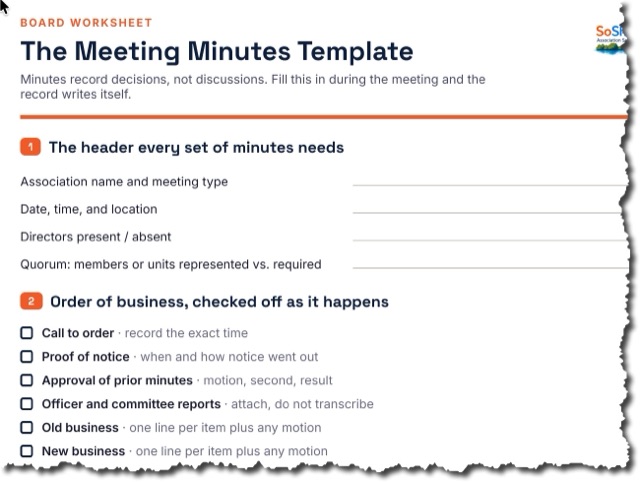
it captures all the raw emotion. Because it captures every offhand comment, every raw emotion, and every potential out-of-context quote that someone might regret later. Wow. Okay, so what should the secretary actually keep? The Secretary must reduce a 40-minute debate down to just a few bullet points. Who was present, what was moved, who seconded it, and the exact vote count with named dissenters. Okay. The AI does the heavy lifting of capturing the raw material so you don't have to stress about missing
9:32
a detail, but the human secretary has to sculpt it into proper, legally sound minutes. But you know, even with all these great habits, even if your chair calls out every name perfectly and strictly enforces Robert's rules, it doesn't matter if the audio going into the AI is garbage. That's the truth. We need to transition from software to hardware. Yeah. Because as we saw with the HVAC unit, the microphone is the entire ballgame here. The golden rule of audio transcription is distance. Distance. The physical
10:03
distance from the speaker's mouth to the microphone drives accuracy far more than whatever expensive cutting-edge AI model you're running on your laptop. Really? The microphone must be within six feet of each speaker. It's basic physics, the inverse square law. Every time you double the distance between the sound source and the microphone, you don't just lose a little bit of audio quality, you exponentially destroy the transcription accuracy. Wow. So if you're sitting on a board right now wondering how to fix this, I found a
10:29
really practical breakdown of budget tiers for hardware. Let's hear it. If your board has virtually no money, say under a hundred bucks, you get a 360-degree USB speakerphone, something like an anchor power cough. You put it dead in the center of the table. And that works because it's an omnidirectional microphone. It's designed to capture a small tight radius equally from all sides, but it will fail if your table is too long and people are sitting 10 feet away. Right. So moving up, if you
10:58
have $150 to $300, you get a handheld field recorder. Right. Like a zoom age series or a task cam. But here's where it gets really interesting. You don't just place it directly on the table, you place it on a folded towel in the middle of the table. Ah, the folded towel trick. It is an absolute lifesaver. Wait, really? A towel? Yes. If you put a sensitive microphone directly on a hard wooden or glass table, the table itself acts as an acoustic conductor. Oh, I didn't think
11:25
about that. Every tapped pen, every coffee mug being aggressively set down, every shuffled stack of papers sends low frequency vibrations straight into the mic casing. It completely masks the frequencies of human voices. And the towel fixes that. A cheap folded hand towel absorbs all of that kinetic energy before it hits the microphone. I love that. It is an incredibly low-tech solution to fix a multi-billion dollar high-tech software problem. It really is. Now, if the board has real money, let's say $300 to $600, you step up
11:58
to wireless lavalier mics. You clip one on the chair, you put one on a stand for the board, and you keep a handheld mic to pass around for owner comments. That's smart. Because owners are usually sitting 20 feet away in the back of the room. And as we just established, distance is the enemy of AI. Right. Lavaliers are excellent because they physically isolate the acoustic signature of the voice right at the chest, ignoring the room completely. Which is super important. Very important because there are absolute
12:25
recording records you must avoid in these clubhouses. Do not place the microphone under an HVAC vent directly overhead. Turn off the ceiling fans during the meeting, and avoid hard, reflective rooms without any carpet or curtains. Garbage in, garbage out, right? Exactly. Because if you feed an AI a bad, noisy, echoey room, it won't just politely give you a blank page and say it couldn't hear. It's gonna make stuff up. Yes. It will confidently hallucinate words to try and make sense of the ambient noise. Hence the
12:54
air conditioner proposing a motion to fix the roof. Precisely. Okay, so we've got the habits down, we bought the towel. I want to look at two specific setups that try to solve this naming trap in entirely different ways. PLAUD and Zoom. These are great contrasting examples because they approach the identity problem from two completely different technological angles. Let's look at the PLAUD device first. There's a board in Fort Worth using this. It's a dedicated pocket recorder with a physical four-mic array built into it. Okay. It
13:26
actually separates the voices physically before the AI even touches the file. Then, after the meeting, you can manually label speaker one as Ray, or you can use its auto-labeling feature where the device actually learns your specific voice sprint over time. It's very powerful hardware and it solves the diorization problem at the source, but it introduces a major variable. Yeah, I have to admit I look at that and feel slightly creeped out. Are we really building biometric voice databases for the neighborhood architectural committee? I get that.
13:55
It just feels like a massive overreach for a volunteer board deciding on landscaping contracts. This raises an important question about privacy and consent. It is a highly valid concern. Now, it's worth noting that owners in states like Florida, Texas, and California do have statutory rights to record open board meetings. Sure. But from the board's perspective, if they are using this tech, they must announce the recording out loud to the room every single time the meeting starts. It needs to be clear, transparent, and documented in the
14:25
minutes that an AI recording device is active. And there is a massive red flag here regarding executive sessions. Oh, yes. For those who might not know, an executive session is a closed-door meeting where the board talks about highly sensitive stuff, legal advice, personnel issues, or delinquent owners by name. You should never, ever point an AI recorder at a closed executive session. That is a disaster waiting to happen. Absolutely not. The standard rule of thumb is the recorder runs during the open meeting and the recorder gets
14:54
powered all the way off before the closed session begins. You do not want AI-generated transcripts of confidential legal strategy floating around a cloud server. Yeah, that would be bad. Yep. Now contract that PLAUD hardware with the Zoom solution. I read about a board in Anaheim that uses Zoom for all remote meetings. And for that entirely remote setup, Zoom's AI features, which are now bundled under meeting summary and smart recording inside Zoom workplace, they are flawless. Because it's not guessing based on audio at all.
15:26
Right. It uses the login metadata to identify the speakers. It knows you are you because you physically logged into your specific account on your device. So the transcript attribution is perfect every single time. There's a trap here too. The hybrid meeting. The hybrid meeting is where the technology completely stumbles again. Tell me about it. Say you have three people sitting at home on laptops. They get named perfectly by the metadata. But if you have five board members sitting in the physical clubhouse
15:53
all sharing one iPad in the middle of a table to dial into the Zoom. Let me guess. The system collapses all five of those human beings into one identity. The entire physical room just becomes Clubhouse iPad on the transcript. So once again, the software cannot save you from a bad physical setup. You either need everyone on their own muted laptop in the room, or you go back to the chair calling out names manually. Yeah, exactly. So you've got perfect minutes, the AI worked, the towel worked
16:20
the chair called out the names. Sounds good so far. The secretary condensed the minutes, verified the votes, and the board officially approved them. We are done, right? You get your Tuesday night back. Not quite. We have to talk about where this highly sensitive, perfectly summarized data actually goes. Because perfect minutes are utterly useless if that perfect PDF gets buried in an email thread from 2026 that the next board president can't find.
16:49
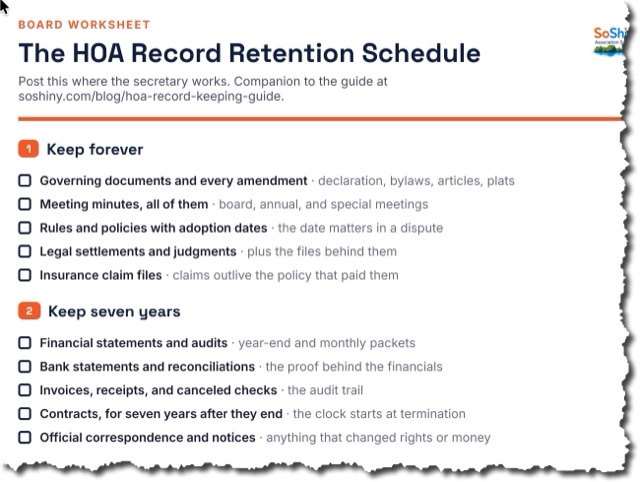
Digitally storing your approved minutes on a centralized, searchable platform like SoShiny is essential. It ensures that owners, future board members, or even state inspectors can instantly find and read the content without hunting. That makes total sense. Think about it. If a new secretary takes over in 2031, they shouldn't have to sift through a predecessor's dusty physical filing cabinet or try to hack into an old volunteer's personal Yahoo account to find out why a fence was approved five years ago. So what does this all
17:19
mean? It means the final step of AI efficiency isn't actually AI at all. It's rigorous digital hygiene. You use the transcription program to create a highly accurate record, but you use a proper digital platform to preserve and distribute that record. And that digital hygiene must include a strict audio deletion policy. Oh, this is critical. It is for any board listening. Raw audio files of board meetings are discoverable in lawsuits. Boards need a written, officially voted upon policy that states clearly recordings exist only for
17:51
the purpose of drafting the minutes. And once those official minutes are approved by the board, the raw audio files are explicitly and immediately deleted. Because again, going back to the verbatim problem, you do not want a two-hour recording of neighbors emotionally arguing about a fence, sitting on a cloud server for five years just waiting to be subpoenaed. Exactly. Knowledge is only valuable if it can be safely found and applied. Having perfect AI minutes means you have extracted the corporate value. Once you have the value, you
18:19
must delete the liability. Raw, messy data is a massive liability. Wow. So let's wrap this up into a playbook. If you're sitting on a board right now and you want to use AI to get your Tuesday nights back, here is what you do. First, buy the right mic based on your room size. Do not rely on your laptop microphone and put a folded towel under it. Crucial step. Second, force your chair to call out names before people speak and always do a verbal roll call. Third
18:46
you must read every single word the AI gives you before you hit send or commit it to the record. Read every word. Remember, it's confident, but it's not always right. It doesn't know the difference between a board member and an HVAC unit. And finally, delete the raw audio once the official record is digitally filed somewhere safe and searchable, like So Shaney. It really is a paradigm shift for how communities govern themselves. But if we connect this to the bigger picture, I'll leave you with this thought
19:16
to ponder. Right now we're using these AI tools simply to transcribe and summarize what happened today. But as these models get more advanced and more integrated, what happens when an AI note taker doesn't just transcribe, but starts actively cross-referencing decades of digitized historical minutes in real time? Oh wow. Like sitting in the meeting with you. Exactly. What happens when a board member proposes a motion and the AI instantly flags that it contradicts a variance granted back in 2018? Will we welcome the AI as the ultimate
19:46
objective parliamentarian that keeps everyone perfectly honest? Or will relying on an algorithmic referee strip away the human nuance, the flexibility, and the empathy that is often required to actually run a community of neighbors? That is a wild thing to think about. I mean, we're worried about it confusing a person for an air conditioner today, but tomorrow it might be vetoing our budget because it remembers a vote from 10 years ago that we all forgot. We better figure out the microphone placement and the digital hygiene first
20:14
before we give it that much power over our neighborhoods. Thanks for joining us on this deep dive. Until next time. Next time, we cover the story of a fire that gutted a 51-unit building. One non-compliant tenant started it. 110 people, including a nine-month pregnant mom, lost their homes, and the association had to figure out how to rebuild.