Auto-pulled from Buzzsprout. Times mark where each stretch starts in the audio.
0:00
Holy crap, the pavement is heaving. Welcome to the HOA Case Files. A fun but serious look at running a self-managed board. Each week we cover one real problem with two opinions and ways to tame the craziness. Things like dues, repairs, reserves, vendors, software, meetings, and the neighbor who will not stop emailing you at 1 a.m. We argue the cost, debate the risk, and which fights are worth the trouble. The volunteer boards who have to decide something quickly and need advice on real-world association concerns. Let's get
0:39
right into it. Imagine for a second that you are, you know, just walking out of your massive Florida condo building on a Tuesday morning. Right, just a normal day. Yeah, exactly. You've got your coffee, you're uh you're ready to start the day, and you look over at the concrete walkway. Except the concrete is literally bulging upward. Oh boy. It's cracking. And underneath it, water is just bursting out, bubbling up like this furious, completely uncontrollable hydra volcano right in the middle of your perfectly manicured landscaping. Aaron
1:12
Powell I mean, it is the absolute definition of a waking nightmare for anyone involved in property management. Or frankly, for anyone who just, you know, wants to live in a building that isn't actively sinking into a localized flood. Aaron Powell That is exactly what we are getting into today on this deep dive. We have a really fascinating stack of sources for you. We're looking at a wild firsthand account from the Secretary and Treasurer of a large self-managed condo association in Florida who uh who actually woke
1:38
up to that exact scenario. Aaron Powell Yeah. And alongside that, we're looking at the documentation for a specialized property management platform they use, which gives us a really incredible window into the anatomy of a crisis, like how it actually plays out in real time. Aaron Powell Okay, let's unpack this. Because the mission for our deep dive today is to explore how surviving a major property disaster requires this incredibly delicate, almost, you know, perfect marriage of lightning fast, modern cloud technology, and irreplaceable, dirtier hands, old school
2:11
institutional knowledge. Trevor Burrus, Jr. It's such a rare combination to get right. It really is. Because the stakes here are immediate. The treasurer's account details how they quickly realized this wasn't just like a sprinkler issue. Trevor Burrus, Jr. Right, not just a broken sprinkler head. Trevor Burrus, Jr. No, the main water feed for the entire building was ruptured. Fixing it would require a jackhammer, digging a 10-foot trench through the concrete, and basically dedicating most of the day just to the repair. And you know, the human
2:36
element of property management is often the most volatile part of the equation here. To fix a main line like that, you have to cut the water to the entire property. Aaron Powell Which means hundreds of residents. Exactly. Suddenly, no water, no morning showers, no coffee makers working, and I mean, most critically, no flushing toilets. Yeah, the toilet situation is that's the real crisis right there. I always wonder about this with big buildings, though. Couldn't they just shut off the water to that specific wing or, you
3:05
know, that specific block of apartments instead of punishing the entire complex? Aaron Powell Well, in a modern building, maybe, but you have to look at the architecture of the air. A lot of these Florida coastal buildings, they were put up in the 1970s. Uh right. Yeah. So the plumbing architecture often relied on a single massive trunk line feeding the whole structure without the uh localized isolation valves we use today to section off water flow. Oh, wow. So if the main trunk bleeds, the whole system has
3:32
to be drained to fix it. There's just no way around it. So they are forced to plunge hundreds of people into the 19th century with zero warning. I was thinking about this, and it's honestly like diffusing a bomb. But the timer is just the rising anger of hundreds of unshowered residents. Aaron Powell That's a great way to put it. Because if they don't know what's happening, if they just, you know, turn the tap and nothing comes out, panic sets in, then outrage. You're gonna have a
3:56
mob of people in the lobby demanding answers, demanding to use facilities that literally do not function. Let's talk about the psychology of that for a second. When you deprive hundreds of people of basic fundamental sanitation facilities without warning, the timeline for maintaining order is incredibly short. I bet, like minutes, not hours. Right. Because the psychological mechanism driving that mob is the sudden loss of control. When you live in a modern society, you just expect utilities to be invisible and constant. You flip a switch, the light
4:28
comes on, you turn a knob, water comes out. Exactly. The moment they vanish, the brain goes into a low-level panic. And if there's a perceived lack of urgency from the people in charge, that panic converts instantly into aggression. Aaron Powell, so how do you neutralize that? I mean, the treasurer's account makes it clear they avoided a resident revolt entirely, and they didn't do it with wrenches or pipes. No, they didn't. They did it with information. They used their association portal software, Soshini, to basically get ahead
4:57
of the anger. Aaron Powell The key here is expectation management. Instead of having volunteers, you know, running floor to floor, knocking on doors. Which would take hours they didn't have. Exactly. While the mob was already forming in the lobby. Instead of doing that, they used the software to instantly push an emergency announcement directly to these 60-inch TVs they had installed in their three lobbies. Aaron Powell That's brilliant. So anyone walking into the lobby, maybe on their way to the management office to scream at someone, is
5:25
immediately intercepted by the bad news on a giant screen. But importantly, they are also intercepted by the explanation. They see that management is aware and they see a repair is already underway. And they back that up by simultaneously broadcasting an emergency email to every single resident through the same platform. In an instant, the entire building was informed. It changes everything. It really does. If we connect this to the bigger picture of crisis management, anger usually stems from feeling ignored or kept in the dark. By aggressively
5:59
broadcasting the reality of the situation, the software fundamentally changed the psychological dynamic in the building. Right. It shifted them. Yeah, it shifted the residents from feeling like, you know, victims of neglect to feeling like informed bystanders who are just watching an active repair. And I should note, looking at the So Shiny capabilities, the treasurer mentioned they also have future options for like automatic voice messaging. Oh, like robocalls. Basically, yeah. Yeah. Imagine using that for hurricane evacuations or sudden board meetings. It just neutralizes the panic instantly.
6:32
So technology bought them a few hours of patience from the residents. But you know, a digital email blast can't patch a physical pipe. Very true. They had to transition into the mud, the team was out there with jackhammers, they start with a small hole, but water is tricky, right? It travels. It always finds the path of least resistance. Exactly. So they kept having to move further and further up the concrete walkway, just chasing the leak back to its actual source. Aaron Powell They ended up having
6:57
to jackhammer a ten-foot-long pathway of concrete. And when they finally excavated the pipe, they found the culprit. It was an old galvanized pipe that had been sitting in the ground since the 1970s. The treasurer's account expresses sheer disbelief at this. I mean, who has the bright idea to bury galvanized pipe in a Florida beach area where there is corrosive salt water literally everywhere? It's a classic real estate discovery. Decisions made half a century ago by people long gone suddenly become your immediate emergency today. Yeah, tagging
7:30
you from the grave. Right. But to understand why this was such a ticking time bomb, you have to look at the chemistry of the materials. Galvanized pipe is essentially steel coated in a layer of zinc to prevent rusting. Okay, so it's supposed to be rust proof. Right, in theory. But coastal soil is heavily saturated with salt and moisture. Salt water is a highly effective electrolyte.
7:54
So over the decades, that galvanic zinc coating acts as a sacrificial anode. It slowly gets eaten away by the electrical and chemical reactions in the salty soil. Yeah, and once the zinc is gone, the underlying steel is fully exposed to the elements. It rusts from the outside in while simultaneously corroding from the inside out due to the water flowing through it. It was honestly, it was doomed the day they put it in the ground during the Nixon administration. Man, so they have this massive crater exposed
8:24
completely corroded 1970s pipes, and the clock is ticking on the residents' patients. This is where we get to the real hero of the story. Absolutely. The condo association didn't just rely on their fancy software, they called in their in-house plumber. This is an older gentleman who has been working on this specific building for almost 30 years. That detail is paramount. 30 years of continuous experience in a single facility. What we're talking about here is the sheer economic and practical value of institutional memory. Because he knew
8:53
the building inside and out, there was no standing around scratching heads. He knew exactly where the hidden shutoff valves were located. He brought in the right crew and they just got straight to work. The time saved there cannot be overstated. I want you to think about how complex these older buildings are. Shutoff valves are notoriously difficult to locate. Over 50 years, they get paved over, walled in, or you know, the landscaping literally grows right over them. But shouldn't they just have blueprints? Wouldn't any competent contractor
9:24
just unroll the schematics from 1974 and find the valid in 10 minutes? If only it were that simple. Original blueprints, often called as built, they almost never reflect the reality of a building 50 years later. Really? Oh yeah. A renovation in the 80s moves a walkway. A landscaping project in the 90s buries a utility box. If you bring in an outside contractor who has never seen the property, they might spend three hours just doing investigative demolition to find the valve to stop the water. Wow, just
9:52
blindly digging holes. Exactly. This veteran plumber bypassed all of that purely from the knowledge stored in his head. Sometimes you just need the guy with dirt under his fingernails who remembers what happened during the storm of 98, you know? The software manages the mob so the craftsman can actually manage the pipes. Exactly. But, and this is crucial, his institutional knowledge actually saved the building a second time in a way that is arguably even more critical than just finding the shutoff valve. Wait, really? Because I would
10:23
assume turning the water back on is the easy part, but the treasurer's notes made it sound incredibly tense. What were they worried about? Well, think about it. I mean, you patch the pipe, the trench is dug, you just walk over to the massive main switch, let the water flow back in, and everyone takes a shower, right? Job done. If you did that, you would likely cause catastrophic damage throughout the entire building. This is the most crucial mechanical takeaway from the entire scenario. Okay, I'm listening. Because
10:49
this older plumber had vast experience with old buildings, he knew that you cannot just turn a massive water main back on at full blast. The technical term the treasury used was spiking the pipes. What is actually happening inside the walls if you do that? Okay, so when you shut off the water to repair a main, the pipes throughout the building drain and they fill with air. When you turn the main valve back on, water rushes in. But water is incredibly dense and it is largely incompressible.
11:18
Right. Air, however, is compressible. If you open that valve completely and immediately, the sudden violent surge of water pressure acts like a piston. Oh wow. It rapidly compresses all that air in the lines, creating a massive shockwave of kinetic energy. Plumbers often call it water hammer. So it's like taking a dried-out old garden hose and suddenly turning the spigot on to maximum pressure, the water shoots through and the force is going to blow a hole right through the weakest, oldest part of the rubber. That is
11:47
a perfect analogy. Now scale that garden hose up to a multi-story concrete building. That sudden kinetic force hits the joints, the elbows, and the older, weaker sections of plumbing behind the drywall hundreds of apartments. Good grief. Yeah, if he had just flipped the switch, that pressure wave would have caused cascading breakages. Fixing the one leak outside could have instantly caused 50 new leaks inside people's actual living rooms. So how do you prevent the garden hose from bursting? What did he do? The veteran plumber meticulously, and
12:17
I mean slowly, eased the water back on. He opened the main valve just a fraction of an inch at a time. So it's basically a soft reboot for the building's plumbing. Exactly. He allowed the system to pressurize gradually, giving the air time to bleed out of the fixture slowly rather than violently compressing it. He consciously protected the fragile, aging infrastructure of the entire complex. To me, this is the ultimate aha moment. It's the difference between a textbook fix where you know step one is turn water
12:44
off, step two is fix pipe, step three is turn water on, and watching a real master craftsman at work. Right. Because the textbook doesn't tell you about the fragile 1970s plumbing upstream. Only experience tells you that. It is the unseen disaster averted. The residents will never know that the plumber's slow turn of a wrench saved their homes from flooding. That's incredible. So we've got this massive crisis averted. But I want to look a little closer at the engine behind the communication side of this operation, too.
13:14
Yeah, let's pivot to that. Trevor Burrus, Jr. Because the treasurer heavily credited their so shiny software for laying the groundwork for this success. And looking through their documentation, it's a fascinating piece of software, largely because of its origin story. Aaron Powell It really is. It wasn't built by some giant tech conglomerate in Siliton Valley that just decided to dabble in real estate software. Trevor Burrus, Jr. Right. Not a bunch of bros and hoodies. Aaron Powell No, it was actually built by a sitting condo treasurer down
13:41
in Daytona Beach, Florida. Aaron Powell Which explains so much. It's built specifically for volunteer boards that run themselves without a massive expensive management company stepping in and take over. Trevor Burrus And that presents a really unique challenge. Trevor Burrus Yeah. Because you have everyday people, retirees, teachers, accountants, suddenly acting as the governors of a small municipality with a multi-million dollar budget. That is the core dilemma of local property governance. These are amateurs, in the literal sense of the word, tasked with professional level asset management. Right.
14:14
If you look at the feature list of the software, you can see the DNA of a frustrated treasurer all over it. The core philosophy of the software is explicitly stated in the documentation. It says get paid.
14:30
We saw the get the word out part in action with the lobby TVs and the email blasts that stopped the resident revolt. Exactly. But the get paid and get things done parts are just as critical for a volunteer board trying to keep their heads above water. Yeah, the software is aggressively anti-bloat. It focuses purely on what self-managed boards actually need to survive day-to-day. It handles the financial side with real double entry books, even does QuickBooks imports. Nice. And it manages the administrative side by tracking work
14:57
orders and monitoring when vendor insurance certificates expire. Which I assume is a massive liability issue if a board lets a vendor's insurance lapse and then someone gets hurt on the property. Oh, it is a massive liability. The software basically acts as a set of guardrails. It takes the administrative burden of remembering every single expiration date off the volunteers so they can focus on actual governance. It acts as training wheels for people who are learning on the job. It prevents costly compliance mistakes. Yeah. And the software
15:25
tailors these features based on the specific type of community. They have distinct tool sets for condos versus marinas versus mobile home parks. Oh, that makes sense. Because managing boat slips and environmental regulations at a marina is mechanically and legally different than managing an architectural review committee at a suburban HOA. It reflects a deep understanding that community governance is not one size fits all. So, what does this all mean for you, the listener? Let's summarize this perfect storm. You have a massive 1970s galvanized pipe that decides
15:57
today is the day it's going to burst. Disaster is imminent. Right, the hydro volcano. Exactly. But total catastrophe is averted because cloud software managed the people, keeping them calm and informed, while a veteran plumber managed the pipes, fixing the physical break and easing the system back to life so the water hammer didn't destroy the building. It really is the ultimate team up of digital efficiency and human experience. It is. But this raises an important question, and it's something I want to leave you with based on
16:28
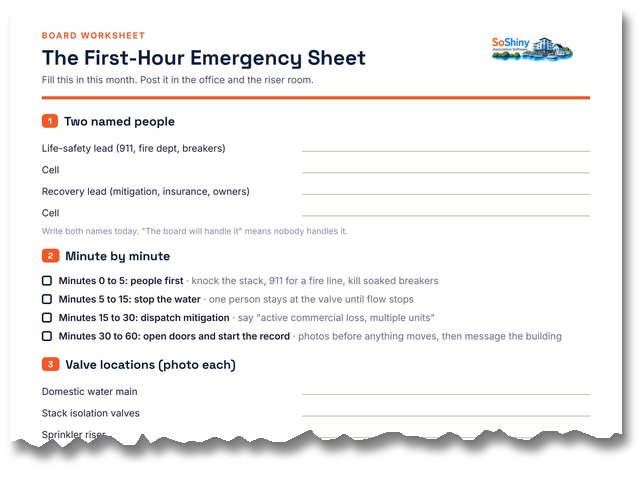
one specific detail from the So Shiny source material. Oh, the emergency sheet. Yeah. Among those free resources So Shiny offers is something called the first hour emergency sheet. It's a printable document designed to be posted in the management office. And specifically, it includes named leads, 24-hour vendors, and crucially, shut-off locations documented with photos. Shutoff locations mapped out with actual photos. Right. Think about the hero of our story today, the in-house plumber with 30 years of experience. He knew where the hidden valves were. He understood the
16:59
fragile nature of the 1970s plumbing. But eventually that veteran plumber is going to retire. Exactly. He will walk out of that building for the last time and he will take all of that irreplaceable knowledge with him. When that happens, will the building be in trouble the next time a pipe bursts? That is a terrifying thought for any board member relying entirely on one person's memory. It is. So the provocative thought I want you to mull over is this Is the ultimate hidden goal of specialized platforms
17:28
like this not just to send emails or collect dues, but to actually act as a digital brain download? That's a fascinating way to look at it. Is the true value of taking a photo of a hidden valve and logging it into cloud software about taking all that brilliant, hard-earned human institutional knowledge and permanently mapping it into the building's digital DNA before the experts are gone for good? You're extracting the genius of the master craftsman and preserving it so the next generation of volunteers doesn't have to
17:57
learn by flooding the building. Exactly. The software doesn't replace the veteran, it ensures his legacy actually survives his retirement. So next time you see a massive water leak on your front lawn, you'll know exactly the kind of teamwork it takes to survive it. Thank you for joining us on this deep dive, and we'll see you next time. And stay tuned for the next episode where we talk about how a major electrical issue caused unnecessary stress for owners. And don't forget, if this podcast helped you or
18:25
your board, give us a thumbs up wherever you listen to this podcast. Thanks so much for listening.