Auto-pulled from Buzzsprout. Times mark where each stretch starts in the audio.
0:34
This week, we look at why a written rule failed to save a 51-unit building from burning to the ground. Welcome to the HOA Case Files, a fun but serious look at running a self-managed board.
0:47
Each week, we cover one real problem with two opinions and ways to tame the craziness.
0:53
Things like dues, repairs, reserves, vendors, software, meetings, and the neighbor who will not stop emailing you at 1 a.m.
1:02
We argue the cost, debate the risk, and which fights are worth the trouble.
1:07
For volunteer boards who have to decide something quickly and need advice on real-world association concerns.
1:14
Let's get right into it.
1:15
So, um, if you want to accidentally burn down a 50-unit condo building, the statistics say you actually shouldn't start on the roof.
1:23
Or even on like a wooden balcony, which is what most people think. You should actually start on a ground floor catio.
1:29
Which is terrifying, honestly.
1:31
It really is. And well, in August 2026, 51 families in California learned this the absolute hard way. Welcome to today's deep dive. I'm your host.
1:42
And I'm your expert for today.
1:44
And we are taking a massive stack of incident reports, fire codes, and legal analyses regarding the uh the massive six-alarm Spinnaker co-fire in Foster City. Our mission here is to unpack the anatomy of this entirely preventable disaster.
1:59
Yeah, and more importantly, we're looking at the systemic risk management that's required to stop it from happening again.
2:05
Exactly. From the psychology of community enforcement to the very specific software-like um so shiny that boards are using to digitize their legal defense.
2:15
Because, you know, the destruction at 815 Seaspray Lane, it wasn't caused by a lightning strike or some massive gas main explosion.
2:22
It was literally just caused by a Sunday afternoon barbecue.
2:25
Just a normal weekend.
2:27
Right. And that single totally mundane activity displaced over 150 people, injured four firefighters, and basically kicked off a legal and financial fallout that most communities are completely unprepared for.
2:42
The human toll in the source material is just heavy. I mean, you have a resident, Shi Chen, who was due to deliver a baby boy in less than two weeks, and she lost every single one of her baby shower gifts in the blaze.
2:54
Oh, wow. That's just heartbreaking.
2:57
It is. You have people fleeing with literally just the clothes on their backs. And the building itself, um, it was built in 1981, entirely wood framed, and critically it had zero fire sprinklers.
3:08
Oh, not a single one.
3:09
Okay, let's unpack this because the initial spark and the totally bizarre realities of the California fire code surrounding it, they reveal a massive blind spot in how we think about fire safety.
3:20
So fire investigators eventually traced the origin of the blaze to a propane barbecue. And this was located on the exterior wooden deck of a first floor unit, just pushed right up against the siding of the building.
3:31
And see, that immediately defies basic physics for a lot of people. I mean, the golden rule of condo living is, you know, no grills on balconies.
3:38
Right. Everyone knows that one.
3:39
Jr. But if a fire starts on a ground floor patio, it has the entire building above it to consume as fuel. Heat rises. So why on earth would people think a ground floor is inherently safer than a balcony?
3:52
Well, it's a psychological blind spot, really. People tend to view a ground floor patio as an extension of a backyard.
3:58
Oh, sure. Like it's disconnected.
4:00
Exactly. Rather than an attached part of a multi-unit structure. But the U.S. Fire Administration data from our sources explicitly highlights this exact danger.
4:11
What do the numbers say?
4:13
Well, thirty-two percent of residential grill fires actually start on ground level courtyards, patios, or terraces.
4:19
Wait, really? That high?
4:21
Yeah. Elevated balconies only account for about 23.7%. Wow. So when you place a grill against first floor wooden siding, you are essentially lighting the bottom of a wick. The flames easily breach the exterior siding and just travel rapidly up the wall cavity.
4:37
Right. That's what they call the chimney effect.
4:40
Which brings us to the actual law here. Um, California Fire Code, section 308.1.4 states that open flame cooking devices cannot be operated on combustible balconies or within ten feet of combustible construction at any building with more than two units.
4:56
And 10 feet is a massive perimeter for a condo patio. Most of them aren't even that big.
5:01
No, they're tiny. It effectively bans traditional grilling for a huge portion of attached housing.
5:06
It does. But you know, because it's a code, it is largely defined by its exemptions. Like single-family homes are exempt because the state basically assumes you are only risking your own property.
5:17
Right. There's no shared wall to catch fire.
5:19
Exactly. But the really critical exemption applies to sprinklered condo buildings.
5:23
So wait, if the building has modern sprinklers, the code allows you to grill on a wooden deck.
5:29
Yes. What's fascinating here is that this creates a hyperlocalized discrepancy.
5:35
Well, you can have a building constructed in, say, 2015, right next to a building from 1981 like Spinnaker Cove. They sit on the exact same street, but because the newer one has sprinklers, they follow completely different behavioral rules.
5:49
Because the law assumes the sprinkler system will suppress that chimney effect before it consumes the upper units.
5:56
I assume the code treats electric grills differently, right? Because there's no pressurized fuel source. But don't they still pose a radiant heat risk against wooden siding?
6:05
They do, yeah. But the code entirely exempts electric grills because the statistical risk of a catastrophic rapid fire spread is vastly lower without a combustible fuel like propane or charcoal.
6:17
Right. It's the explosive potential.
6:19
Exactly. The primary hazard is really the propane tank itself. The code only offers an exception for a propane container with a 2.5 pound water capacity or less.
6:27
which is basically the tiny nominal one-pound green camping canister.
6:32
Yes, exactly those. The standard 20-pound backyard tank has no exception whatsoever in an older, unsprinklered building.
6:41
And the sources point out a regulatory friction specifically in Foster City that makes this even harder for residents to understand.
6:49
Yeah. There is actually a typo or like a cortification error in their locally adopted municipal code. Right. The state code exempts one and two family dwellings, but Foster City's amended code lists the exemption as group R2, R3, and R3.1 occupancies, which technically includes condos and apartments.
7:10
Yeah, read literally Foster City accidentally exempted multifamily buildings from the state grill ban.
7:16
It totally illustrates how convoluted this becomes for just the average person trying to grill a burger.
7:20
Right. But you know, regardless of the municipal typo, the Spinnaker Cove Homeowners Association had a crystal clear rule on their own books banning gas grills. A resident even confirmed it to the press.
7:31
Which shifts this whole thing from a conversation about fire physics to a conversation about systemic liability.
7:37
Exactly. Because writing a rule in a dusty binder and actually enforcing it are two entirely different universes. I mean, a board that writes a safety rule but looks the other way isn't protecting the community.
7:50
They are just hanging a giant SUMY sign on the front door.
7:55
Yeah. And the legal aftermath of the Spinnaker Cove fire demonstrates perfectly how that burden of proof shifts.
8:02
Well, a few days after the blaze, police actually arrested a resident named Keith Tompkins. He lived in the unit where the fire originated.
8:11
Yeah, they arrested him on suspicion of unlawfully causing a fire resulting in injuries. But shortly after that, the district attorney, Steve Wagstaff, just dropped the case.
8:20
Because criminal negligence requires a threshold of intent or like extreme recklessness, right? Which is incredibly hard to prove with a burned out grill.
8:30
Precisely. Fire investigators had to rule the cause as undetermined, in the sense that they just couldn't definitively prove the grill was left on intentionally or with criminal disregard.
8:40
They can't prove what was in his head.
8:41
Right. Wagstaff had to draw a hard line between criminal negligence and civil carelessness.
8:47
But you know, dropping criminal charges doesn't just erase the millions in damages. It just moves the battlefield from criminal court over to civil court.
8:56
And this is where the concept of subrogation comes in because insurance companies don't just write a $20 million check for 51 destroyed condos and just walk away. Oh, definitely not. They deploy subrogation teams, which are basically forensic accountants and attorneys, and their sole job is to find a party who violated a duty of care.
9:15
So they could legally force them to foot the bill.
9:17
Exactly. And the HOA board is the ultimate target because they hold the master insurance policy.
9:22
Yep. The subrogation teams will come in and ask, did the board know residents were using 20-pound propane tanks? Did anyone log a complaint about that specific patio prior to the fire?
9:33
Did the board execute their fiduciary duty to enforce their own ban?
9:37
But I mean, you're asking a volunteer board, which is usually like a retired accountant and a busy graphic designer, to actively find their friends and neighbors. The social friction of that is just immense.
9:48
It is huge, yeah. But in a disaster's aftermath, insurance companies look for that exact hesitation. If a volunteer board has no documented record of enforcing their own rules, they basically have zero defense against a claim of negligence.
10:04
Pretty much. Clear, timestamp paper trails are really the only shield a community has against complete financial ruin in civil court.
10:13
So um what does this all actually mean for you, the listener, especially if you live in or manage a condo association?
10:20
Well, it means the community has to move from having passive rules to an active prevention playbook. It's a full exercise in systemic risk management.
10:28
And the sources outline a very specific yearly schedule that boards must implement to establish this legal shield. They do.
10:34
First, the grill and balcony rules must be articulated in plain English.
10:38
None of that legal jargon.
10:39
Right. If it requires a law degree to understand the CCNRs, it entirely fails the test of reasonable communication.
10:45
So instead of citing California Fire Code 308.1.4, the rule just needs to say something like no 20-pound propane tanks within 10 feet of any wooden structure, full star.
10:57
Yes, exactly. Keep it simple. Second, you must secure a signed acknowledgement of this specific rule from every single owner and every renter at Move In.
11:06
And crucially, it must be renewed every single year.
11:09
Just to keep it fresh in their minds.
11:11
Yes. It establishes an annual recommitment to the baseline safety of the building. And third, the board or management has to conduct physical, documented walks of the balconies and ground floor decks on a strict schedule.
11:23
Okay, but what is the actual mechanism for dealing with the inevitable resident who just ignores the rule? Because knocking on their door and asking nicely doesn't exactly hold up in court.
11:33
No, it doesn't. This requires a really rigid escalation protocol.
11:37
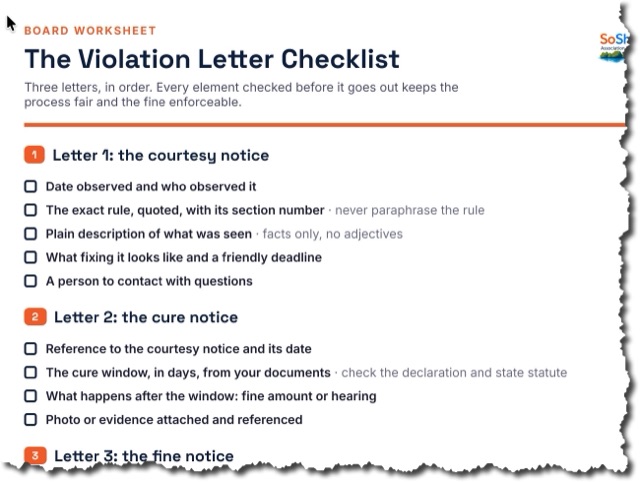
First, you long the initial offense with a date stamped photo. Then you issue a written courtesy warning. Makes sense. If the hazard remains, you issue a cure notice with a strict legal deadline for removal. Right. And if they still fail to comply, you escalate to a formal fine notice and a summons to a board hearing.
11:55
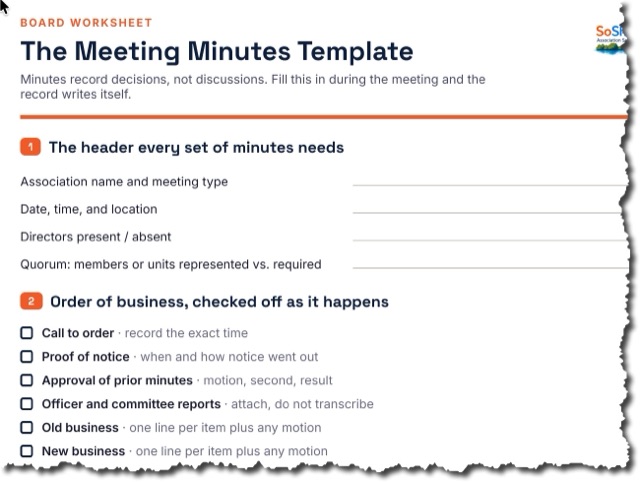
And every single vote on that fine must be recorded in the official board meeting minutes just to prove the board took action. Right. But let's be realistic for a second. The administrative load of managing hundreds of pieces of paper, tracking down annual signatures from absentee landlords, mailing out cure notices, it just outstrips the human capacity of almost any volunteer board.
12:18
It's a full-time job.
12:19
It really is. And that gap between legal necessity and human capacity is exactly why we are seeing a massive shift toward automating this process. Here's where it gets really interesting.
12:30
The sources highlight the adoption of cloud-based HOA and condo software, specifically platforms like SoShiny, that's SoShiny.com. And these are engineered for self-managed boards.
12:41
And you know, the goal of this software isn't just convenience, it's about systematically shifting the burden of proof.
12:47
Right, because an app doesn't put out a fire. But it eliminates the concept of plausible deniability for the resident while simultaneously building an ironclad legal defense for the board.
12:58
So how does a platform like Sochini actually alter the behavior of a community before a fire even starts?
13:04
It addresses the ambient awareness of the rules. Like burying a fire safety rule in a hundred-page PDF that a resident reads once during closing. That guarantees it will be forgotten.
13:17
But Sochany utilizes this lobby TV feature. Boards can push digital rules and safety announcements directly to screens in the common areas, lobbies, or mail rooms.
13:28
So it conditions behavior through repetition. Right. You see the fire safety reminder every time you check your mail. You can't claim you didn't know the rule when it's cycling on a digital board in the exact space you walk through every day.
13:38
Exactly. And it also solves the signature problem we talked about. The software captures electronic signatures for those annual rule renewals.
13:46
And those are actually legally binding, right?
13:48
Yes. Under the eSign and UAADA acts, those electronic signatures are fully legally binding for HOA documents.
13:56
So the board has a permanent searchable database proving that Unit 107 legally acknowledged the propane ban on January 1st.
14:04
And the software completely changes the friction of enforcement, too. Like if a board member is doing their scheduled property walk and they see a 20-pound propane tank on a wooden deck, they don't have to go back to a desk, write a formal letter, print it out, and mail it.
14:18
No, nobody wants to do that.
14:20
They just pull out their phone, snap a photo of the tank, and log it instantly against that specific unit's profile in SoShiny.
14:26
And that data point is permanent. The violation history follows that unit indefinitely.
14:31
So they can't just hide the grill for a week and bring it back out.
14:34
Exactly. If a second offense occurs months later, the software recognizes the pattern. It can actually automatically generate the courtesy warning, the cure notice, and the fine notice.
14:45
With the photo attached.
14:46
With the timestamp photo evidence attached directly to the file.
14:49
It takes the social friction completely out of the equation.
14:53
The board member isn't confronting their neighbor. The system is just impartially executing the bylaws. And if the subrogation lawyers come knocking after an incident, the board doesn't have to dig through like a banker's box of loose paper.
15:07
No, they just export a digital log that proves they executed their fiduciary duty. They enforce the rules, they find the violators, and their liability is legally severed. This raises a really important question, though. We've dissected the clinical mechanisms of liability and software, but the core reason these systems must exist is the sheer devastation that follows when they fail.
15:29
Once the preventative measures break down, the community pays an ultimate and often permanent price.
15:35
Yeah, let's bring the reality back to Foster City for a second. The Spinnaker Cove building wasn't just damaged by the fire, it was entirely red tagged by the city.
15:44
Meaning no one can go in.
15:45
Exactly. It was fenced off with an immediate risk of structural collapse. The residents couldn't even go back inside with an escort to sift through the ashes for, you know, passports, hard drives, or sentimental items.
15:57
Just everything gone. And the recovery infrastructure required for an event of this magnitude is staggering.
16:04
What did that look like?
16:06
Well, the U.S. Small Business Administration, the SBA, they actually had to open a temporary disaster loan outreach center inside the Foster City City Hall.
16:15
Just for this one fire.
16:17
Yeah, their primary function was just helping survivors navigate the massive complex bureaucracy of applying for low-interest federal loans, literally just to replace their basic living essentials.
16:28
And the residents also had to mobilize politically. They had to petition the city council to declare a formal local emergency.
16:35
Which is so important.
16:36
Yeah. That declaration is a crucial legal lever. It unlocks state-level assistance and price gouging protections that a municipality just cannot trigger on its own.
16:46
But alongside that bureaucratic nightmare, you do see an incredible surge of community resilience.
16:51
Yeah, the community response was amazing.
16:53
It was. Crystal Tilton, the CEO of the Foster City Chamber of Commerce, she spearheaded a GoFundMe that raised over $125,000. And that was transferred to Samaritan House for direct distribution to the victims. Also, the San Mateo Foster City Administrators Association raised another $60,000 specifically for displaced school families.
17:16
And it wasn't just institutional money either. There was a resident named Shimizu who gave an interview detailing how neighbors who had lost literally everything were turning around and offering their extra donated items to other victims.
17:30
That's just incredible.
17:31
She mentions someone handing her two donated kettles, and immediately she turned and offered the second one to another neighbor. It's just a profound display of what she called the Sea Spray family.
17:41
If we connect this to the bigger picture, a donated kettle is a beautiful gesture of human solidarity. But the sobering truth of risk management is that the goal of every HOA board and every fire code is to ensure that kind of disaster relief is never necessary in the first place.
17:58
Absolutely. And I want to leave you with a final provocative thought today that builds on our sources regarding what happens after the smoke actually clears. Older attached housing stock places built in the 70s and 80s like Spinnaker Cove is often the last remaining bastion of affordable housing in hyperexpensive regions like the Bay Area.
18:19
The median sale price for a condo in that specific area was around $1.27 million, compared to the overall city median of over $2 million.
18:29
So it's relatively affordable.
18:30
Exactly. That older, unsprinklered stock is literally how a middle class family gets a foothold in the city.
18:37
But you know, the recovery process triggers a massive economic paradox. How so? If an older building is severely damaged, local rebuilding codes activate. Foster City utilizes a 50% rebuild rule.
18:51
What does that mean?
18:52
It means if the repairs affect more than half of the building's gross area, the entire new structure must be brought completely up to modern building code.
19:01
Ah, I see. It's exactly like trying to replace the motherboard on a 10-year-old laptop. Right. You swap the motherboard, but then you realize the new board requires a new power supply, which requires a new casing, and suddenly you are forced to buy an entirely new machine just to make the thing turn on.
19:17
That's a perfect analogy. In this case, the 50% rule mandates the installation of modern fire sprinklers throughout the entire complex.
19:25
Which, from a pure life safety perspective, is an absolute necessity. As we discussed, sprinklers neutralize the chimney effect and prevent the loss of life.
19:34
They do. They make the building infinitely safer.
19:37
But they also make the building infinitely more expensive to construct.
19:40
And that cost is passed on, making the resulting units vastly more expensive to buy or rent.
19:46
It completely changes the market for that building.
19:48
Right. So I want you to ponder this. How do we, as a society, balance the desperate need for affordable, accessible housing with the systemic safety risks of aging wooden structures?
20:00
A really tough question.
20:02
When disaster strikes and triggers these mandatory upgrades, does the drive for modern safety codes inadvertently gentrify the neighborhood? Does it permanently price out the very community that just lost their homes?
20:15
It is a brutal paradox. We demand that everyone live in a safe environment, but the strict economic cost of that modern safety is often just full displacement.
20:24
Which brings us right back to why prevention is the only sustainable strategy. You cannot control the 50% rebuild rule, and you definitely cannot control the physics of a propane fire.
20:36
But a community can control its adherence to safety protocols. By utilizing modern tools like SoShiny to enforce clear rules and maintain an airtight digital paper trail, boards can protect both the lives of their residents and the economic viability of their community. Absolutely. Thank you for joining us on this deep dive. If you live in a multifamily building, take 10 minutes today. Find out your building's sprinkler status, review the exact phrasing of your community rules regarding open flames, and just ask your board how they document enforcement.
21:06
You could literally save your home. Next time, we cover the vendor paperwork trap every association board falls into. How missing insurance, permit, or business license could create a liability nightmare for your association.
21:20
And don't forget, if this podcast helped you or your board, give us a thumbs up wherever you listen to this podcast.
21:27
Thanks so much for listening. See you next week.