

Georgia · Article GCA
Georgia Condominium Act (O.C.G.A. §§ 44-3-70 to 44-3-117) — Plain-English Summary
Every section of this body of law translated into plain English for Georgia board members and homeowners.
Creation and instruments
-
§44-3-70
Names this article the Georgia Condominium Act. Georgia condominiums live here. Subdivision HOAs do not — they are either under the opt-in Property Owners' A…
-
§44-3-71
Defines condominium, unit, common elements, limited common elements, association, declarant, condominium instruments, conversion condominium, and the other w…
-
§44-3-72
A condominium exists when the declaration is recorded together with the plats and plans §44-3-83 requires. All owners and lessees of the submitted property m…
-
§44-3-73
After property is submitted, a unit description is not too vague if it identifies the condominium and the unit. Naming the unit automatically includes its un…
-
§44-3-74
The declaration and amendments record like deeds. Plats, plans, and condominium instruments go in the county real-estate records so a title searcher can find…
-
§44-3-75
Defined terms have the Act's meanings unless the instruments say otherwise. If the declaration, bylaws, and plats conflict, the Act's order of priority contr…
-
§44-3-76
Owners and occupants must follow the instruments, lawful bylaws, and reasonable rules that have been provided to them. After the instrument's notice — or 10 …
-
§44-3-77
Every declaration must name the condominium (the name includes 'condominium' or is followed by 'a condominium'), describe the submitted property, allocate vo…
-
§44-3-78
The declaration allocates to each depicted unit an undivided interest in the common elements, by percentage, fraction, formula, or any method that shows rela…
-
§44-3-79
The declaration allocates votes to each depicted unit. Co-owners of a unit vote as one; if more than one is present they must agree unless the instruments sa…
-
§44-3-83
Before the first unit conveyance, a survey plat of the submitted property and (for buildings) plans certified by a registered architect or engineer must be r…
-
§44-3-84
Plans already recorded with the declaration may be reused, with a new certification, instead of drawing a second set when the Act later requires plans.
-
§44-3-85
Slight deviations from the recorded plats or plans do not undo the condominium. The Act implies the easements needed for support, utilities, and access. Will…
-
§44-3-86
Special rules when the condominium sits on a lease rather than fee land: the lessor's rights, how unit owners perform the lease covenants, and how liens atta…
-
§44-3-87
The declarant of a conversion condominium must notify each tenant in possession and offer to convey the unit on the terms this section sets, with the stated …
-
§44-3-88
With mortgagee consent, the declarant may convert convertible space into units or common elements by recording an amendment and the required plats or plans. …
-
§44-3-89
A condominium expands only as the declaration and this section allow, by recording an amendment that adds the additional property and reallocates interests. …
Assessments and limited commons
-
§44-3-80
Limited-common-element costs are specially assessed to the assigned unit(s) unless the instruments say otherwise. Other common expenses follow the declaratio…
-
§44-3-81
Interests, votes, and expense shares are not allocated to units that do not yet exist. When additional property or convertible space becomes units, the decla…
-
§44-3-82
Limited common elements are assigned only in the condominium instruments. Reassignment follows the method the instruments and this section set — an owner can…
Alteration, amendment, casualty
-
§44-3-90
Unless the instruments prohibit it, an owner may alter the interior of a unit. Combining adjoining units needs the association's recorded amendment reallocat…
-
§44-3-91
If the instruments allow it, adjoining-unit owners may relocate the boundary by applying to the association, recording an amendment, and filing the new plats…
-
§44-3-92
If the instruments allow it, a unit may be subdivided the same way: application, recorded amendment, and new plats or plans that reallocate votes and expense…
-
§44-3-93
Unless another section says otherwise, the instruments amend by agreement of owners of units to which two-thirds of the votes pertain, or a larger majority t…
-
§44-3-94
Damage or destruction of units; restoration; vote not to restore; allocation of insurance deductibleUnless the instruments say otherwise, casualty damage covered by the association's required insurance is restored. A vote not to restore follows this section…
-
§44-3-95
Foreclosing a mortgage that is subordinate to the declaration, or from which a unit has been released, does not wipe out the condominium as to that unit. The…
-
§44-3-96
Each unit is its own parcel of real property. Once there is any owner other than the declarant, tax is levied on the units, not on the condominium as a whole.
-
§44-3-97
A taking of common elements is allocated among owners by their undivided interests, except a permanently assigned limited common element goes to that unit. T…
-
§44-3-98
Termination takes the agreement of owners of units to which four-fifths of the votes pertain and all mortgagees of those units, or a larger majority the inst…
-
§44-3-99
Unless the instruments forbid it, submitted property may be withdrawn under this section. A unit or limited common element cannot be withdrawn in part. Remai…
Association
-
§44-3-100
Before recording the declaration the declarant must incorporate the association as a business corporation (Title 14 Ch. 2) or a nonprofit membership corporat…
-
§44-3-101
If the instruments allow it, the declarant may appoint and remove directors and officers, but that power always expires at the earliest of: the instruments' …
-
§44-3-102
Member meetings follow the bylaws and must be called at least annually. A declaration recorded on or after 1 July 1990 must also let 15 percent of the unit o…
-
§44-3-103
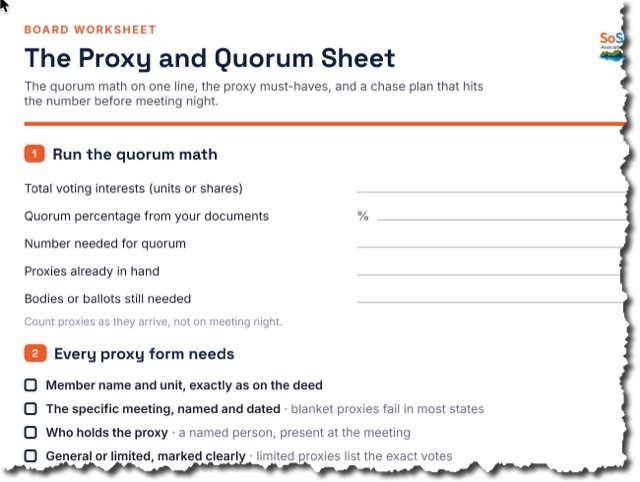
Unless the instruments or bylaws say otherwise, a member-meeting quorum is persons entitled to cast more than one-third of the votes, measured at the start o…
-
§44-3-104
If the instruments require a director or officer to be a unit owner, an entity owner may serve through an officer, partner, or trustee. Losing that affiliati…
-
§44-3-105
Unless the instruments say otherwise, the association maintains, repairs, and replaces the common elements; unit owners do their units. The association has a…
-
§44-3-106
Unless the instruments prohibit it, the association may hire agents, improve common elements, run architectural control, grant common-element easements, borr…
-
§44-3-107
The association must carry replacement-cost property insurance on the buildings — including common elements, foundations, roofs, exterior walls, windows and …
-
§44-3-108
Common profits go first to common expenses. Any surplus belongs to the units in the same ratio as their common-expense liability.
Money, sales, and applicability
-
§44-3-109
Lawful assessments, fines, and reasonable owner-requested charges are the unit owner's personal obligation and a lien from the moment they fall due — recordi…
-
§44-3-110
A right of first refusal or other restraint on selling a unit is void unless the instruments create it and this section's statement procedure is followed. Fa…
-
§44-3-111
On the first bona fide sale of a residential unit for residential occupancy, the seller must deliver the items this section lists. The contract is voidable b…
-
§44-3-112
Deposits on the first bona fide residential sale must be escrowed as this section requires until closing or until the contract is lawfully terminated.
-
§44-3-113
This article applies to every condominium submitted to it, and to pre-October 1, 1975 condominiums created under the old Apartment Ownership Act to the exten…
-
§44-3-114
Zoning, subdivision, and building codes cannot ban the condominium form of ownership or treat it more harshly than a physically identical development under a…
-
§44-3-115
The Act and recorded instruments are construed in favor of a valid condominium. Substantial compliance is enough. Defects can be cured by an association amen…
-
§44-3-116
The 20-year clock and other limits in O.C.G.A. §44-5-60(b) and (d)(1), (2), and (4) do not apply to covenants in a condominium created or submitted under thi…
-
§44-3-117
A condominium may contain a subcondominium. This section says how the subassociation, insurance, liens, eminent domain, unit descriptions, and assessments wo…
Frequently asked about Article GCA
- What is Georgia Article GCA?
- Georgia Article GCA — the Georgia Condominium Act (O.C.G.A. §§ 44-3-70 to 44-3-117) — is the body of law that governs how every Georgia condo is structured, operated, and held accountable. It covers governance, voting, records, assessments, fining, and most of the day-to-day legal questions a board will face.
- How many sections are in Article GCA?
- Article GCA contains 48 sections in this reference. Each is summarized in plain English on its own page, with links to the official text at legis.ga.gov.
- Is the summary on this site legal advice?
- No. These pages are plain-English summaries prepared by SoShiny for board members and managers. For binding legal advice or interpretation of how a section applies to your specific situation, consult a Georgia-licensed attorney.
- How often does Georgia Article GCA change?
- The Georgia General Assembly can amend any chapter in any session. We update these summaries when we re-import the official text — see the 'Last updated' date on each section page.
- Does SoShiny enforce Article GCA for me?
- No software 'enforces' a statute — but SoShiny is built around it. Voting, meeting minutes, records access, fining workflow, and audit trails are designed to meet this body of law's requirements out of the box, so the board can demonstrate good-faith compliance if challenged.
Running a condo in Georgia?
SoShiny is built around Article GCA from day one — every feature on every plan.
Start your community free →