

Colorado · Part CCIOA-3
CCIOA Part 3 — Management of the Common Interest Community — Plain-English Summary
Every section of this body of law translated into plain English for Colorado board members and homeowners.
Organization
-
§301
A unit owners' association must be organized no later than the date the first unit is conveyed. Membership is all unit owners. The association is typically a…
-
§306
The bylaws must provide for the number of board members, the titles of officers, the qualifications and terms of board members, the powers of the board, and …
-
§318
With respect to a third person having a contract or tort liability to the association or dealing with the association, the association is a trustee of the ow…
-
§319
The Colorado Revised Nonprofit Corporation Act and other Colorado statutes apply to the association to the extent they do not conflict with CCIOA. Where they…
Powers
-
§302
Unless the declaration says otherwise, the association may adopt bylaws and rules, adopt budgets and collect assessments, hire and fire a manager, sue and be…
-
§302.5
The association may not unreasonably prohibit or restrict unit owners' access to common elements. If it does restrict access (for example during maintenance)…
Board
-
§303
The board acts for the association, except it may not amend the declaration, terminate the community, or elect its own members (it may fill vacancies). Withi…
-
§303.5
Before the association sues for construction defects, it must disclose specified information to the owners and obtain the owner approval this section require…
-
§310.5
A board member with a conflict of interest must disclose it and recuse as this section and the association's conflict policy under §209.5 require. The Nonpro…
Declarant rights
-
§304
Special declarant rights may be transferred only by a recorded instrument. The transferee steps into the declarant's shoes for those rights.
-
§305
After owner-elected directors take office, the association may terminate, on at least 90 days' notice, certain contracts and leases the declarant entered (ma…
Maintenance
-
§307
Except as the declaration or this section provides, the association maintains, repairs, and replaces the common elements; each owner maintains that owner's u…
Meetings
-
§308
Owners must meet at least once a year. Special owner meetings: president, a majority of the board, or owners with 20 percent of the votes (or a lower bylaw p…
-
§309
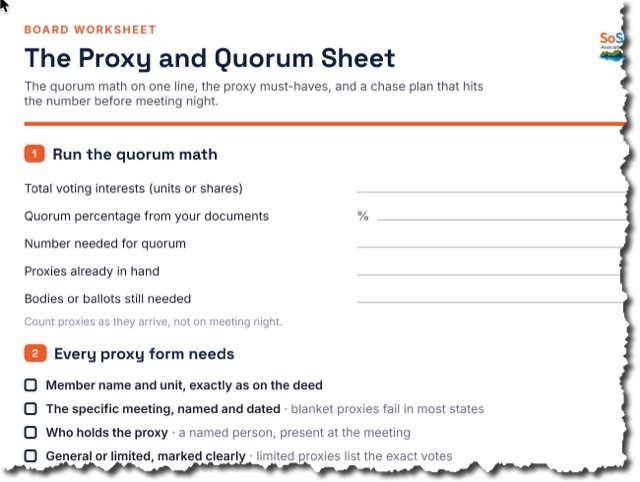
Unless the bylaws provide otherwise, an owners' meeting has a quorum if persons entitled to cast 20 percent of the votes (10 percent if the association has m…
-
§310
Multiple owners of a unit vote as a majority-in-interest unless the declaration says otherwise. Contested board seats are elected by secret ballot. On reques…
Liability
-
§311
A unit owner is not liable, solely by reason of being an owner, for injury or damage arising out of the common elements. The association and the declarant ha…
Common elements
-
§312
Portions of the common elements may be conveyed or mortgaged only if owners of units to which at least 67 percent of the votes are allocated (or any larger p…
Insurance
-
§313
Beginning no later than the first conveyance of a unit to a person other than a declarant, the association must maintain property insurance on the common ele…
Finances
-
§314
Unless otherwise provided in the declaration, any surplus funds of the association remaining after payment of or provision for common expenses and prefunding…
Assessments
-
§315
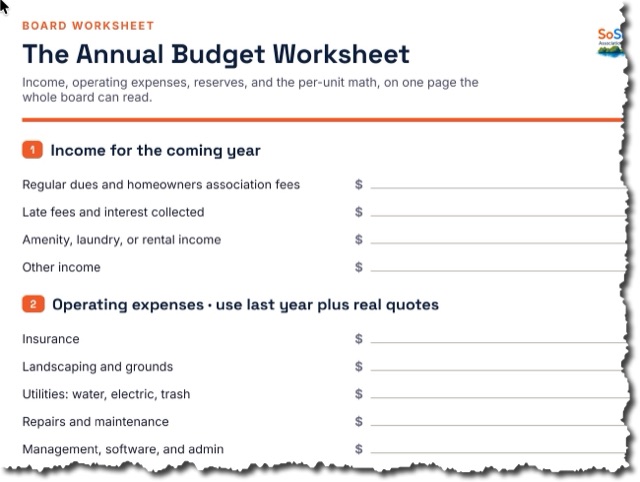
Once the association has levied an assessment, assessments must be made at least annually based on a budget adopted at least annually. Common expenses are as…
-
§316
An incorporated association has a statutory lien on a unit for assessments. Fines, fees, late charges, and attorney fees may be part of a lien but may not be…
-
§316.3
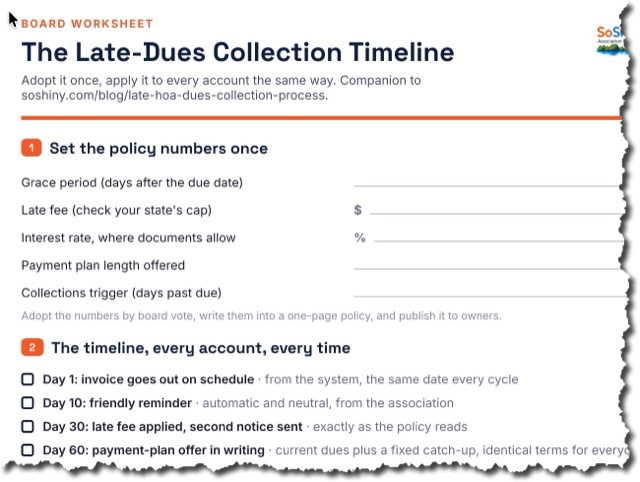
Before collecting, the association must follow the collections policy in §209.5 and make a good-faith offer of a payment plan of equal installments over at l…
-
§316.5
Special foreclosure rules for a time-share estate, including definitions that distinguish a time-share from an ordinary unit.
Records
-
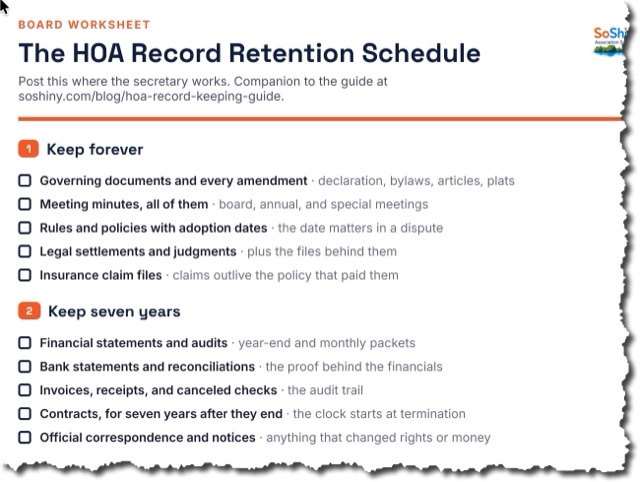
§317
Lists the records the association must keep (financials, minutes, owner list, contracts, reserve study, ballots for one year, and more). Owners (or their age…
Frequently asked about Part CCIOA-3
- What is Colorado Part CCIOA-3?
- Colorado Part CCIOA-3 — the CCIOA Part 3 — Management of the Common Interest Community — is the body of law that governs how every Colorado CID is structured, operated, and held accountable. It covers governance, voting, records, assessments, fining, and most of the day-to-day legal questions a board will face.
- How many sections are in Part CCIOA-3?
- Part CCIOA-3 contains 24 sections in this reference. Each is summarized in plain English on its own page, with links to the official text at leg.colorado.gov.
- Is the summary on this site legal advice?
- No. These pages are plain-English summaries prepared by SoShiny for board members and managers. For binding legal advice or interpretation of how a section applies to your specific situation, consult a Colorado-licensed attorney.
- How often does Colorado Part CCIOA-3 change?
- The Colorado General Assembly can amend any chapter in any session. We update these summaries when we re-import the official text — see the 'Last updated' date on each section page.
- Does SoShiny enforce Part CCIOA-3 for me?
- No software 'enforces' a statute — but SoShiny is built around it. Voting, meeting minutes, records access, fining workflow, and audit trails are designed to meet this body of law's requirements out of the box, so the board can demonstrate good-faith compliance if challenged.
Running a CID in Colorado?
SoShiny is built around Part CCIOA-3 from day one — every feature on every plan.
Start your community free →